

As the overall crypto market cap continues to remain range-bound around the $2.26 trillion mark, the stablecoin supply in the industry appears to be dwindling. According to data received on Tuesday, the leading stablecoin by market cap – Tether’s USDT – saw its market cap fall to historically extreme levels.
USDT market cap crashes to extreme lows
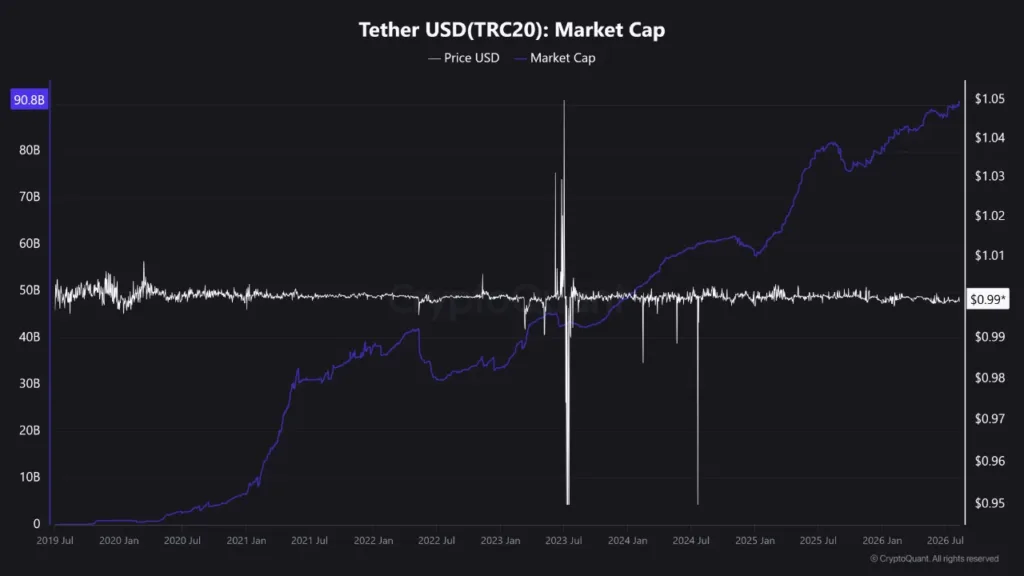
Notably, over the past 60 days, USDT’s market cap has fallen by around $4 billion, currently hovering close to the $183 billion mark. This is the stablecoin’s lowest market cap reading since October 2025.
It should be remarked that it was back in October 2025 itself when BTC hit its current all-time high of more than $125,000. Since then, the premier cryptocurrency has plunged by almost 50 percent – currently exchanging hands around $64,000.
USDT’s 30-day simple moving average of the 60-day change recently stood near –$4.88 billion. In the most recent 11-day window alone, nearly $870 million of USDT supply disappeared.
The broader stablecoin market – which includes Circle’s USDC stablecoin – has also contracted by approximately $10 billion over a similar period.
Past data shows that the steepest phases of USDT supply contraction have tended to occur closer to the exhaustion of selling pressure rather than at the beginning of a new, intensified distribution phase.
That said, this does not necessarily mean that a market bottom is in or that fresh demand has already returned. Rather, it highlights that one of the crypto market’s primary sources of deployable liquidity has been shrinking aggressively.
In simple words, a declining stablecoin supply reduces the amount of capital available to enter risk assets – limiting the fuel needed for sustained rebounds. This helps explain why recent upside moves have struggled to gain traction.
Keep an eye on returning spot demand
The historical relationship between extreme USDT contractions and market cycles suggests that the heaviest phase of capital exiting the ecosystem may be closer to completion than to acceleration.
For now, the key variable to watch next is whether new stablecoin inflows and spot demand begin to reappear once the current liquidity drain stabilizes. Even though the USDT market cap is sliding, stablecoins on other layer-1 chains – like SUI – are seeing increasing adoption.