

USDT, the leading stablecoin in terms of market cap, is seeing one of its greatest declines in recent years. According to data from Coingecko, USDT’s current market cap is hovering around $183.1 billion.
USDT market cap sees contraction
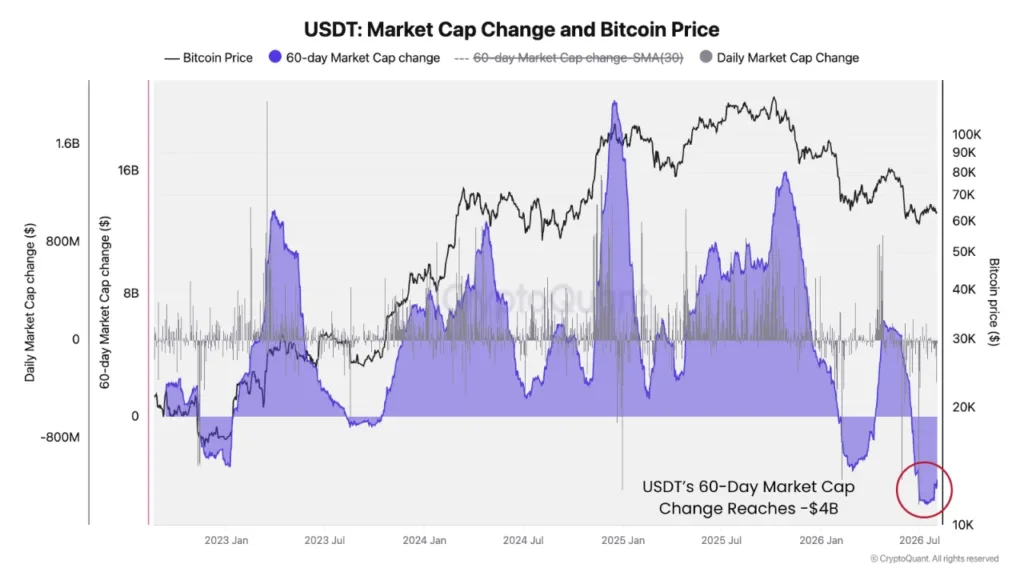
Exchange data from Tuesday shows that the 60-day change in USDT market cap has fallen to around -$4 billion – placing the metric around the most negative territory in recent history.
It’s worth pointing out that the deterioration surrounding USDT has also started around its edges. For instance, nearly $870 million of USDT supply disappeared over the latest 11-day period, showing that the contraction is not merely a legacy effect from earlier redemptions.
The aforementioned fact is important because stablecoins – which are essentially cryptocurrencies pegged to fiat currencies like USD – represent the most liquid and immediately available source of deployable liquidity.
What’s worth noting is that the correlation between USDT flows and Bitcoin price doesn’t exactly mean one is causing the other. Rather, both the assets respond to the same kind of risk-off conditions, with redemptions accelerating alongside spot selling rather than strictly ahead of it.
History shows that periods of sustained USDT expansions have generally coincided with stronger BTC price regimes. On the contrary, periods of USDT contractions have accompanied weaker demand, deeper corrections, and deteriorating market conditions as far as BTC is concerned.
In the past, the market’s deepest USDT contraction phases have also marked points where selling pressure was closer to exhaustion, than to further acceleration. As a result, to say that the current BTC price fall is happening in isolation would be false.
Rather, the premier cryptocurrency is performing poorly when one of the market’s largest liquidity bases is contracting significantly.
It also explains why any rebound in BTC’s price has failed to sustain, simply because there is less stablecoin liquidity available beneath price to convert into sustained spot demand.
USDT adoption continues to grow
In June, USDT briefly surpassed ETH as the second-largest cryptocurrency by market cap. Although the change in rank didn’t last for long, it showed the market how USDT is becoming a behemoth digital asset.
In the same vein, on July 13, Bolivia announced that it was mulling integrating the USDT stablecoin into its economy on account of the shortage of USD.