


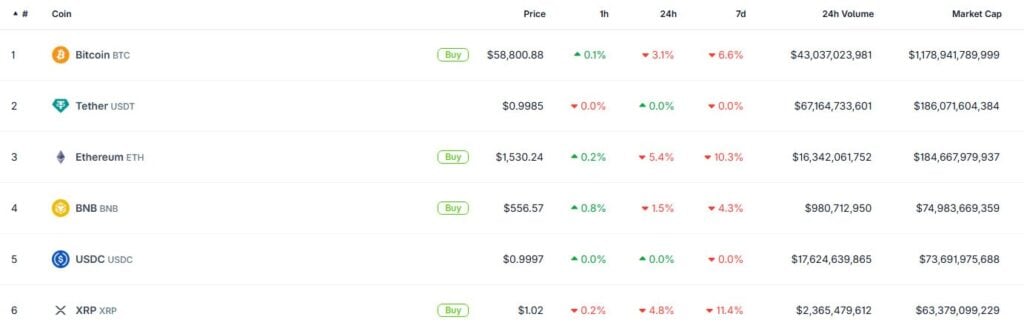
On Friday, Tether’s USDT stablecoin became the second-largest cryptocurrency by reported market cap, as it surged past Ethereum, following the latter’s negative price action. ETH tumbled to its lowest level in 2026, at around $1,510 on Coinbase exchange.
USDT market cap shoots past ETH
ETH crashed to a major support level it had last seen in October 2023 and April 2025, as its market cap declined to approximately $185 billion. The digital asset is down 6.5 percent over the past 24 hours.
ETH’s price pullback paved the way for the industry’s leading stablecoin, USDT, to rise to the 2nd position in terms of market cap as it inflated to $186 billion. USDT flipping ETH is less about the latter’s poor price performance, and more about the rising utility of stablecoins in the industry.
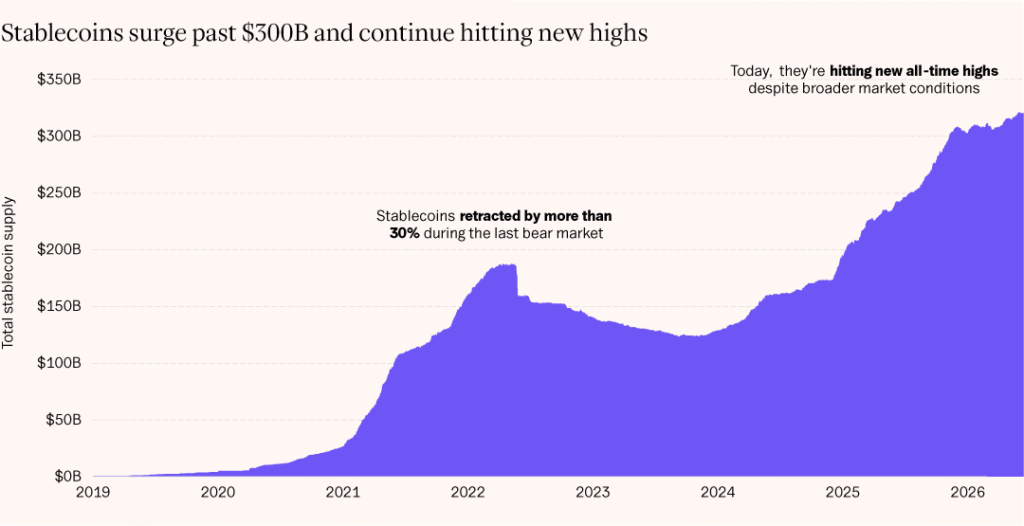
According to data from Coingecko, all stablecoins currently represent approximately 15 percent – or roughly $310 billion – of the industry’s total market cap of $2.12 trillion. While stablecoin market cap shrunk by more than 30 percent during the last bear market, in contrast, it is climbing to record highs in 2026.
On Thursday, crypto-asset manager 21 Shares wrote that the expansion in stablecoin market cap is clear evidence of stablecoins being one of crypto’s defining use-cases. They added that demand for stablecoins no longer depends on market cycles.
Besides USDT, Circle’s USDC stablecoin is also ranked among the top 10 cryptocurrencies by reported market cap. USDC boasts of a market cap of $73.5 billion, while stablecoins like USDS, USD1, and DAI, hold a market cap of $10.3 billion, $4.7 billion, and $4.6 billion, respectively.
Stablecoin adoption rapidly increasing
Some might argue that stablecoins are perhaps the crypto industry’s most successful use-case to date, and it wouldn’t be entirely wrong. An increasing number of global companies are now venturing into the stablecoin space with ambitious products.
For instance, on June 3, Mastercard stated that it is expanding its stablecoin service network across 9 more blockchains, including Solana, Base, and Polygon, among others. On the same day, Moneygram also launched its MGUSD stablecoin on the Stellar network.
Stablecoins are also being actively integrated into bank workflows, as shown by layer-1 blockchain Sui on June 17. In addition, stablecoins are finding a novel use-case in generating RWA yields.


