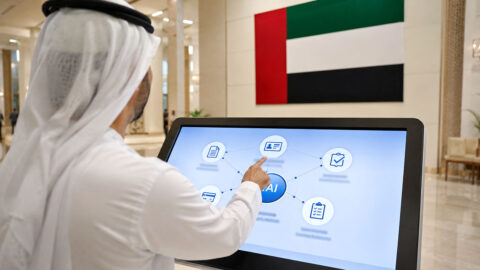

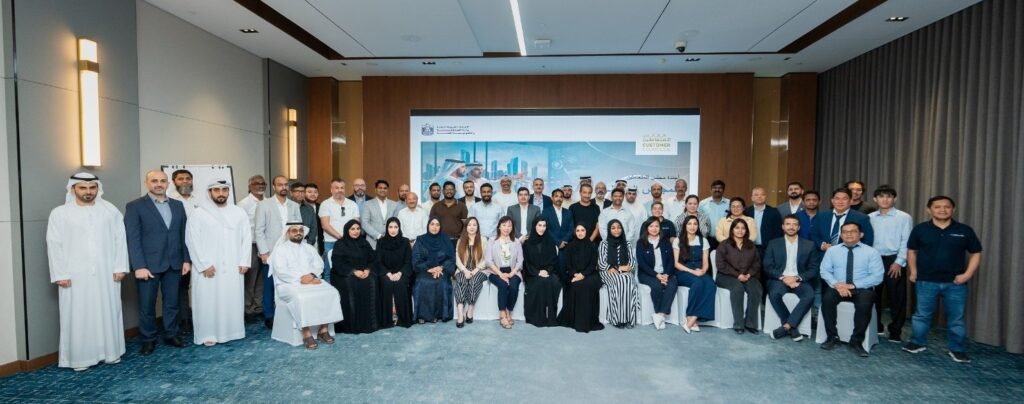
The UAE’s Ministry of Industry and Advanced Technology held an interactive service-development council in Dubai to explore how artificial intelligence can improve industrial government services and turn investor feedback into a 100-day action plan.
The “Interactive Council for Service Development” brought together investors, manufacturers and suppliers to identify bottlenecks in government industrial services, with the ministry targeting faster processing, fewer repeated requests, clearer requirements and more proactive digital platforms.
The meeting builds on April’s Industrial Resilience and Supply Chain Continuity Forum, with the ministry saying the next phase will focus on moving from coordination to implementation by giving industrial companies a direct role in shaping services that affect investment decisions, production capacity and supply chain stability.
AI moves deeper into industrial services
Artificial intelligence emerged as the clearest direction for the ministry’s service overhaul, with participants discussing a 2035 investor journey built around paperless processes, fewer repetitive requests and AI-supported government platforms.
Hassan Khalid Sabt, Director of Government Services at the ministry, said the work aligns with the UAE government’s framework to convert 50% of federal government operations and services to Agentic AI models.
“We will analyze customer feedback and translate it into practical solutions that simplify procedures, reduce unnecessary requirements and enhance the industrial investor journey,” Sabt said.
Ministry sets 100-day reform window
His Excellency Hasan Jasem Al Nowais, Undersecretary of the ministry, said the council marks a practical step toward converting customer feedback into measurable service improvements under the National Strategy for Industry and Advanced Technology and the “Make it in the Emirates” initiative.
“Together with our partners, we continue to develop a service ecosystem that places the customer at the heart of the design and improvement process, delivering tangible development outcomes that enhance the UAE’s position as a globally attractive hub for industrial and technological investment,” Al Nowais said.
He added that the ministry would study the priority challenges raised during the council and develop an implementation plan within 100 days, in line with Zero Bureaucracy directives to simplify procedures, improve digital integration and strengthen the industrial investor journey.
Council turns industry feedback into reform priorities
Industrial customers were first asked to rank priority bottlenecks, flag procedures that should be removed or reinforced and propose practical fixes that could be folded into the ministry’s 100-day plan.
The discussion then focused on where industrial services can be simplified, from faster processing and fewer document requirements to clearer procedures, smoother digital platforms and stronger follow-up.
The ministry said the outputs will help develop more efficient and innovative services, raise customer satisfaction and support a more resilient industrial economy as the UAE seeks to strengthen its position as a competitive hub for manufacturing and advanced technology.
UAE moves AI from pilots to practical use
The council comes as the UAE widens its AI agenda across government, finance, hospitality and customer-facing services, moving the technology from pilots into more practical uses across the economy.
In May, the UAE unveiled its first Agentic AI agents for government services, covering procurement, tax auditing, customer service and technical support. The rollout forms part of a wider plan to shift 50% of federal government operations and services into AI-powered models within two years.
In June, H.H. Sheikh Hamdan bin Mohammed bin Rashid Al Maktoum reviewed DIFC’s ambition to become the world’s first fully AI-native financial center, placing AI at the center of DIFC’s next growth phase and Dubai’s wider financial ambitions.
Most recently, Dubai’s Grand Millennium Hotel introduced Zaya, a virtual personality designed to turn the hotel’s dining, nightlife and guest experiences into an ongoing AI-led social media narrative.