


The process of sending crypto transfers in Australia is set to undergo a bank-like revamp as the Travel Rule comes into effect on July 1. Under the new rule, Australia’s financial regulator, AUSTRAC, will require crypto platforms to verify their credentials before each crypto transaction. The aim is to prevent the exploitation of digital assets for money laundering and terror financing among other illegal purposes.
In order to keep crypto from being misused by criminals, regions like the EU and Australia decided to adopt the FATF-approved Travel Rule to bring more tracibility to circulating crypto funds.
The Travel Rule essentially challenges the core principles of crypto transactions, that once promised largely anonymous transactions. Many from the crypto industry have been criticizing the Travel Rule calling it a violation of financial privacy. Critics include Coinbase CEO Brian Armstrong and think tanks like Coin Center and DeFi Education Fund among others.
Travel Rule: Understanding the nitty-gritties
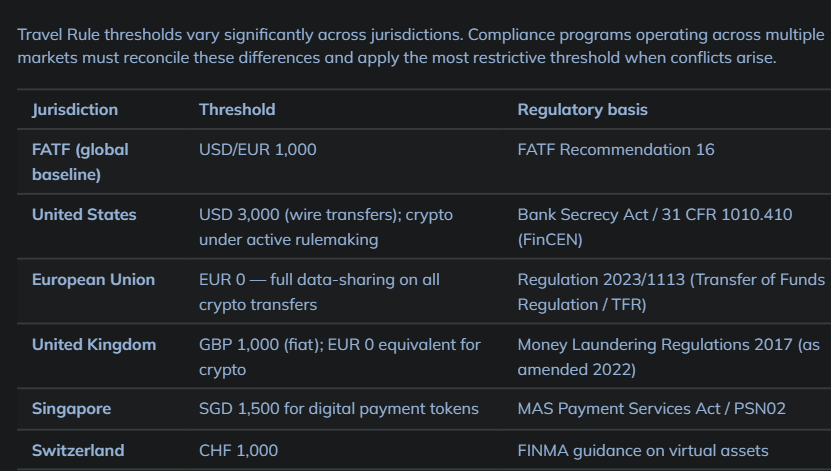
The Financial Action Task Force (FATF), an international financial watchdog headquartered in Paris, had approved the Travel Rule for crypto transactions back in 2019. The FATF guidelines allow governments to have crypto firms collect extensive transaction details for orders above $1,000. However, countries have the autonomy to customize this threshold. The U.S., for instance, caps its threshold at $3,000.
Australia has mandated a zero-dollar floor for the Travel Rule implementation This means that every single crypto transaction — irrespective of its size — will be subject to strict identity verifications. So whether a transaction is worth AUD 10 or AUD 5,000 — details on it would have to be submitted to the exchanges.
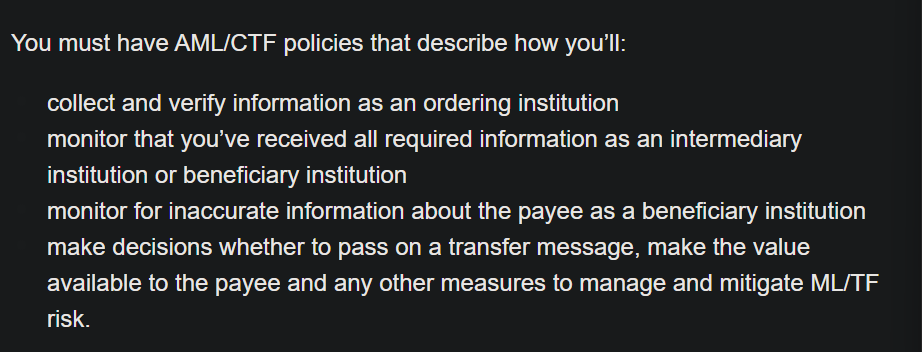
Under the AUSTRAC guidelines, crypto exchanges will have to acquire the full names of payers and payees for all transactions. The payers will also have to disclose their residential or business addresses along with their customer identification number and details of the wallet where the funds are being wired.
Source: AUSTRAC
Exchanges have been instructed to maintain all logged records for seven years incase a transaction is required to be reconstructed.
“You must also keep records that demonstrate that you’ve met your travel rule obligations, including complying with your AML/CTF policies, and keep these records for seven years,” AUSTRAC noted.
The opinion paradox
Over $82 billion reportedly reached money launderers via cryptocurrencies in 2025 — up from $10 billion logged in 2020. China-based money laundering syndicates have been actively using crypto to unlawfully move money on a global scale, a report by onchain intelligence firm Chainalysis said earlier this year. Chainalysis, hence, has batted in favour of the Travel Rule.
“Financial regulators cannot screen illicit actors out of the financial system if they cannot see who is moving money through it. The Travel Rule exists to close that visibility gap,” the research platform said in a recent report, favouring the Travel Rule.
Under the rule, the collection of crypto transaction records could come in handy for law enforcement agencies investigating financial crimes afterall. The rule essentially ties together data governance, real-time sanctions screening, and evidence management which adds more layers of trust and transparency for majority users — exempting the malicious ones from misusing the ecosystem.
Along with the U.S. and Australia, other regions including the EU, the UK, Singapore, and Switzerland have also brought crypto transactions of varied thresholds under the Travel Rule. South Korea is also mulling a stricter Travel Rule enforcement over its digital assets sector, most likely in the coming months.
Source: Chainalysis
Crypto leaders have a different opinion on the Travel Rule, mostly revolving around its hinderance in private money movement — which was one of the most distinct features that digital assets brought to the table.
In 2022 when the EU decided to stitch the Travel Rule to its crypto-focussed MiCA regulations, top voices from companies like Coinbase, Ledger, and Unstoppable Finance had expressed a strong pushback against the rule.
At the time Armstrong had said, “This (the Travel Rule) eviscerates all of the EU’s work to be a global leader in privacy law and policy. It also disproportionately punishes crypto holders and erodes their individual rights in deeply concerning ways. It’s bad policy.”
While Ledger CEO Pascal Gauther had slammed the EU Parliament for choosing “fear over freedom”, Patrick Hansen who are at Unstoppable Finance at the time and now serves as the senior director for EU strategy and policy at Circle, had called the Travel Rule a recipe for disaster for EU’s crypto fabric.
Bank-grade fund tracking features could bring more legitimacy and Wall Street adoption of crypto assets. However, for the DeFi-first communities, mandates like the Travel Rule strips crypto off its privacy element. For now, the divide in opinion around such policies is vast, perhaps, the next generation of crypto rules manage to put forward a sweet spot.


