

Tether announced it had led a $7 million Series A financing round in Pact Labs, with participation from Blockchange Ventures and Lasagna, to expand the utility of USAT (a dollar-backed stablecoin issued by Anchorage Digital Bank) across payroll, earned wage access, credit, and everyday payments.
The investment aims to integrate digital dollars into the $10 trillion U.S. payroll system, which still runs on legacy rails built decades ago.
The vision: Digital dollars in every paycheck
America’s payroll infrastructure is antiquated. Workers wait weeks for money they have already earned and paid over $12 billion in overdraft fees last year waiting for funds to clear. Pact Labs’ infrastructure tokenizes the paycheck, making wages instant, credit programmable, and payments available 24/7.
Through its Software Development Kits (SDKs), Pact Labs has already deployed hundreds of thousands of embedded wallets and live stablecoin payroll flows across enterprise platforms. “With Tether as our strategic partner, USAT becomes the digital dollar working Americans actually use, every payday,” commented Bo Hines, CEO of Tether USAT.
The strategic partnership
Tether’s $2.5 million equity investment is part of a broader strategy to support infrastructure that brings digital dollars into practical, high-frequency use cases. Paolo Ardoino, CEO of Tether, framed the move as a natural extension of Tether’s global mission: “Workers in emerging markets have used USDT to bridge payroll gaps for years because their domestic systems failed them first. We are now building the same capability into the U.S. market with USAT, because even a functional system built on batch processing means unnecessary costs for the people who can least absorb them.”
Pact Labs operates as a key member of the PACT Consortium, providing the technical foundation for the protocol’s global network of fintechs, asset managers, and infrastructure partners.
The Aptos connection: Why Tether chose this blockchain
Tether’s move into Pact Labs is also a big bet on the Aptos blockchain. Since Pact launched its protocol on Aptos back in February 2025, it’s already handled almost $2 billion in onchain loans. Pact Labs President Joshua March cited Aptos’s architecture as the key reason: high throughput and low transaction costs make it suitable for high-volume, low-margin financial transactions like lending and payroll.
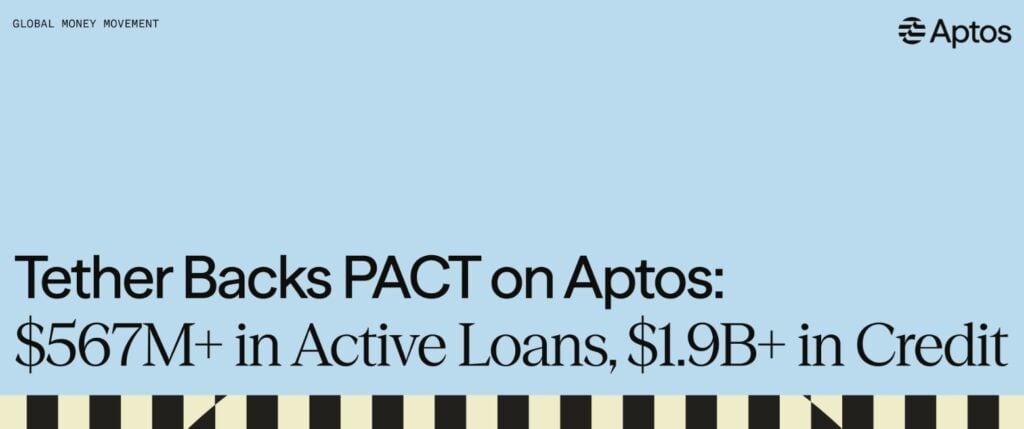
For Tether, putting money into Pact Labs shows they really believe Aptos can handle serious financial applications. When you mix Tether’s stablecoin tech with the massive amount of lending Pact is already doing, it’s clear that Aptos is not just hype, but it’s actually useful in the real world.
Pact actually started on Celo but decided to migrate its infrastructure to Aptos, which pretty much tells the speed and performance of the network won them over. Now that Pact is looking to hit $10 billion in loans, Aptos is on track to become the go-to spot for Tether’s payroll and credit plans in the U.S.