

SUI prices have surged by nearly 50 percent following a combination of favourable events. The catalysts that lifted the prices were the transfer of approximately 110 million SUI from DeFi protocols’ treasury into staking, the launch of CME Group SUI futures, and the Paga partnership.
SUI crosses $1 psychological resistance level
SUI crossed the major psychological resistance level at $1 after a few events happened in favor of the token. The exponential price spike saw SUI rising from $0.98 to as high as $1.35 during the past couple of days. Even the trading volume surged from $213M to $2.5B.
An increase in trading volume can be used to indicate bullish momentum based on how the price reacts to the rising volume. This is because volume is a basic measurement of how much buying and selling activity is happening in the market.
In the case where a cryptocurrency or stock goes up in value amid rising volumes, it is taken as a positive indication, as it shows that buyers were participating actively in driving the value higher. The current situation regarding SUI is that the rise is fueled by strong buying activity.
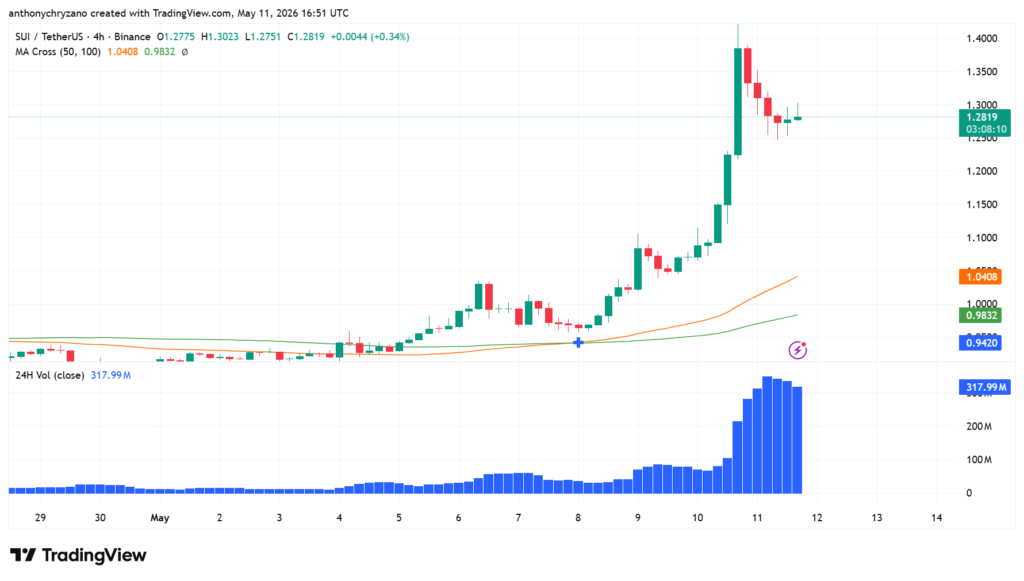
In spite of this, regarding SUI, volume analysis shows a bullish trend; there are occasions when high volume may suggest the complete opposite scenario. At times, high volume may take place during selling frenzies or profit booking.
SUI Group moves 180 million token from Defi into staking
On May 10, the SUI Group Holding, which is listed on NASDAQ as SUIG, made a huge transfer, moving 108.7M SUI from liquid DeFi into staking in a single day, removing 2.7 percent of the total supply from the liquid float on top of 74 percent already staked. Now this means that 76.7 percent of all SUI is now illiquid. The 50 percent price movement occurred on when the already thin float was reduced to a thinner float, which skyrocketed the price, which was already moving upwards with the supply crunch.
The supply crunch was not the only factor that was driving the prices higher, but events like the launch of the SUI futures derivatives were also another major catalyst. According to CoinMarketCap, CME Group, the world’s largest derivatives exchange, has announced the launch of Avalanche and SUI futures contracts, which will be available for trading at the end of this month.
SUI futures contracts to be launched end of May
The launch of SUI futures derivatives pushed the coin’s price higher because it signals growing institutional interest and expands the market around the asset. If such an important exchange as CME Group or a finance platform chooses to list futures on a digital currency such as Sui, then this is typically seen by investors as a confirmation of its increased maturity and liquidity. This enhances investor confidence and leads to increased capital flow to the ecosystem.
The futures contract also enhances the liquidity of the token for large investors who may not be comfortable holding the token in the blockchain ledger. Hedge funds, market makers, and other types of professional traders can trade the SUI through derivatives, thus adding more players into the SUI ecosystem. Such an environment would likely generate positive sentiment towards the token.
Traders position early anticipating price appreciation
Another reason prices can rise is speculative anticipation. Traders often buy the asset before or during a futures launch because they expect higher liquidity, media attention, and institutional demand to follow. Often, the market “prices in” future adoption before it actually happens. This creates a short-term demand surge in the spot market, pushing the coin upward.
Paga Group integrates SUI stablecoins
On top of that, Paga Group, Africa’s leading payments infrastructure company, announced a partnership with Sui, which will integrate Sui Dollar (USDsui), Sui’s native stablecoin, and adopt Sui as the primary blockchain across Paga’s ecosystem.
The market will consider a partnership with a high-profile company as a sign of real-world adoption and expanding utility for the network. In the sphere of cryptocurrency, when it comes to partnership agreements, such initiatives are taken as a signal that the technology moves away from being purely speculative into becoming functional.
Since the partnership strengthens Paga’s ecosystem and the long-term demand outlook for the network, there could be more users joining. In the event more users, merchants, or financial applications operate on Sui, activity on the blockchain could increase significantly. Higher network usage often creates positive sentiment because investors expect the ecosystem to grow, attract developers, and generate more economic activity around the token.
Partnership with market leaders affect market psychology
Partnership announcements also affect market psychology. Traders often react quickly to news involving recognized companies because such deals improve credibility and legitimacy. When investors see a blockchain partnering with an established payments company, they may believe institutional confidence in the project is increasing.
SUI is about to spike again as golden cross appears on horizon
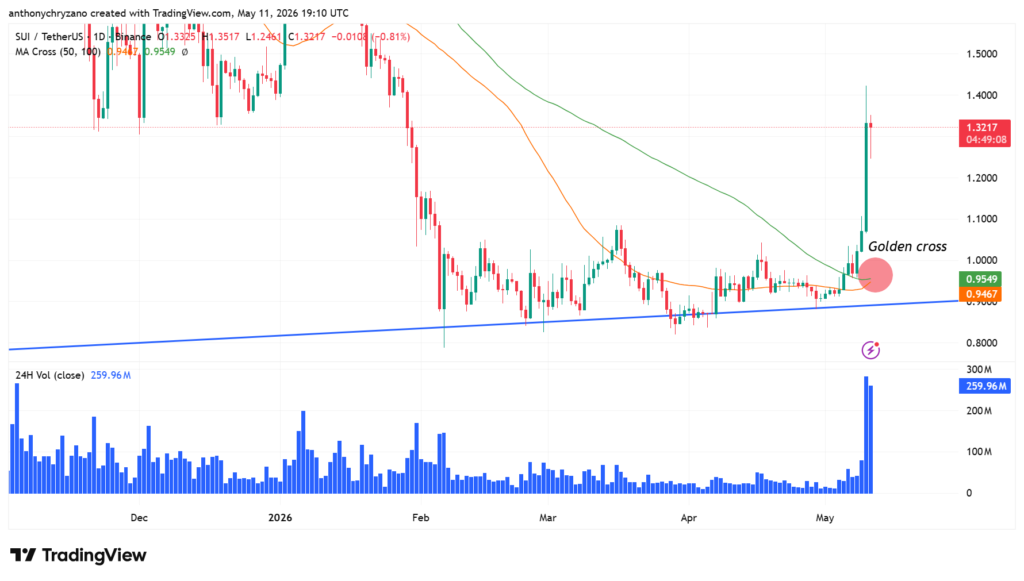
As shown in the chart above, there is going to be a golden cross. A golden cross happens when the 50-day moving average (short-term trend) indicator intersects with the 100-day moving average (long-term indicator) from below.
The golden cross pattern is a bullish pattern, which means that it indicates possible strengthening of the positive market momentum. This happens when the 50-day simple moving average passes over the 100-day one. This indicates the presence of increased short-term buying power in comparison with the longer-term downtrend, and therefore, the shift from consolidation or weakness to the uptrend may happen soon.
It is used to determine when there is a bullish trend confirmation, so many traders open their long positions based on this signal, especially if it is accompanied by an increase in trading volume or a breakout above some levels of resistance.
It usually is used together with other elements of technical analysis, such as determining support and resistance levels, momentum patterns, and market structure analysis. For instance, a trader might wait until the moving averages cross each other and after that wait for the prices to remain above both of them.
The golden cross pattern might be observed by institutional traders and automated systems, since its occurrence is indicative of the change in the market sentiment. It means that more and more participants realize that this is what happens in the market now.