

Stellar (XLM) is changing hands at $0.1853 and has seen a rise by 1.93 percent in the session. The asset is up roughly 4.4 percent over the time of 24 hours. The important thing that counts more is the drawdown of 4.66 percent over a week. Both aforementioned statements are reasonable right now, and the distinction that sets apart the two is the key to understanding this asset’s trend.
The post-formed range that needs attention
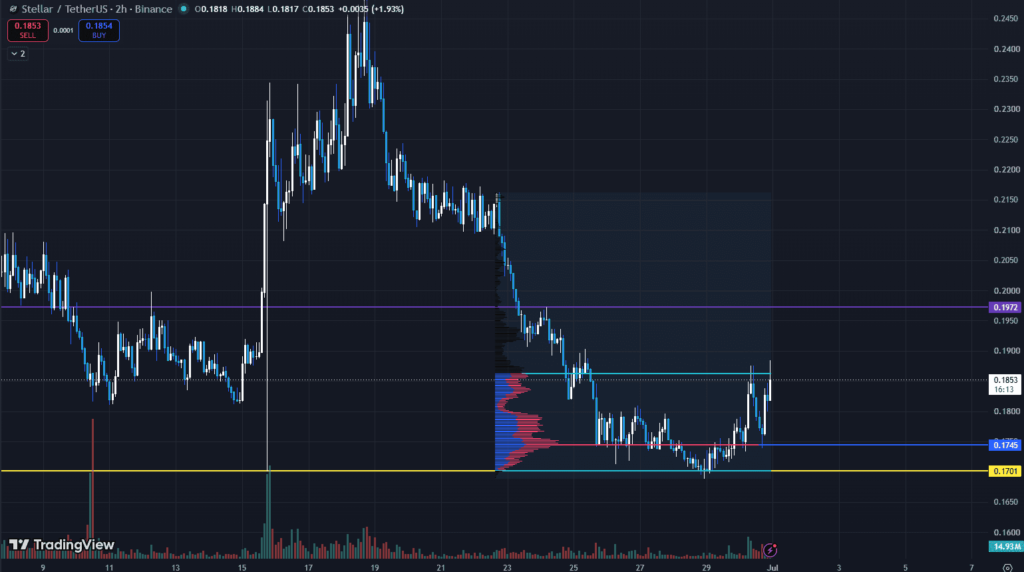
XLM peaked near $0.2450 on June 19 after a sharp rally off the June 16 base. Everything since has been the unwind. The price fell through $0.2150, lost the $0.1972 level, and by June 23 found a floor that has held for a week: $0.1701 on the low side, with a secondary shelf at $0.1745. That low has been tested and rejected three separate times. It did not break once, and that repeated defense is the technical detail driving the current Stellar price structure.
XLM marked a high at $0.2450 on June 19, and this was then followed by a sudden move higher out of the June 16 swing base. Since then, the market participants have observed nothing more than the unwinding process. Prices broke down through $0.2150 and subsequently through the $0.1972 level just prior to finding a bottom on June 23, which in turn has held support for the last week at the lows that are around $0.170 and secondary support at $0.1745. Three times, the corresponding lows have been tested, but the underlined base was not broken; that repeated defense results in the current technical configuration for this mentioned asset.
Resistance that has been tested before
The marked level from $0.1853 to $0.1858 is the VAH on the volume profile, and this is the range that is densely packed with trading volume. That point also proved to be the highest point on June 24, ahead of temporarily doing so one more time now.
At the time of this writing, the price is testing the same cautiously. On the upside, the next notable line of defense is at $0.1972, and that is the same level that acted as resistance subsequent to the May 19 peak in advance of dropping to support following the breakdown in price. In the case of XLM, breaking this resistance convincingly would push the short-term outlook for this digital asset firmly back toward positive territory.
Hence, the structure isn’t challenging, but the context behind it may be a complex one: the range low is at $0.1701, VAL and POC are close together in the $0.1745 – $0.1780 range, VAH is holding strongly at $0.1858, and the range top is around $0.1972. XLM has recently approached the VAH following the fact that it had one of the better volume sessions of the last 7 days, more so than a generic resistance level. A stall at the VAH is depicting that it’s stalling where the market participants have determined there to be a sufficient volume transacted, instead of at an arbitrary price point on the charts.
The order flow is depicting key info at lows
The repeated support and defending of $0.1701, along with higher and higher volume on each test, is the explanation for why this cannot be termed a dead-cat bounce. Three tests with no breakdown frequently refers to rested buy orders, not just random noise. The selling effort was low at $0.1701, and sellers were expecting a 4th leg down. That was simply bought up, and the resulting move from $0.1745 up to $0.1880 in 2 hours was impressive and is nearly 15 percent.
This type of action on a defensible low is generally indicating that the short squeeze took place and has nothing to do with the long openings. The market broke out to resistance and is now grinding higher and digesting, but reversal signs are still not visible.
The gap that is still unfilled
There was no consolidation between the 16th of June and the 19th of June, simply $0.18-$0.245 over three days. Moves like that put a magnet above. Clear $0.1972, and the gap-fill path begins to open up. Failed, and the range continues; $0.1701 remains the key area. The relevant move will be decided by the order book bids and asks rather than that of the fundamental catalyst.