

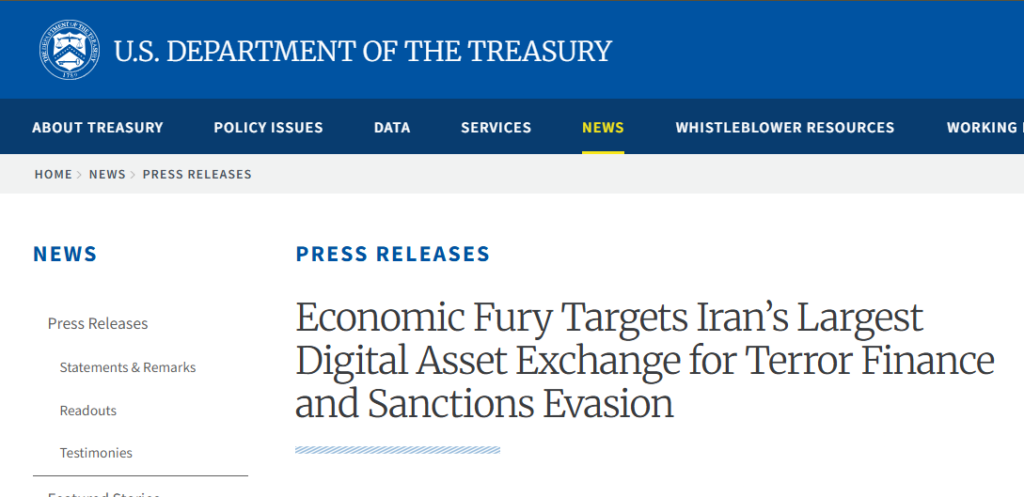
The U.S. Treasury’s Office of Foreign Assets Control (OFAC) just slapped sanctions on Nobitex, Iran’s top crypto exchange, along with a few other platforms and their bosses. They’re accused of handling over half of Iran’s digital asset traffic in 2025, basically helping the Islamic Revolutionary Guard Corps (IRGC) dodge sanctions, fund their operations, and hide the regime’s cash while the U.S. was in combat.
Why the U.S. acted: A parallel financial system exposed
Here’s what the Treasury uncovered, building on an investigation: Nobitex wasn’t just a harmless local exchange. It had become the central node in a parallel financial system, processing hundreds of millions of dollars for Iran’s central bank and the IRGC. When the Iranian rial collapsed, the Central Bank of Iran used Nobitex to access stablecoins and prop up the currency.
When internet blackouts hit during U.S. attack operations, Nobitex kept running, moving regime wealth out of the country. The exchange also facilitated transactions for IRGC-affiliated ransomware actors. Treasury Secretary Scott Bessent put it bluntly: “While Iran’s economy is in free fall, the regime has chosen to co-opt digital asset technologies for its own corrupt agenda, including evading sanctions and transferring wealth out of the country.”
The sanctions: Who got hit and why
OFAC designated four exchanges: Nobitex (50 percent of Iran’s crypto volume), Wallex (12 percent), Bitpin (10 percent), and Ramzinex ($2.45 billion in processed transactions). But the personal designations are equally telling.
- Amir Hossein Rad, Nobitex’s chairman and former CEO, helped reconstitute the exchange after a $90 million hack in June 2025.
- Current CEO Seyed Ali Khoee was also designated. All property and interests in property of these entities and individuals within U.S. jurisdiction are blocked, and U.S. citizens are prohibited from performing any transactions with them.
- Two co-founders, Seyed Mohammad Ali Aghamir and Seyed Mohammad Aghamir, are members of the Kharrazi family (one of Iran’s most powerful dynasties), with direct ties to the new supreme leader.
How this affects Nobitex and Iran’s crypto context
Let’s put it this way: for Nobitex, the sanctions are devastating. Going further, any exchange or financial institution anywhere in the world that deals with Nobitex now risks U.S. secondary sanctions. That means liquidity dries up, international partners vanish, and the exchange is forced into an isolated, Iran-only shadow market.
For Iran’s broader crypto ecosystem, this is a gut punch. Iranians have increasingly turned to crypto to preserve wealth amid hyperinflation and a crashing rial. Now their largest on-ramp is a sanctions target. Nevertheless, the Iranian regime has shown resilience before; expect them to launch new exchanges or rebrand existing ones, just as they’ve done with oil tankers and front companies.
The US-Iran geopolitical situation: Economic Fury in action
These sanctions are all part of “Economic Fury,” which is the Trump administration’s full-court press after the U.S. started operations in Iran. The plan is pretty straightforward: cut off every single way they make money (oil, banks, and now crypto). The Treasury’s already locked up nearly half a billion in crypto linked to the regime, all while peace talks are stuck in limbo.
Secretary of State Marco Rubio told senators an interim deal “could happen today, it could happen tomorrow, it could happen next week.” But with sanctions escalating, the U.S. will use every tool, including digital asset enforcement, to force Iran’s hand. A $15 million State Department reward is also offered for information disrupting IRGC financial mechanisms.