

Michael Selig, the chairperson of the U.S. Commodity Futures Trading Commission
(CFTC), on Wednesday reiterated that a CBDC is not in the cards for the U.S. under the Trump administration. A CBDC is essentially the digital representation of a fiat currency that is issued and monitored by central banks. U.S. President Donald Trump has maintained a strict anti-CBDC stance so far calling these tokens tools for financial surveillence.
Selig, on Wesnesday, said that the Trump administration would never allow the creation of a CBDC.
“The President actually put this out just a week into office, I think on the 25th of January last year, prohibiting central bank digital currencies,” the CFTC head said. “I’m very concerned about central bank digital currencies, and we in the Trump administration have been very clear that not going to happen under our watch.”
The U.S. has presented a bullish stance on majority-things-Web3 ever since President Trump returned to the White House for the second-time last year. After regulating stablecoins under the GENIUS Act last year, the U.S. is standing on the brink of passing its crypto market structure bill famously referred to as the CLARITY Act.
The idea of a CBDC, however, has never sat well with the pro-crypto Trump administration.
In January last year, as Selig mentioned, President Trump had said, “Measures will be taken to protect Americans from the risks of CBDCs, which threaten financial system stability, individual privacy, and US sovereignty. This includes prohibiting the establishment, issuance, and use of CBDCs within the United States.”
Towards the end of June, President Trump’s anti-CBDC push actually got its approval from the Senate as it approved the 21st Century ROAD to Housing Act in an 85–5 vote. Nestled within the bill was a clause that prohobited the Federal Reserve from creating a CBDC.
The inclusion of this anti-CBDC clause in the Housing bill was political. Because the Democrats wanted to pass a housing bill to crack down on corporate landlord, the Trump administration wanted a hard ban on a federally-issued digital currency. To ensure that the housing bill had enough support to pass, lawmakers packaged the two completely unrelated topics together into one envelop.
President Trump was supposed to sign this bill into law on June 24, however, the signing was delayed. Until Trump signs the bill, the CBDC restriction remains approved by Congress but not enacted.
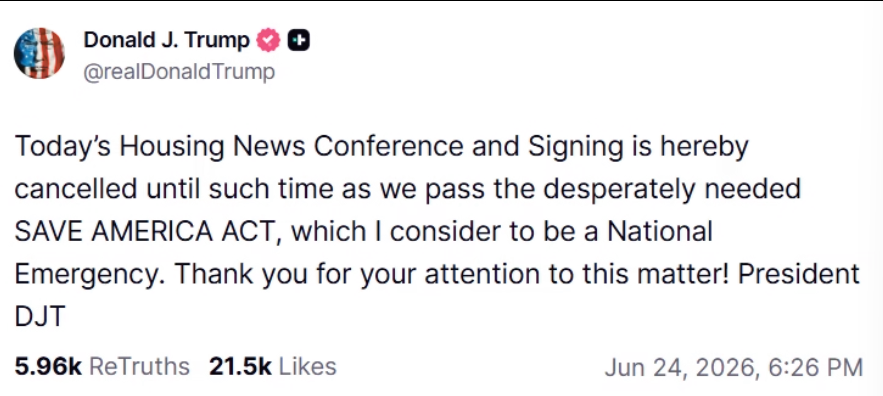
Source: @realDonaldTrump/ Truth Social
While the U.S. has constantly maintained an anti-CBDC stance under President Trump, other nations have tapped on a more supportive approach.
India and China — both nations that retain major skepticism around crypto — are in the advanced trial phases of — eRupee and eCNY — their respective CBDCs. Russia’s digital ruble CBDC has also been coined to upgrade its cross-border settlement rails.