

President Donald Trump cancelled a scheduled signing for a sweeping bipartisan housing bill on Wednesday, delaying a measure aimed at expanding housing supply, tightening rules on residential investment and banning a U.S. central bank digital currency (CBDC), as he demanded that Congress first pass the SAVE America Act.
Trump announced the cancellation in a Truth Social post, saying the housing news conference and signing would not move forward until lawmakers approve the election-focused SAVE America Act, which he described as a “National Emergency.”
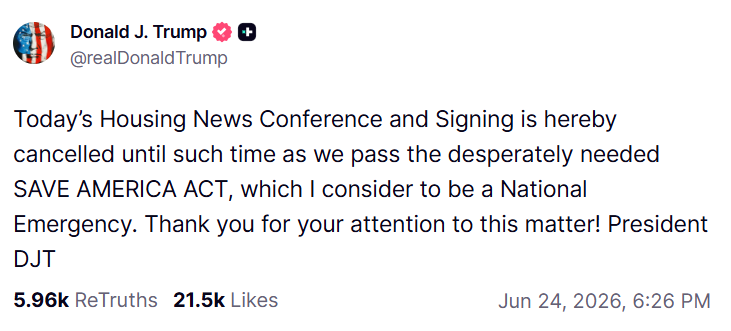
The move put a rare bipartisan housing package on hold after it had cleared Congress with broad support.
Housing bill becomes leverage in election fight
The delayed legislation, known as the 21st Century ROAD to Housing Act, was designed to address housing affordability by speeding up construction, expanding access to affordable homes and reducing federal delays that can slow new development.
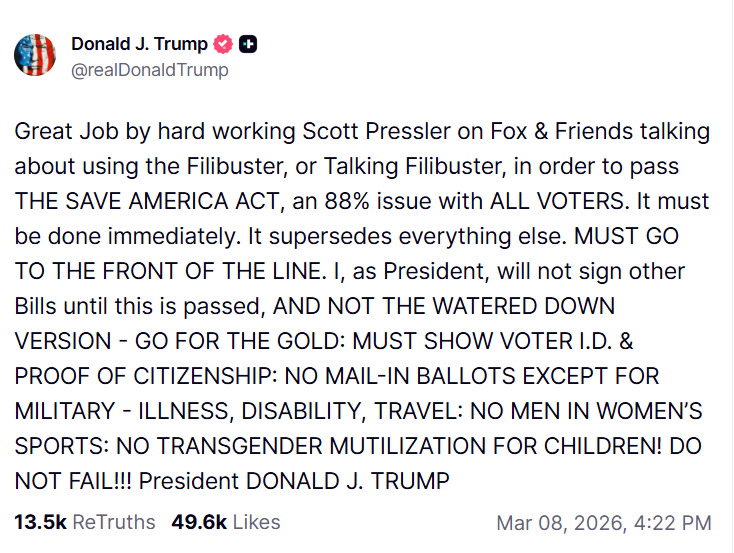
Trump’s decision turned what was expected to be a housing-focused signing event into a wider political standoff, delaying not only the housing measures but also a proposed federal ban on a central bank digital currency, as he said in March he would not sign other bills until the SAVE America Act is passed.
What Trump wants first
The SAVE America Act is a Republican-backed election measure centered on proof-of-citizenship requirements for federal voter registration.
Supporters say the proposal would strengthen election integrity through stricter voter eligibility rules, while critics argue it could create new barriers for eligible voters without easy access to documents such as passports or birth certificates.
By delaying the housing bill, Trump has placed a major affordability package and a central crypto provision targeting a U.S. central bank digital currency inside a separate political fight over election law, creating uncertainty over when the measure will become law.
Crypto market watches CBDC ban closely
For the crypto industry, the most closely watched part of the delayed bill is its provision blocking the Federal Reserve from issuing a U.S. central bank digital currency, a move that brings a key policy battle into the broader housing package.
A CBDC, often described as a digital dollar, would be a government-backed electronic version of central bank money.
Supporters say it could modernize payments, but opponents, including many crypto advocates and Republicans, warn it could give the government greater visibility into financial activity and place a state-backed digital currency in competition with private stablecoins.
That CBDC provision gives the bill significance far beyond housing. If enacted, the language blocking a U.S. central bank digital currency would mark one of Congress’s clearest moves against a digital dollar and strengthen the position of private dollar-backed tokens in the broader payments debate.
Crypto market left waiting
The delay does not immediately change crypto laws, but it keeps a major digital asset policy win out of force for now.
Until Trump signs the bill, allows it to become a law, or takes another formal step, the CBDC restriction remains approved by Congress but not enacted. For crypto markets, the message is direct: Washington’s resistance to a government-run digital dollar is gaining momentum, but the policy is now caught in a wider standoff over election law.