



Minnesota lawmakers introduced a bill allowing banks and credit unions in the state to offer virtual-currency custody services, creating a formal regulatory framework for traditional financial institutions seeking to safeguard crypto assets and private keys for customers.
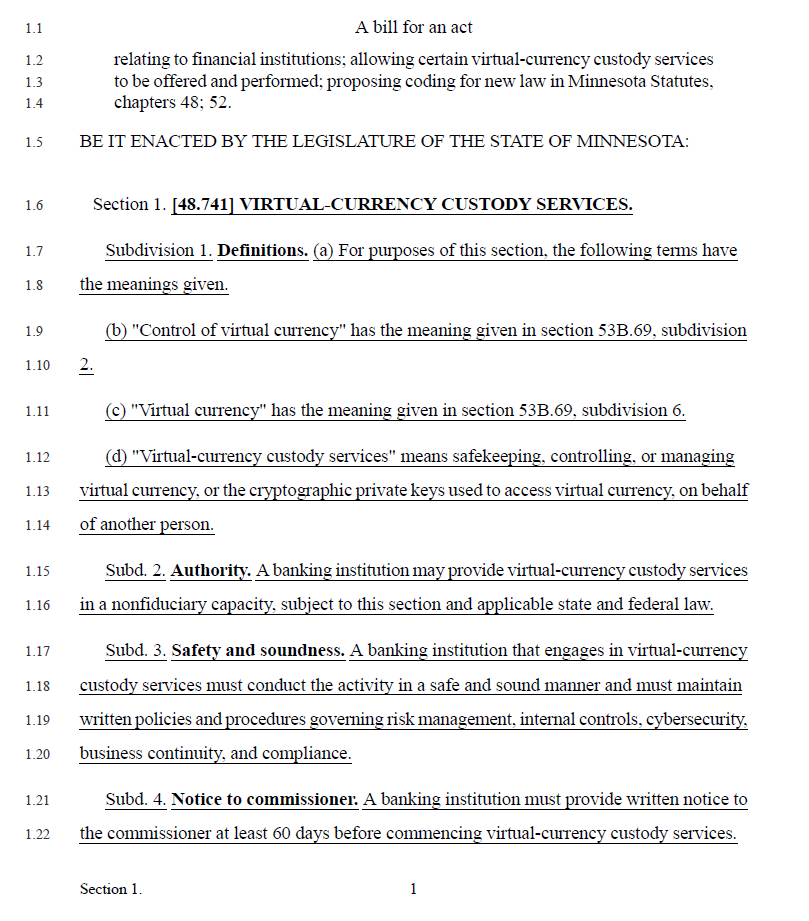
The measure, HF3709, would permit banking institutions to provide crypto custody services in a nonfiduciary capacity, while credit unions would be allowed to offer the same services to their members, according to the bill text.
The proposal defines virtual-currency custody as safekeeping, controlling or managing virtual currency, including the cryptographic private keys used to access it, on behalf of another person.
Banks and credit unions face 60-day notice rule
Under the bill, any bank or credit union planning to launch virtual-currency custody services would be required to notify the state commissioner at least 60 days before beginning operations.
That notice must describe the nature of the planned services and outline the institution’s risk-management framework. The bill also requires participating institutions to maintain written policies covering risk management, internal controls, cybersecurity, business continuity and compliance.
The proposal gives the commissioner authority to limit or condition the custody activity only if it is found to be conducted in an unsafe or unsound manner.
Customer crypto must be segregated
The legislation’s safeguards would require banks and credit unions to keep customer virtual currency and related control mechanisms legally and operationally separate from their own assets.
The bill states that customer crypto must not be treated as the property of the bank or credit union, mirroring custody protections used for other assets held on behalf of clients or members.
Financial institutions would also be allowed to use qualified third-party service providers or subcustodians to help deliver crypto custody services, provided they retain oversight responsibility and ensure compliance with the law.
Oversight remains with state regulators
The measure does not authorize banks or credit unions to engage in any activity already prohibited by law, nor does it change the legal classification of virtual currency under state or federal rules.
Virtual-currency custody services offered under the bill would be subject to examination by the commissioner as part of Minnesota’s regular supervisory process.
If enacted, the bill would take effect on August 1, 2026, and would apply to virtual-currency custody services launched on or after that date.
Minnesota follows other state crypto custody moves
Minnesota’s proposal follows a state-level push to fold digital-asset custody into regulated banking channels, echoing measures already taken in Wyoming, South Dakota, Nebraska and Virginia.
Wyoming and South Dakota have allowed banks to offer digital-asset custody services through notice-based frameworks, while Nebraska created a special digital asset depository charter and Virginia authorized credit unions to provide virtual-currency custody services under risk-management conditions.
The Minnesota bill would extend that model to both banks and credit unions, giving traditional financial institutions a clearer path into crypto custody while keeping customer assets separated from institutional property and subjecting the services to state examination.