

Liquidity for Chainlink’s LINK token on crypto trading platform Binance has crashed to its lowest level since June 2025, significantly raising the possibility of violent price action in the digital asset. The liquidity index for LINK shows it has fallen down to 0.68.
Chainlink liquidity crashes on Binance exchange
According to the liquidity index for LINK on Binance, the digital asset’s market is currently experiencing one of its most fragile liquidity periods to date. Specifically, the metric has plunged to its lowest level since June 2025, to around 0.68.
For the uninitiated, a liquidity index measures how easily an asset can be bought or sold in the market without causing major price changes.
A lower liquidity index usually means thinner order books and weaker market depth, making the asset more vulnerable to sharp volatility and sudden price swings. As of Monday, LINK is trading around the $9.5 price level.
The fall in the cryptocurrency’s liquidity level on Binance is a clear indication of its weak demand among investors. It shows a shallow market depth, which could make LINK highly susceptible to volatile price movements.
Besides the liquidity index, the Turnover 30-day indicator shows that liquidity turnover volume over the past 30 days has reached around 32.7M, while the liquidity index has also seen gradual decline over recent months.
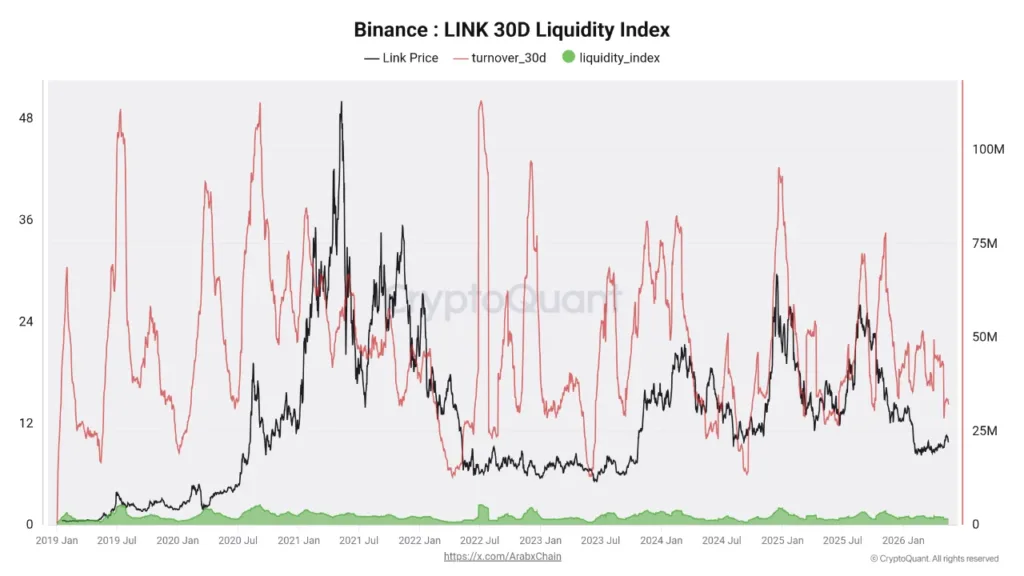
In simple words, these dynamics suggest a sharp decrease in regular market activity compared to periods which saw stronger outflows and higher liquidity during previous volatility waves.
The strong decline in LINK’s liquidity index means that relatively large orders on Binance exchange can initiate stronger-than-usual price fluctuations in the digital asset. This is due to the market’s weaker-than-usual ability to absorb the current market liquidity.
State of caution among traders
The fact that LINK’s liquidity has been at such a low level for so long shows that there is a general state of caution among LINK traders – especially following the period of volatility recently seen in the market.
The following weekly-chart shows LINK cratering from around $27.8 in August 2025, to its current price of $9.34, representing a decline of more than 66.6 percent.

The weak liquidity makes sense, as it tends to decline when short-term investor confidence in the underlying asset weakens. Currently, the LINK market is likely in a phase of consolidation, waiting for a new direction to chart its future course.
However, despite the current weak retail interest in the cryptocurrency, it is enjoying formidable institutional confidence. On May 14, crypto exchange Kraken moved its funds to the Chainlink bridge following the LayerZero bridge’s $292M exploit.