

MEXC has announced its 5x Guardian Fund expansion, which increases the goal from $100M to $500M over 2 years. Parallel to that, the exchange bought up 1000 BTC to establish the reserve structure, which consists of two separate reserves: one for immediate liquid capital and the other for the long-term capital reserve. The architecture of the reserve is the technically more interesting part that needs to be watched.
Dual-reserve architecture
The majority of the exchange protection funds will be denominated as a single asset. Usually denominated as USDT, or a similar stablecoin. Structure of MEXC is clearly designed for the separation of these two functions, which address two distinct risk scenarios.
Operational liquidity for the USDT layer. If a stress event like a cascading liquidation, a security breach, or a dramatic market dislocation occurs, then the stablecoin reserves can be accessed without price-execution risk. The funds are instantly at face value.
The Bitcoin layer functions differently. Currently, a 1000BTC notional position of long duration is offered, where the nominal value is variable. MEXC is selling out to carry the mark-to-market volatility of the tranche for a reserve element free of the stablecoin depegging risk and will grow in real value for the bullish macro assumption without any further capital.
It is an inherent tradeoff and one worth naming: if BTC prices plummet alongside the event that necessitates use of the reserve, the BTC slice depreciates just when that drawdown capacity is most critical. This is the risk intrinsic to all dual-reserve models containing both volatile assets and stablecoins. MEXC is effectively wagering long-run BTC gains will dominate this timing risk and the signaling effect of holding Bitcoin will prove more important than short-term fund balance volatility.
On-chain transparency
Both reserve components are traceable on-chain with public wallet addresses. The USDT reserve is stored at ETH address 0x469AFE803C54A36674C55231489Cf4b61da8c1bC, verifiable on Etherscan. The BTC allocation sits at 1MDVjZdX8QD212pT8Z8EMP7DuFQHKqN3mx.
By posting these addresses, any user can check concurrent holdings in real time and do so by themselves. This is a good minimum. What it doesn’t give the user alone is a guarantee as to governance-namely, the activation threshold, who has deployment permission, and the multi-event coverage waterfall.
On-chain holdings are one thing; managed reserves are another. These are defined by addresses, published funds terms, and third-party validation, respectively, which is how this initiative will prove itself to the institutionally minded.
Platform context
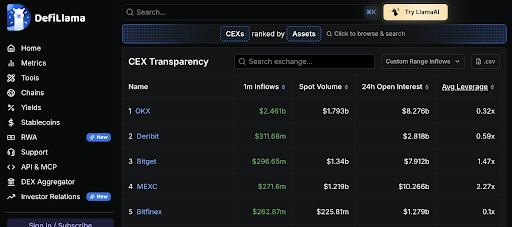
DefiLlama data on Monday indicates that in the last month, MEXC had net inflows of $271M. This put it fourth for the largest 1-month inflow on centralized exchanges, behind OKX with $2.46B net inflows, Deribit with $311.68M, and Bitget with $296.65M.
MEXC had a 24h open interest of $10.266B, the largest in the listed DefiLlama ranks with 2.27x average leverage. The spot volume of the trailing month was $1.219B. While 5th in the inflow rank at $262.87M, Bitfinex traded $225.81M of spot with 0.1x leverage.
Open interest provides an actual operational substance to the Guardian Fund expansion. The 10.266B of open interest coupled with 2.27x average leverage places a material amount of stress on platform liquidity management during disorderly markets, a big forced liquidation event, and a correlated positions unwind. A protection fund built to size, that exposure is sound from structural and marketing perspectives. The current 100M fund amounts to under 1 percent of open interest. The goal of 500M is ~4.9 percent of open interest, which, while low, is significantly more prudent than current levels.
Phased build-out
The 2-year timeline for reaching $500M is strategically paced: There is not much sense in building the full $500M right away, as either it would be a massive portion of operational funds or it would be raised from the public, both structurally problematic. Using a phased approach publicly and in an auditable way, MEXC has committed to a standard that can be compared to the reported on-chain reserves.
Timing is also a relevant consideration. It is better to build up reserves during times of inflow (a $271M flow during the last month) rather than during times of stress. When inflows reverse, it becomes harder to fund reserve accumulation and much harder to credibly announce that they are doing so.
Structural implications
The dual reserve model proposes a framework for other exchanges to analyze. In the case that BTC has appreciated significantly by the end of the two-year building phase, MEXC will be left with an insurance pool that appreciated, without requiring commensurate capital. This is fundamentally different from a stablecoin-only fund and serves as a precedent for exchange reasoning regarding their allocation of reserve assets, as opposed to just their quantity.
These unanswered questions, fund governance documents, independent audits, and conditions for formal activation are not uncommon gaps at this stage of reserve build-out, but these are the particulars that distinguish whether the Guardian Fund becomes an actual risk management mechanism or a robustly drafted statement of intent. The speed at which MEXC fills these vacuums will shape how this initiative will ultimately be judged in a two-year time frame.