

Priced at $9, Chainlink is undervalued, and it has a lot of potential, as its activated value is equivalent to the U.S. GDP. Even whales are tampering with the tokens, seeing the token’s potential.
A crypto netizen on X, Julius, stated that $9 is not the price for Chainlink given the number of companies that have adopted it. Making a startling revelation, Julius stated that the 30 trillion in activated value in Chainlink was equivalent to or even greater than the US GDP.
Chainlink is being adopted by big names
Naming a few institutions, Julius stated, “Swift. DTCC. Euroclear. JP Morgan. Mastercard. Fidelity. UBS. The Central Bank of Brazil. All have chosen Chainlink independently. These aren’t marketing partnerships. These are the institutions that clear, settle, and move global capital. They’ve all arrived at the same place.”
In addition, the CCIP (Chainlink Cross-Chain Interoperability Protocol) or the infrastructure that allows different blockchains and traditional systems to communicate and transfer value securely, spiked 260% in volume to $1.3 billion, suggesting a sharp increase in real usage—not just speculation—across connected networks, meaning more institutions and protocols are actively using Chainlink’s messaging and settlement layer.
Whale tampers with LINK tokens
At the same time, 970,000 LINK being withdrawn from exchanges in a single day signals that holders are moving tokens into self-custody or staking rather than preparing to sell. In market terms, this reduces available supply on exchanges, which can tighten liquidity if demand continues to rise.
Moreover, Amundi launching a tokenized fund powered by Chainlink ($400M in 3 weeks) si another catalyst that supports Julius’s argument.
Amundi, Europe’s largest asset manager, launching a tokenized fund using Chainlink is a major institutional adoption signal.
Tokenization here means traditional financial products—like funds—are being represented on-chain, allowing for faster settlement, transparency, and programmability. The reported $400 million inflow in just three weeks suggests strong early institutional uptake. Chainlink’s role is to provide the oracle and interoperability infrastructure that connects real-world financial data and systems to blockchain networks securely.
Meanwhile, whales have been tampering with Chainlink (LINK). For instance, one whale withdrew tokens from the Binance exchange and deposited them on Coinbase. This not something that it ordinary, it is strategy.
When a whale moves a large amount of LINK from Binance to Coinbase, it is usually not random but part of a broader positioning or execution strategy rather than simple buying or selling. It might be related to arbitrage trading, where the whales take advantage of the small differences in prices across exchanges. It may also be an indication that the whales are preparing to sell their holdings through OTC markets and institutions since the exchange
Coinbase is more in tune with institutional flow. Other reasons why the whales move their liquidity include preparing to do better execution by splitting their orders in different platforms, reducing slippage.
There could also be a custodial reason for the whales transferring liquidity from one exchange to another, particularly when it comes to transferring their holdings from a volatile exchange like Binance to Coinbase, which is more secure. This kind of activity does not have a particular meaning unless the whales sell, hold, or transfer their holdings in the future.
Chainlink will target double digit after breaking out
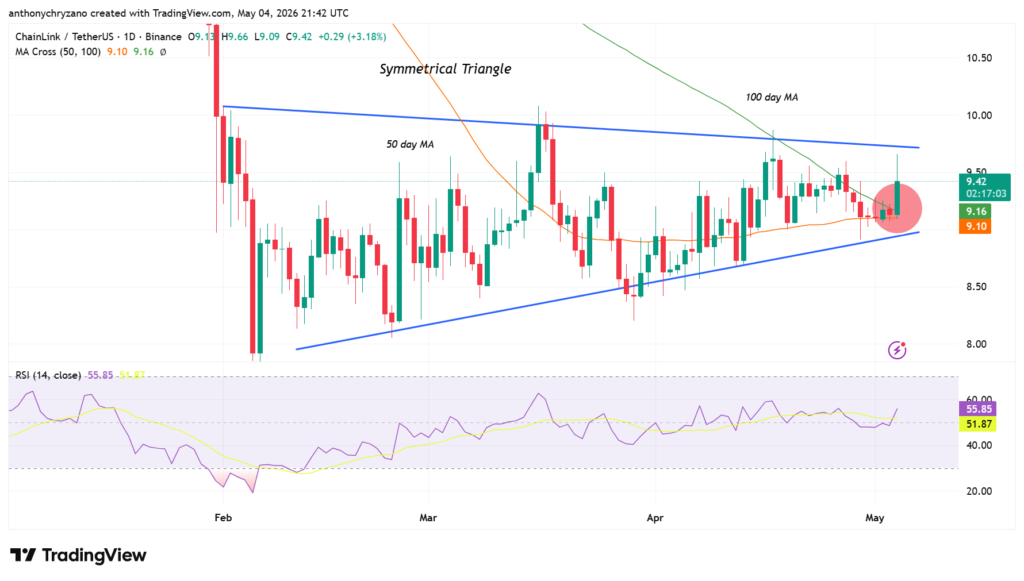
As shown in the chart above, LINK is trading inside a symmetrical triangle and is about to form the apex. Once the apex is formed, the token will break out upwards. Trading volume tends to be low during this period due to lack of decisiveness on the part of traders. Most of the traders prefer not to trade a big amount during this period since the risk/reward ratio is bad here. Rather, they scalp the range or simply wait until a clear breakout is made.
The experienced trader will analyze the building pressure within the symmetrical triangle. This is determined by factors like low volatility, testing of one side of the symmetrical triangle, and breakouts out of the triangle, to name a few. The pressure within the triangle rises significantly as the symmetrical triangle approaches its apex. Traders anticipate a breakout and make arrangements for their orders above and below the resistance/support level.
The point is, trading the symmetrical triangle is a defensive and tactical process. With the rising tension as the symmetrical triangle nears its apex, traders prepare themselves for a breakout by making arrangements to place stop orders above the resistance and below the support.
In brief, the behavior of traders in the symmetrical triangle is defensive and tactical, whereby they see it as an interlude during which liquidity increases to enable a powerful breakout. In this regard, LINK will break above $10 when it emerges out of the pattern.