

Ethereum is currently trading at $1,993.45, down 0.64 percent over the last 24 hours and has seen a growth of 6.23 percent in the last 7 days. The session was high at $2,020.90 before trading lower again, and it spent most of the trading day consolidating under the important psychological zone of $2,000.
That price behavior is not just on the technical side. Bitmine Immersion Technologies revealed on May 26th, 2026 that it holds 5,416,901 ETH which makes up 4.49 percent of Ethereum’s supply of 120.7 million tokens. This is the asset’s trading near a 5-month low. The company has also been on the bullish side and added a total of 26,497 ETH over the last seven days.
The Chart Structure
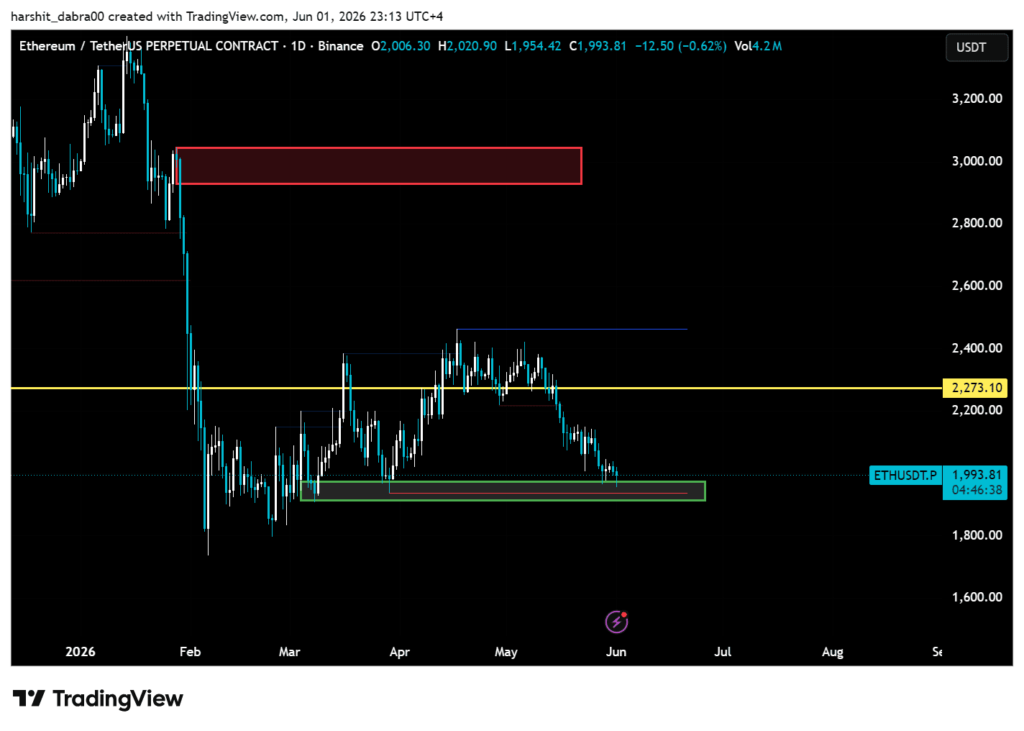
The daily chart here gives the market participants an idea of about what happens when an asset like ethereum breaks and refuses to rebuild structurally since February. ETH experiences a sharp fall from Jan highs of $3200 and below for the entire month of February, finally getting some space, holding higher than the $1800-$1900 area. March and April rallied up, marking the levels above the $2400 level that is marked as a blue liquidity zone and every single attempt higher was capped with a drop and grind lower since may.
The February distribution area, which is marked from roughly $2,900 to $3,050 was indicated by the red supply zone where the initial breakdown happened. The respective price level is 47 percent above the price and is now working as a major resistance and can be tested if there is a significant catalyst that fuels the same.
Looking more in the near term, the yellow level $2,273.10 will be the first resistance that we may see to be tested soon if the bulls show up with strength. This was the breakdown area from the end of April, where the asset experienced its May drop and has not been tested since the drop. Below current price, the green demand area, which roughly covers around $1,900-$2,000, has been support since the end of May. The asset is now directly resting on the top of it.
The red liquidity line within the green zone provides an extra level of definition and highlights the tighter support levels that align with the respective range, between approximately $1,930 and $1,980 approximately. The price levels below $1,930 on a daily close would highlight that the bull trend is taking a break and will take time to build strength, which can’t be termed as noise.
What the Indicators Confirm
All the major moving averages are now trending above the current price levels of ethereum. The 7-day SMA at $2,035.39 and the 30 day SMA at $2,189.89 are now the closest overhead resistance and 200 day SMA at $2,497.41 is now working as a long-term baseline. The 20 percent underprice below the 200 SMA tells the scenario more quickly. The 14 day RSI of 31.66 is relatively close to the oversold zone but can’t be termed under that category, while the 7-day can.
The MACD at -67.00 and histogram of -9.54 indicate that the asset’s momentum has negative readings and is getting worse. Given that, either the market rebounds mechanically, or the other scenario happens. It is unusual for a price at these compressed levels to do so.
Bitmine: Accumulation as a Structural Variable
As per the recent announcement, Bitmine is now holding 5,416,901 ETH which at the current value is equivalent to ~ $10.8 Billion. Of this, they are involved in staking 4,718,677 of these tokens through its MAVAN network of validators, which represents a whopping 87 percent of its ETH holdings. It is also forecasted to generate $258 Million in annual staking revenue. And as per Bitmine, this is not a position that involves or is being managed for a liquidation in the short term.
At 4.49 percent supply, there are around 61,000 ETH that will close the mark of 5 percent if this pace continues for accumulation.