

Bitcoin closed around $65,200 on Monday, slowly moving toward the upper boundary of its recent consolidation range. Although the surface-level price action remains largely muted, the underlying flow of capital points toward a distinct geographical repositioning.
Soft Bitcoin demand in the U.S.
According to exchange data received on Monday, U.S. spot demand for BTC is still showing signs of significant weakness. Notably, the Coinbase Premium Index remained deep in negative zone throughout the last 2 weeks – reaching only a modest -0.05 at its peak.
For the uninitiated, the Coinbase Premium Index measures the price difference for an asset between Coinbase, and other major exchanges. A positive reading shows stronger U.S. buying demand, and a negative reading suggesting weaker U.S. demand.
A persistently positive premium can support a bullish outlook, while a negative premium signals subdued US institutional or spot buying pressure.
Alongside this soft institutional bidding, mid-to-long-term holders are subtly active. For instance, their spending behavior across the 1.5-to-5-year age bands remains structurally elevated against quarterly baselines, keeping Coin Days Destroyed (CDD) relatively high.
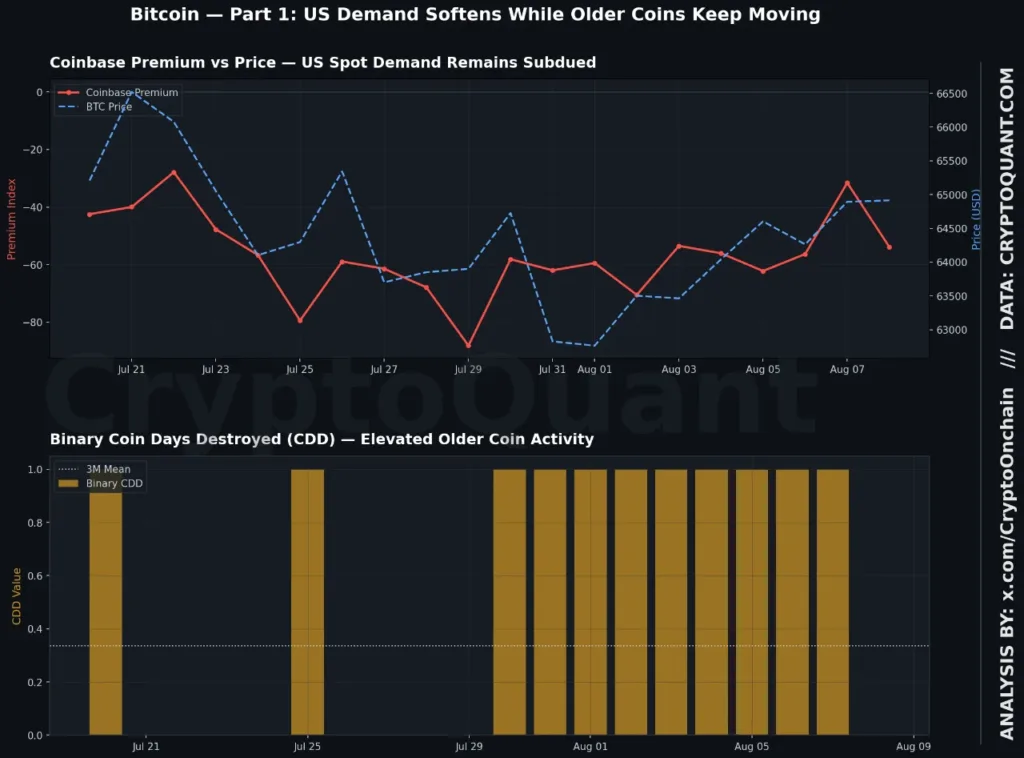
To explain, CDD measures the amount of time Bitcoin has remained dormant before being spent: a coin held for longer contributes more “coin days,” and spending it destroys those accumulated days.
A spike in CDD generally indicates older, long-dormant Bitcoin is moving, which can signal increased activity from long-term holders and potentially greater selling pressure.
Stablecoin liquidity is moving offshore
That said, the more significant shift in capital is happening outside of U.S. exchanges. Stablecoins – also called ‘dry powder’ in crypto jargon – appears to be rapidly getting concentrated on global and Asian crypto trading platforms.
Notably, stablecoin netflow into Binance surged roughly 218 percent week-over-week and over 637 percent against its 90-day baseline, with the 7-day average crossing $81 million.
This clearly shows that while Binance’s actual BTC netflows remain choppy day-to-day, significant purchasing power is quietly being accumulated on the exchange.
At the same time, Upbit netflows have spiked dramatically – over 7,500 percent versus their quarterly average – hinting at a sudden injection of localized activity in the Korean market.