

Bitcoin is changing hands at $65,114.8 and is trending 1.53 percent higher at the time of writing. However, the chart and the calendar are presenting two very different things at this moment, and the distinction is what is supposed to matter to the market participants.
The important range that is in focus
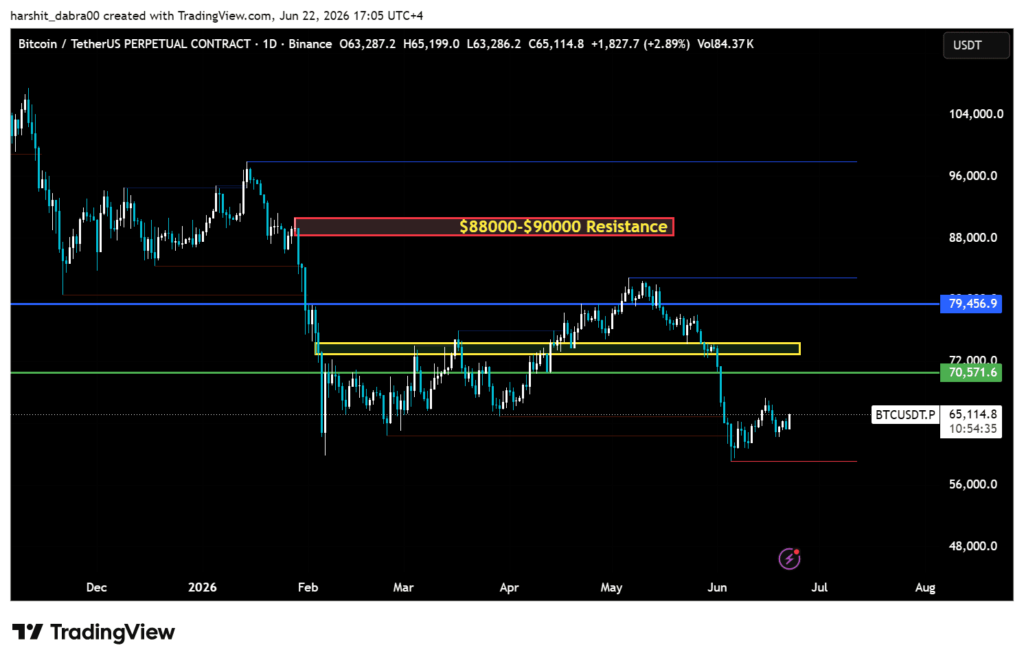
BTC $65,114.8 has been stuck in the range it has traded in since early June. This largest cryptocurrency traded at $63,286 yesterday and turned higher today. The same pattern took place in the past 7 days: it topped $66,289 on the 16th, sank to $62,897 on the 19th, and then recovered back to $65k. Consequently, in total there were three days of negative return and two days that showed the recovery. It can be called a full trip without any position change.
The RSI-14 is currently sitting at 37.79 and the RSI-21 at 37.90. That means neither of the two primary oscillators is indicating anything to worry about. In fact, they are closer to oversold territory than overbought territory, which signals they are more than “worn out.”
On the MACD side, the histogram has crossed the neutral line and is currently at +446.96, whereas the MACD still lingers below the signal line (-2131.99 compared with -2578.94 respectively), and this means that bears are losing strength, but it still doesn’t imply a trend change.
But there is a thing that matters more than this entire bounce. The 200-day SMA is currently sitting at the price point at $76,723. The 200 EMA is positioned at $78,494. Bitcoin is nearly 15 percent below both. The resulting margin has been widening since reaching the swing high of $77,990 in late spring, and additionally, it has not closed at any point on this entire leg down to the $59,108 swing low. The market participants who actually invested in the May high near the price point of $79,456 (which is marked clearly on the chart as the resistance) are still facing drawdown in double figures.
The macro factor: Iran talks move the calendar
The U.S. and Iran worked out the first 60-day roadmap towards a deal on nuclear issues and sanctions; technical talks between them are to start in Switzerland this week to work out details on how such an agreement could be enacted.
Beyond the headlines, however, meaningful shifts have remained modest. Iranian crude appears to be coming over the Strait of Hormuz, so sanctions are also appearing to let up somewhat. But unresolved problems persist concerning the status of frozen assets, naval issues, and the Hormuz strait itself, as well as ongoing conflicts in the region. Even with the appearance of a sixty-day interval to a final accord, several major unresolved issues persist.
For crypto, the impact is less about the ongoing discussion and primarily about risk appetite and oil-driven inflation concerns. A real de-escalation could potentially remove some geopolitical risk from markets, which is inclusive of Bitcoin. But if discussions keep going without meaningful results, market participants may start ignoring the noise. So far, BTC’s reaction has been close to zero, and this implies that the market is not considering this as a major catalyst at this time.
Strategy keeps buying regardless
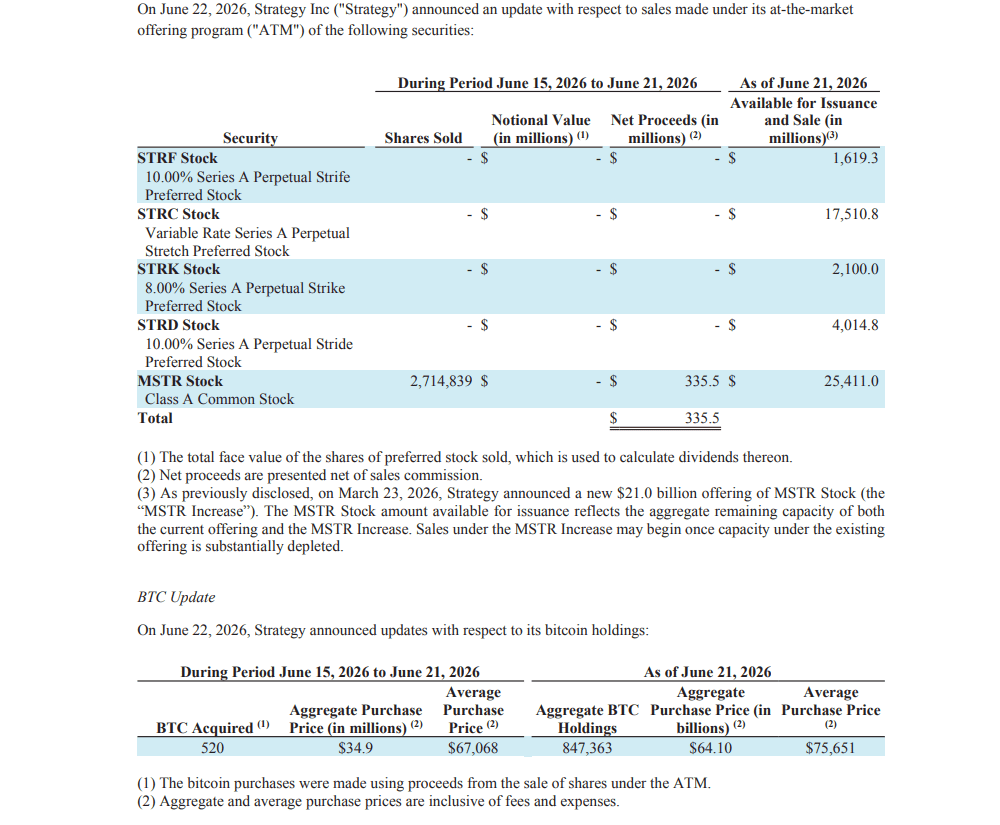
Strategy has an additional accumulation of 520 BTC for $35 million, boosting its holdings to 847,363 BTC, as well as also expanding its USD reserve by $300 million to $1.4 billion to strengthen its preferred securities’ credit quality.
The buying size barely stands out if we compare it to a daily volume in the billions. The timing is the major metric that is relevant here and the largest cryptocurrency remained 15 percent under its 200-day average, in the same range that has been a typical trap for the bulls from early june, and Strategy continued its buying trend anyways.
Building cash reserves despite stepping into weakness is considered to be less like a blind conviction and instead like a company that has a full focus on managing liquidity and accumulation in parallel. Even detailed price data by itself won’t show you that information.