

Bitcoin’s price action, since its inception, has shown that it rarely moves in a straight line. Major rises to euphoric price levels – such as the October 2025 all-time high of $126,000 – have usually been followed by sharp price drops, initiating the bear market phase.
Current Bitcoin cycle shows low price drawdown
What separates BTC’s price drawdown in 2026 is its scale relative to past cycle peaks. For instance, in 2017, BTC’s then all-time high was followed by a sharp price correction. The same pattern was followed in 2021, when BTC fell all the way down to $15,700 following the FTX fiasco.
The two aforementioned incidents – in 2017 and 2021 – involved major shifts in market structure, liquidity, and trader positioning. However, in 2026, despite the price fall, BTC has moved into record territory without yet reproducing the extreme capitulation seen in earlier cycles.
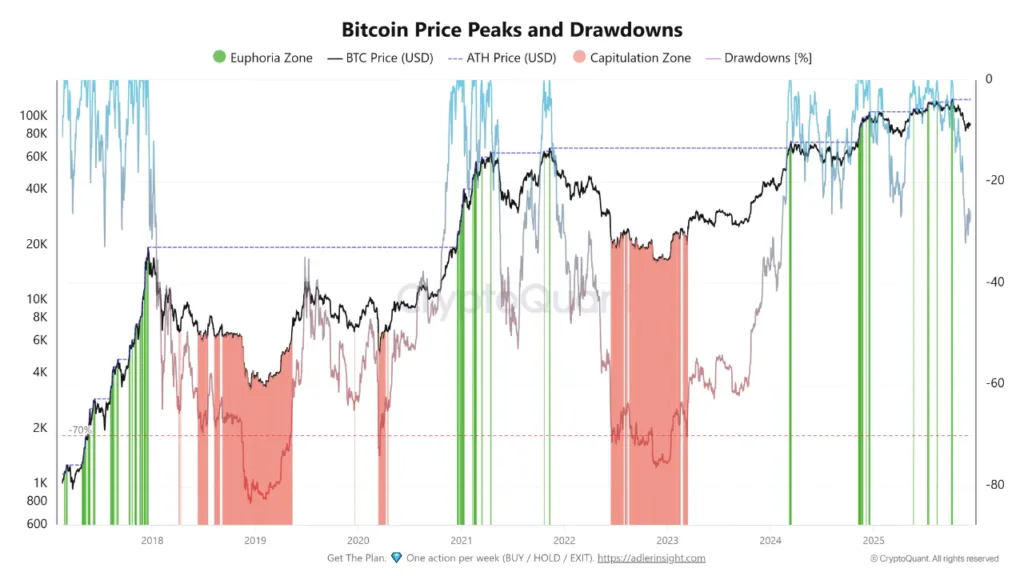
As of Tuesday, BTC is down about 49 percent from its October 2025 all-time high. However, it is still not as deep when compared to prior cycles. That said, it does not mean there’s no more downside risk to the top digital asset.
The market has so far absorbed corrections without the forced deleveraging seen during major reversals. The difference between a normal correction in comparison to structural weakness becomes important as price remains elevated.
From here, if BTC continues to lose more ground but recovers quickly, it’d mean the market is absorbing profit-taking while maintaining demand. On the contrary, if recovery becomes weak amidst the price drawdown, it could mean trouble for BTC.
A market can still look strong on a price chart while internal momentum deteriorates. Historically, the transition from shallow pullbacks to persistent drawdowns has been more revealing than any single red candle.
Macro backdrop makes things complex
The current BTC price action becomes more complex with the prevailing macro backdrop. Despite the cooling U.S. inflation, Bitcoin has failed to post any meaningful price gains.
The ongoing geopolitical tensions in West Asia are further exacerbating the pressure on risk-on assets, including BTC. On July 8, the cryptocurrency fell below $62,000 amid rising tensions in the geography.