



Bitcoin (BTC), which is down 12.1 percent on a year-to-date (YTD) basis is starting to show signs of bullish capital rotation. Notably, the BTC Risk Index (RI) has reached its 2023 floor zone, suggesting that the top cryptocurrency may soon see a reversal in price action.
Bitcoin RI reaches 2023 floor zone
The Bitcoin RI reaching a multi-year low is usually considered a precursor to a multi-month long reversal. Since the premier digital asset has been stuck in the mid $70,000 range for the better part of the year, BTC bulls are confident that it is ready to rise toward the key $82,100 resistance level.
For the uninitiated, the Bitcoin RI measures the intensity of capital flows relative to Bitcoin’s market capitalization to estimate whether the market is in a high-risk euphoric phase or a low-risk capitulation phase.
Counterintuitively, higher readings usually signal lower risk because they reflect panic-driven redistribution and heavy flow activity near market bottoms, while very low readings appear near overheated cycle tops where fresh capital inflows begin drying up.
There is some historical evidence to back this argument. For example, following the collapse of the now defunct crypto exchange Mt. Gox, the Bitcoin RI was at a historical high, while the cryptocurrency was hovering close to the cycle bottom.
Similarly, toward the end of the 2018 bull market, the Bitcoin RI was again at a multi-year high, while BTC made its macro-bottom during the bear capitulation. The same story was repeated during the March 2020 COVID crash, as BTC hit almost $3,000.
The two most recent examples of a high Bitcoin RI and bottom price are the mid-2022 Terra collapse, and the late-2022 infamous FTX crypto exchange mishap which saw BTC crater all the way to $16,300.
Each successive cycle becoming less profitable
The following chart shows that both the red and blue descending trendlines connect lower highs in the metric across cycles. It simply means that each successive market capitulation prints a less extreme low-risk signal than the previous one.
In other words, the so-called “maximum opportunity” available to capital ready to be deployed is getting increasingly lesser cycle after cycle – which is the indication that the underlying asset is starting to show signs of maturity.
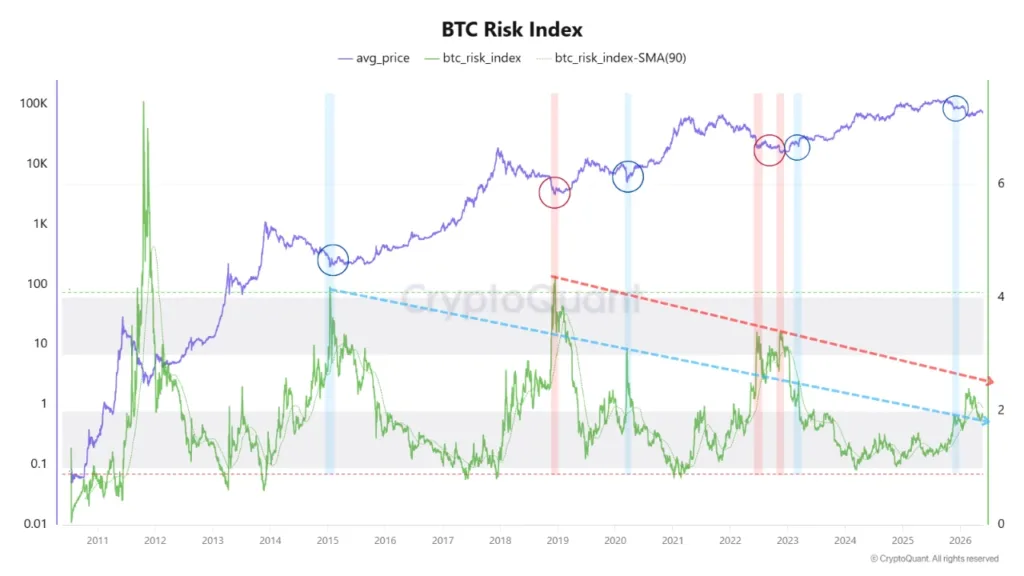
As of Tuesday, the Bitcoin RI has spiked back to the descending blue trendline, marking its strongest low-risk reading since early 2023. While it offers low-risk within the current market dynamics, the asymmetrical gain ceiling is much lower than in 2019 or 2022.
To conclude, investors should expect a smaller payoff per unit of risk taken compared to previous cycles. As the rising U.S. spot exchange-traded funds (ETF) flows suggest, BTC is no longer a speculative asset.