



Fresh exchange data on Friday indicates that the funding rate across all major crypto trading avenues is on the rise. While it shows that sentiment toward BTC may be improving, climbing funding rate increases the risk of a long-biased state for the premier cryptocurrency.
Rising funding rate spells doom for Bitcoin
Notably, the rise in exchange funding rate is not being accompanied with an increase in BTC’s price. The top digital asset by market cap is still trading close to the weak $60,000 price level.
In essence, even though the BTC price has not fully recovered yet from its slump to $59,100, derivatives traders are already starting to bet on an aggressive rebound scenario.
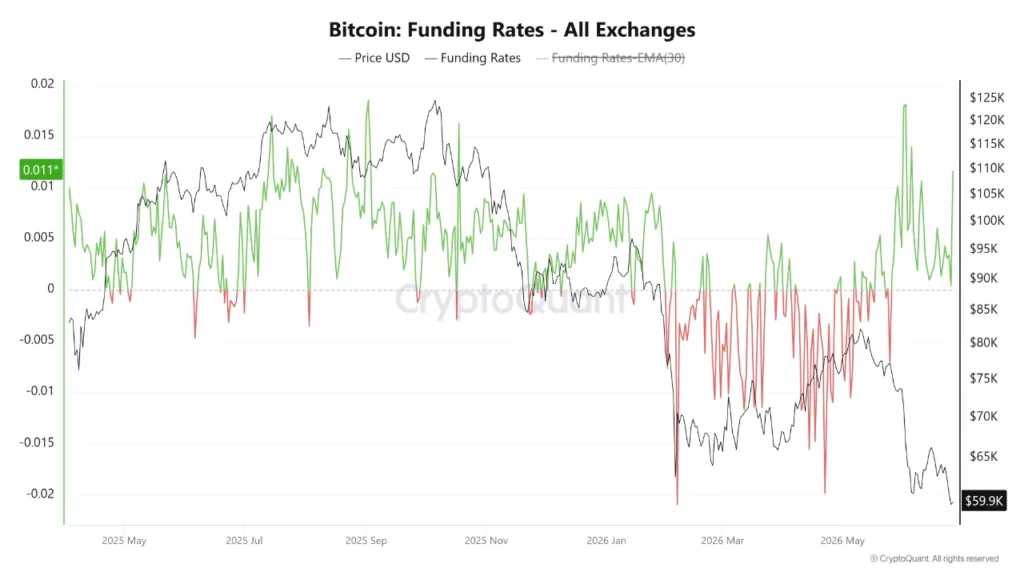
For the uninitiated, the funding rate is a periodic payment exchanged between traders holding long and short positions in perpetual futures to keep the contract price aligned with the spot market.
When the funding rate is positive, long traders pay shorts, signaling bullish sentiment. In contrast, when it is negative, shorts pay longs which reflects bearish sentiment.
In the current case, if BTC’s price doesn’t rise by spot buying pressure, then the market can easily fall into a so-called “crowded long” state. In this scenario, the possibility of a “long squeeze” could increase substantially.
A long squeeze happens when heavily leveraged long positions are forced to close as prices drop, usually triggering automatic liquidations. This cascade of selling further increases the decline, pushing the underlying asset’s prices even lower and trapping late buyers.
If Bitcoin’s funding rate continues to stay positive but price fails to break key resistance zones, then there’s an elevated risk of a short-term correction. However, if there’s a rise in price too, then it could be a stage where the market starts pricing in a new recovery leg to the upside.
Bitcoin’s RSI points toward further decline
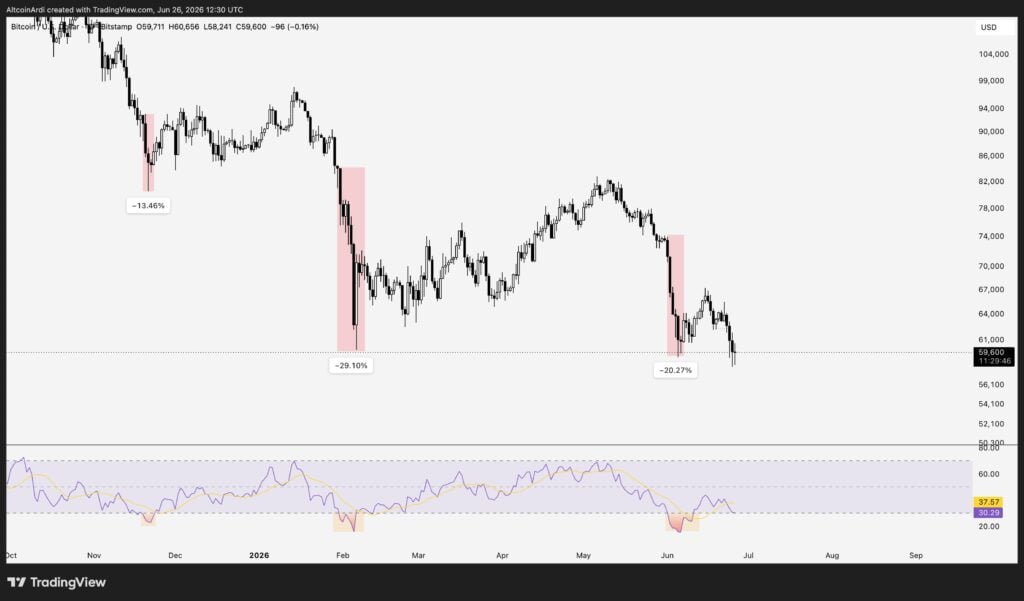
Besides the rising funding rate on exchanges, momentum indicators like the relative strength index (RSI) are also pointing toward further pullback in BTC’s price. In an X post on Friday, crypto analyst Ardi noted that BTC’s RSI has fallen into oversold territory on daily RSI.
The last three times BTC entered this zone, it went on to record further decreases in price of around 15 to 30 percent. That analyst said that they expect BTC to fall further to at least $54,000.
Factors like high inflation data are also weighing BTC down, pushing it to its lowest level in 2026. That said, asset management firm 21Shares reiterated its bullish stance on BTC, saying that it is likely to recover to $100,000 by the end of 2026.


