

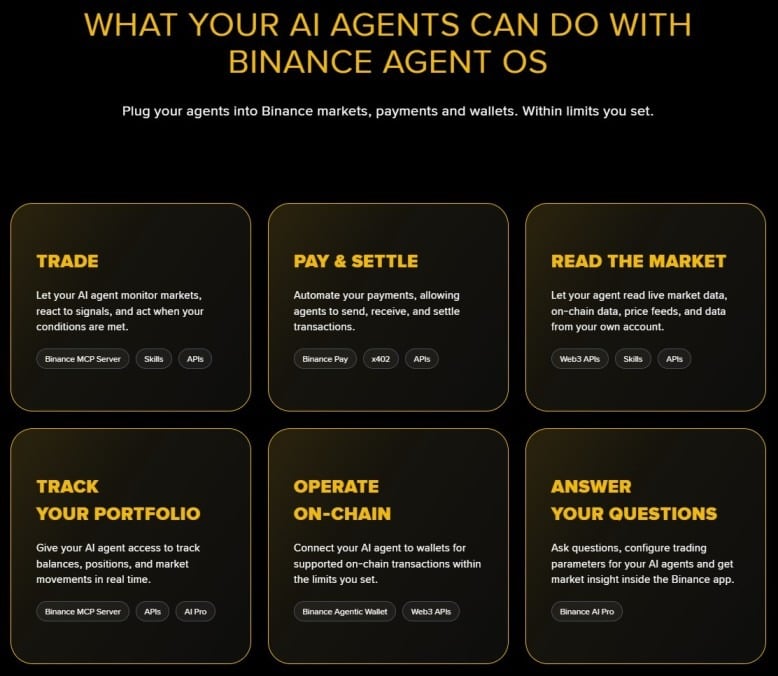
Binance officially launched Agent OS, a developer platform built under its Binance Intelligence initiative. The platform provides a standardized access layer connecting AI applications and agents to Binance’s trading, market data, wallet, payment, and onchain capabilities across both crypto and traditional markets.
What Binance Agent OS really does
Agent OS integrates Binance Application Programming Interfaces, the Binance Wallet Agentic Hub, Binance x402 programmable payments, the Binance Skill Hub, and support for the Model Context Protocol, also known as MCP, an open standard that standardizes how AI applications connect to external tools.
Compatible AI tools include OpenAI’s ChatGPT and Codex, Anthropic’s Claude Code, and Cursor.
How users stay in control
This platform basically gives developers everything they need to build AI tools that plug right into Binance’s financial systems, but the crypto exchange is making sure that regular users are the ones actually responsible for making sure those bots don’t go off the rails.
“Instead of total freedom, we put the power in users’ hands to give them the granular access control of what they can do through the agent,” said Jeff Li, VP of Product at Binance.
Binance enforces control through dedicated “Agentic sub-accounts.” Users assign AI agents to these sub-accounts, and withdrawals are blocked by default, creating a financial sandbox.
You can set up AI agents for specific activities, like spot or futures trading, then decide if they need your okay for every move or can just trade on their own once you give them the green light and permissions are set.
Binance doesn’t set a separate hard cap on what AI agents can trade or lose in a sub-account; basically, whatever cash you move into that account is the max it can play with.
Now, for onchain activity through the Agentic Wallet, Binance does set daily limits: regular swaps are capped at $50,000, decentralized finance transactions at $100,000, and x402 payments at $20 per day.
What Binance can and cannot see
Binance can monitor resulting orders and trading activity initiated through Agent OS, running them through its usual risk controls and anti-money-laundering policies. However, the exchange has limited visibility into why an agent made a particular decision.
The reasoning happens outside Binance’s systems, on the user’s computer or within their chosen AI application. “We really cannot see the reasoning behind the user’s action,” Li remarked.
That means if an agent is compromised through a prompt-injection attack or manipulated by faulty data, Binance cannot detect the deception, only the resulting trades. Li pointed to the sub-account structure as the main line of defense in such scenarios.