

Akash Network, an open-source, decentralized cloud computing marketplace that allows users to buy and sell computing resources might be flying under the radar, according to crypto analyst Jesse Eckel.
In an X post on Thursday, Eckel shared his thesis on why AKT – the native token of the Akash Network – is significantly undervalued in the crypto market.
The core macro bull case behind AKT
In his post, Eckel opines that artificial intelligence (AI) is going to make compute the most strategically scarce resource of the next decade.
As an increasing number of open-source models bridge the gap with frontier closed models like Claude’s Fable/Mythos, the bottleneck will shift from model access to compute access. Akash Network focuses on this compute access, an AI layer that centralized players cannot easily monopolize.
Centralized compute solutions like AWS, Azure, and Google Cloud each have a single point of failure, and carry a so-called “kill switch” that can be turned on or off at the local administration’s wish. Akash Network’s decentralized marketplace resists this.
Akash Network’s offerings span across several jurisdictions and providers, making deplatforming significantly harder compared to centralized alternatives. An increasing number of enterprises are already making moves toward self-hostable open models to avoid dependency on Anthropic and other closed providers.
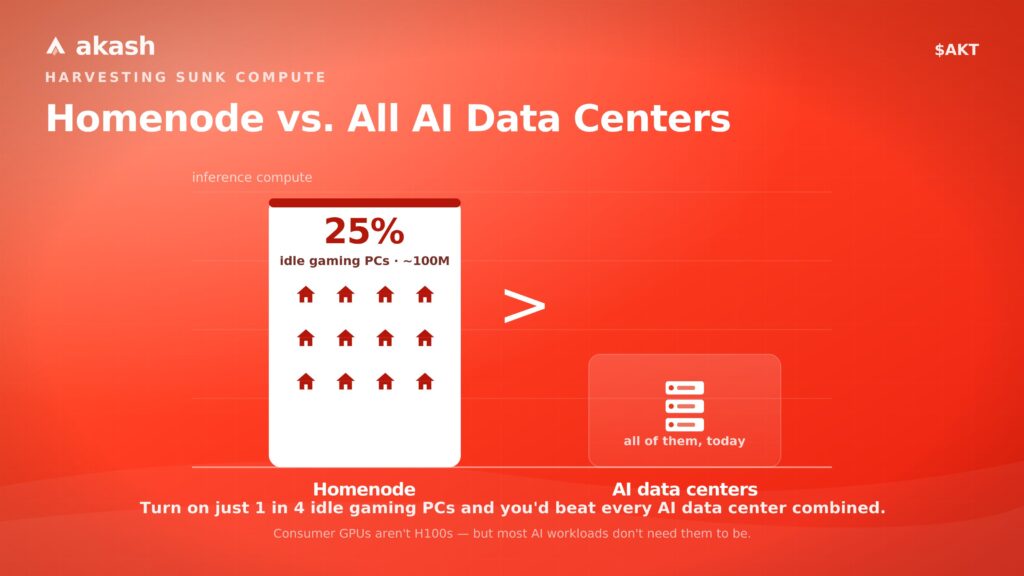
Further, Akash’s Homenode thesis creates supply-side stickiness for its token. At present, there are about 200-400 million PCs globally sitting idle. Akash’s Homenode aims to tap these PCs for compute power.
For example, if just 25 percent of these PCs were onboarded, the total inference compute would eclipse all current AI data center capacity combined. Unlike data centers that build new compute, Akash Network harvests sunk compute, offering a faster supply scaling model.
AKT’s Burnt-Mint Equilibrium
Another bullish catalyst for the AKT token is its Burnt-Mint Equilibrium (BME) token model that links token demand to real network demand.
For instance, when users deploy applications on Akash Network’s decentralized cloud, the AKT tokens spent for the deployment are permanently burned. The BME also safeguards users from cryptocurrency volatility by forcing them to burn their AKT to mint ACT, a USD-pegged unit of account – ensuring that compute costs remain stable and dollar denominated.
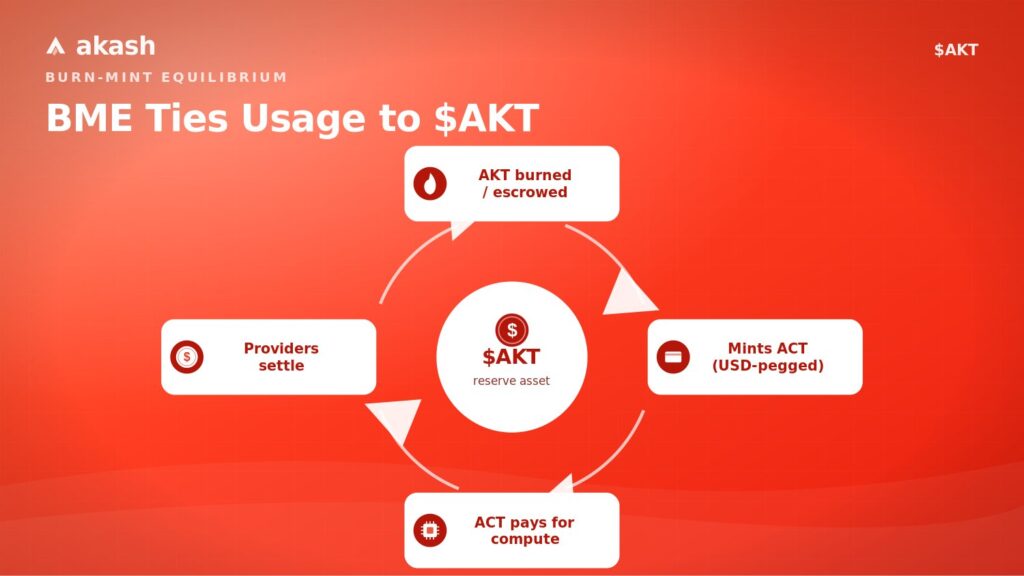
AKT can be thought of as a token that works as much more than a mere governance token for a blockchain project. Much like ETH, as network usage and platform adoption increases, the amount of AKT burned can overtake the amount minted, ultimately resulting in a deflationary circulating supply.
As far as AKT’s recent price action is concerned, the token is up 18.3 percent over the past week, trading at around $0.73. If the AI compute narrative picks steam in the crypto market, expect AKT to breach the $1 barrier soon.