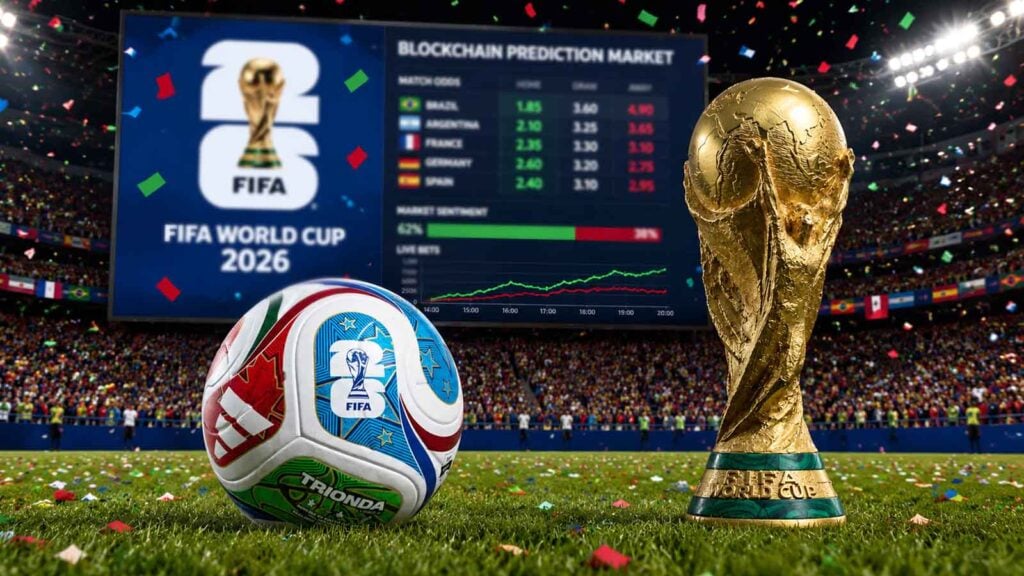


The 2026 FIFA World Cup generated about $20 billion in blockchain-based prediction market volume and another $24 million in digital collectible trading, highlighting the rapid rise of prediction markets and blockchain’s expanding role as infrastructure for everyday economic activity.
In a July 30 report, Chainalysis said nearly 400,000 wallets interacted with World Cup prediction markets, while FIFA’s official digital collectibles platform helped more than 100,000 fans secure match tickets through blockchain-linked assets.
The activity extended well beyond traditional match wagering, covering tournament outcomes, player-related questions and collectible sales, while also exposing the compliance challenges that emerge when large-scale sporting events draw money from a global crypto audience.
More intense matches drove bigger flows
World Cup prediction markets had already generated substantial activity months before the opening match, with daily on-chain volume holding near $50 million from January and periodically rising above $100 million during qualification and the tournament buildup.
Activity surged after the tournament began on June 11, with daily volume climbing toward $250 million and continuing to rise through most of the five-week competition before easing as fewer teams remained and matches became more spread out.
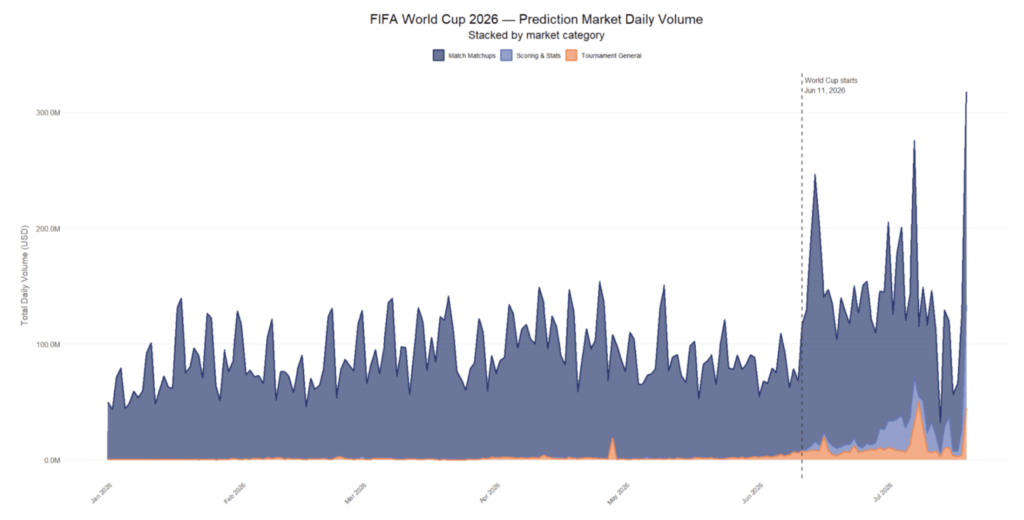
The World Cup final between Spain and Argentina generated more than $300 million in prediction market volume, while tournament-related markets accounted for about 63% of all prediction market volume during the competition, according to Chainalysis.
In total, the five weeks of competition generated roughly $5.7 billion in prediction market volume, forming part of the $20 billion recorded from January through the end of the event.
The largest markets focused on familiar questions such as match winners and the eventual tournament champion, but novelty bets also drew sizable sums. One market asking whether Cristiano Ronaldo would cry at the end of his final World Cup campaign generated $49 million in volume.
Chainalysis said 55% of bettors finished in profit. Among those winners, 79% had prior experience using prediction markets, suggesting that much of the successful activity came from established participants rather than first-time users.
U.S and China led the global betting wave
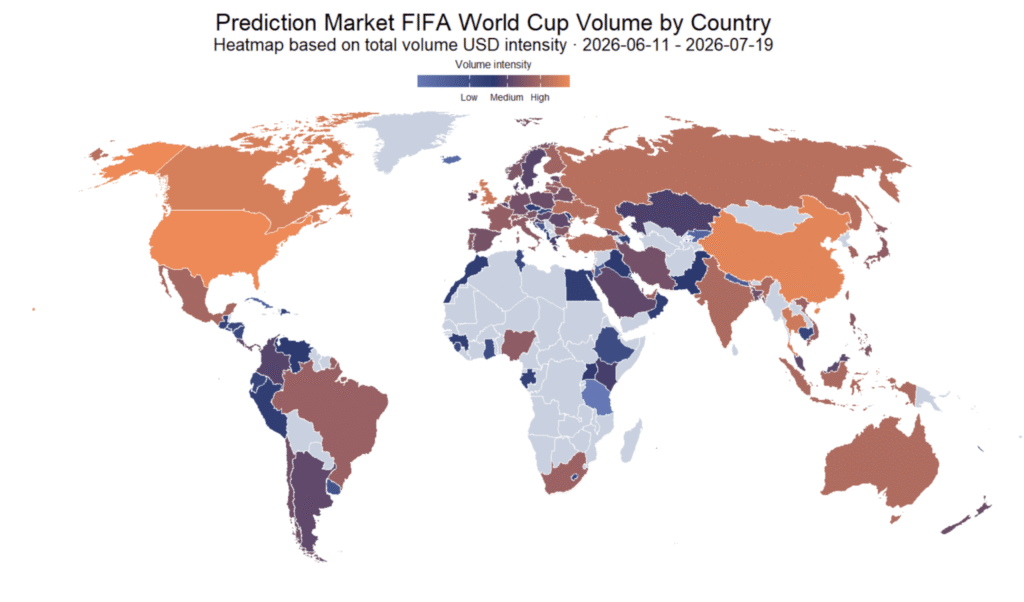
On-chain participation spread across every inhabited continent, reflecting the World Cup’s global reach and the borderless structure of crypto markets.
The United States and China generated the largest identifiable shares of prediction market volume, followed by Canada, Thailand and the United Kingdom. Chainalysis cautioned that country attribution may carry uncertainty when users rely on virtual private networks, mixers or other privacy tools.
Most activity appeared legitimate, with only about 3,700 wallets, or less than 1% of participating addresses, showing identifiable links to illicit actors before placing wagers.
The largest directly traced source was Huobi, also known as HTX, with at least $5.4 million flowing from the exchange into wallets that later interacted with World Cup prediction markets.
Beyond HTX, the report traced roughly $2 million to scam-linked wallets and more than $800,000 in stolen-funds exposure. It also identified about $500,000 connected to over-the-counter trading desks.
FIFA Collect turned digital assets into match access
FIFA’s official collectibles platform offered a different model for on-chain participation by linking digital assets to real-world ticket access.
Built on Avalanche, FIFA Collect allowed fans to trade digital moments tied to players, teams and tournament events, with some assets redeemable for match tickets or carrying the right to buy them through secondary markets.
Chainalysis traced $24 million in payments into a key wallet associated with the platform from May 2025 through the end of the tournament. The wallet processed minting payments, secondary sales and seller payouts, while deducting FIFA’s 5% share from transactions.

The transaction pattern suggested that FIFA collected at least $6 million from secondary-market activity.
Users from countries that qualified for the tournament accounted for $17.6 million in purchases, while wallets from other markets contributed $6.6 million. Most value came from wallets with an existing on-chain history, indicating that the platform attracted more experienced crypto users than newcomers.
Compliance separated collectibles from open markets
FIFA Collect showed negligible direct exposure to illicit funds, a result Chainalysis linked to the platform’s stricter identity and source-of-funds checks.
Fans seeking ticket access had to verify their identities, disclose the source of their funds and undergo manual account reviews, controls that stood in sharp contrast to the more open structure of decentralized prediction markets.
The findings point to a broader shift in which major sporting events increasingly generate economic activity on-chain. They also highlight the trade-off facing organizers and platforms: open crypto markets can drive massive global participation, but stronger compliance systems remain critical when digital assets begin carrying real-world value, access and risk.