

On Tuesday, Tron (TRX) eclipsed both Ethereum (ETH) and Hyperliquid in terms of fee revenue generated over the past 24 hours. Tron earned $1.3M, while Ethereum and Hyperliquid generated $1.2M and $1.1M, respectively.
Tron surges past Ethereum, Hyperliquid in fee generation
The Tron network shot past two of the leading blockchains in terms of fee revenue generated over the past 24 hours. The following data from Artemis shows Tron at the first position, having earned $1.3M since Monday.
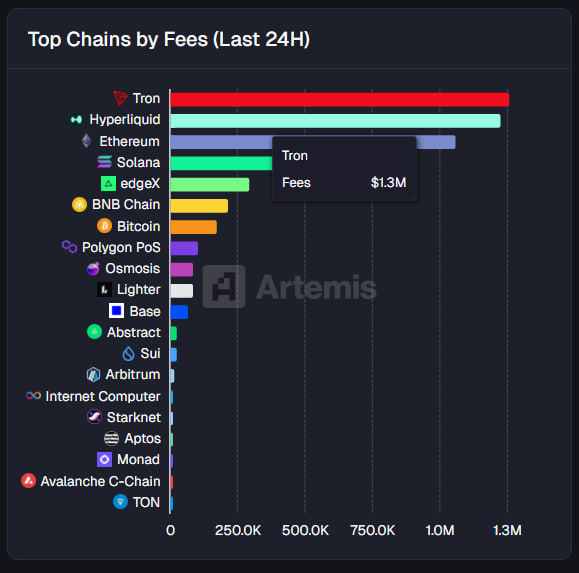
Tron’s dominance further solidifies its position as the preferred blockchain for payment purposes, especially stablecoin transactions. The smart contract platform has become a major hub for Tether’s USDT stablecoin.
Tron enjoys a strong market presence among emerging markets, where there is a healthy demand for low-cost, rapid payment processing blockchains. Unlike Ethereum which might take several minutes to move stablecoins, Tron usually does the business in mere seconds.
Ethereum’s dominance shows clearly in the decentralized finance (DeFi) and institutional tokenization activity spaces. However, when it comes to stablecoin liquidity and user activity, it takes a backseat to Tron.
In Q1 2026 alone, Tron processed stablecoin transactions worth a mammoth $2T. As a result, Tron has been able to consistently generate high fee revenue despite operating at average transaction costs that are a fraction of those on Ethereum.
Layer-2s eating into Ethereum’s stablecoin activity
The launch of layer-2 networks such as Optimism, Arbitrum, and others meant that the majority of stablecoin activity within the Ethereum ecosystem has now moved onto these scaling networks.
In Q1 2026, layer-2 networks like Optimism, Arbitrum, zkSync, and Starknet processed stablecoin transactions in the range of $1.8T to $2.5T. The dominant use cases for these transactions were DeFi activity, retail transfers, and trading flows.
However, onboarding challenges remain a stiff problem hindering Ethereum layer-2 networks’ adoption rate. On the contrary, sending and receiving stablecoins through the Tron network remains simple.
Meanwhile, other competitors are starting to grab their market share. Recently, Coinbase’s Base blockchain reported a 900 percent growth in its stablecoin activity.
Institutional interest in stablecoins is also on the rise. On May 4, Chainalysis predicted that the global stablecoin volumes could hit $719T by 2035.