


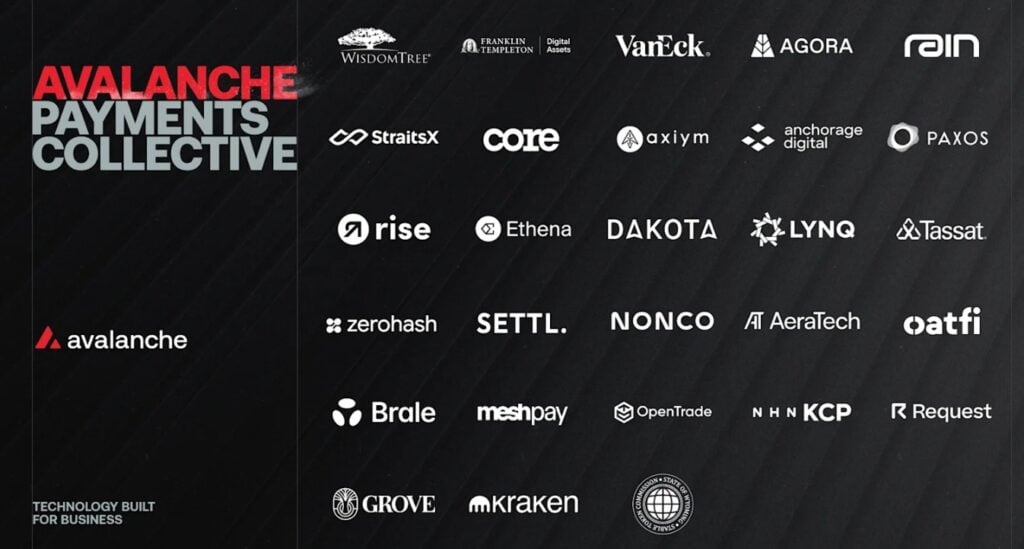
The Avalanche Payments Collective is officially live. It’s a new network of 28 organizations (including big names like Franklin Templeton, VanEck, Anchorage Digital, Paxos, Agora, Ethena, and Rai) teaming up to handle everything from stablecoins and treasury infrastructure to foreign exchange. This infrastructure is already backing payment flows across 150 countries and 96 currencies, reaching around 22 billion payout endpoints globally.
The Collective: More than faster transactions
It is said that the Avalanche Payments Collective is not really about speed, but about bringing everything together. To move money across borders, you need liquidity, settlement, compliance, treasury management, custody, foreign exchange, and local payment networks all working as a team.
Avalanche has quietly built one of the most extensive payment ecosystems around, and this collective finally gives it a name. As John Nahas, Chief Business Officer at Ava Labs, said: “The future of global payments won’t be built by a single company, product, or payment rail. It will be built by interconnected ecosystems.”
The collective also includes Tassat’s Lynq network, which migrated to a dedicated Avalanche Layer-1 (L1) back in April 2026. This connects over 30 participants and brings more than $2.5 trillion in transaction history from Tassat’s banking infrastructure into the ecosystem.

Infrastructure across the payment stack
The collective’s members operate across the entire payments stack:
- Axiym has already processed over $1.4 billion across borders using Avalanche, reaching money services in more than 150 countries.
- Rain is behind those stablecoin card programs that link up with Visa’s massive merchant network.
- Anchorage handles the heavy lifting with regulated custody and banking tech for big institutions getting into stablecoin payments.
- Nonco runs an institutional foreign exchange (FX) venue that connects over 350 liquidity providers to the stablecoin markets through a request-for-quote platform.
The Avalanche Payments Collective also includes Agora, Paxos, Ethena, and the Wyoming Stable Token Commission, expanding the pool of digital-dollar assets available to businesses, fintechs, and financial institutions.
Why this matters for payments
The collective tackles a real-world issue: payment companies need more than just fast rails; they need a complete settlement ecosystem that pulls together liquidity, compliance, treasury workflows, and local networks on a global scale.
The collective’s infrastructure already supports business-to-business (B2B) stablecoin payments, which grew more than 700 percent year-over-year (YoY) in 2025. Plus, with major players like Franklin Templeton and VanEck bringing regulated tokenized securities into the mix, treasury teams can tap into yield-bearing assets that are ready whenever they need to settle up.
For payment operators, the impact is straightforward: money moves on the same schedule as the business, settling on weekends, public holidays, and outside traditional banking hours.


