

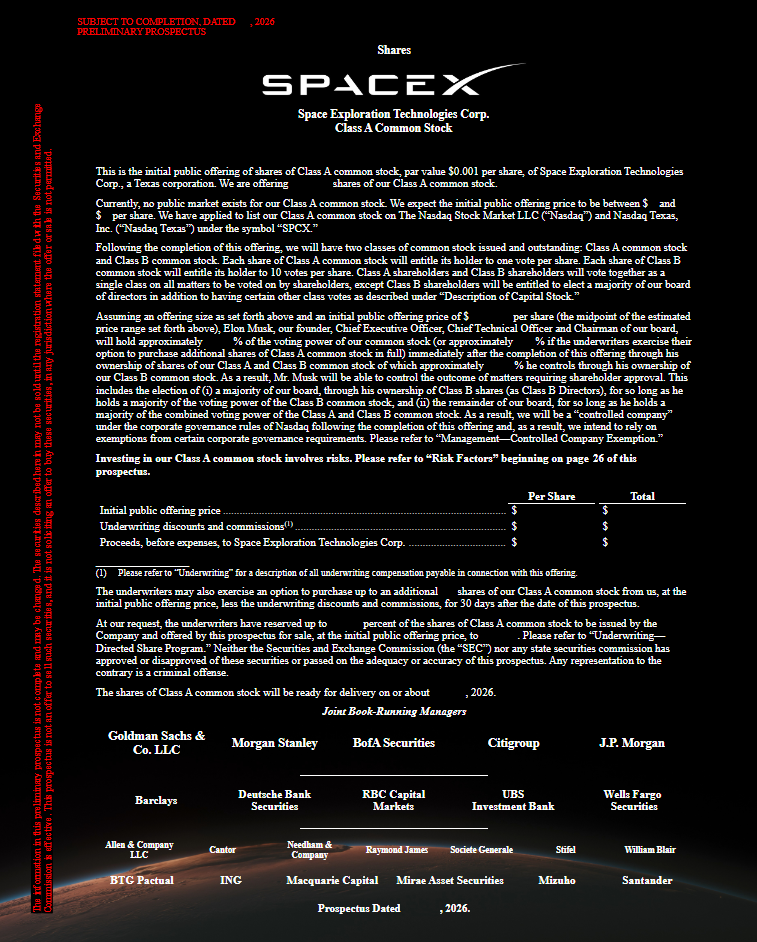
SpaceX filed for an initial public offering that could clear the way for one of the largest market debuts on record, giving investors their first chance to buy into Elon Musk’s rocket, satellite internet and artificial intelligence empire.
The company said in a prospectus filed with the U.S. Securities and Exchange Commission on Wednesday that it plans to list its Class A common stock on Nasdaq and Nasdaq Texas under the ticker symbol “SPCX.”
Goldman Sachs is listed first among the joint book-running managers, followed by Morgan Stanley, BofA Securities, Citigroup and J.P. Morgan, with several other banks also named on the prospectus.
The filing follows SpaceX’s confidential submission in April and puts the company on course for a likely Nasdaq debut next month. The deal is expected to draw heavy demand from investors, driven by SpaceX’s strong position in rocket launches and the scale of Starlink, its satellite internet network.
SpaceX was valued at $1.25 trillion in February after merging with xAI, Musk’s artificial intelligence startup, meaning new investors would be buying into the company at a historically high valuation.
Musk’s empire heads to Wall Street
The IPO would place Musk at the center of another trillion-dollar public company, expanding his market presence beyond Tesla at a time when SpaceX is pitching itself as far more than a launch provider.
SpaceX said in the filing that it has built an integrated business across space, connectivity and AI. The company said it has launched more than 80% of global mass to orbit each year since 2023, with a more than 99% mission success rate across Falcon rockets.
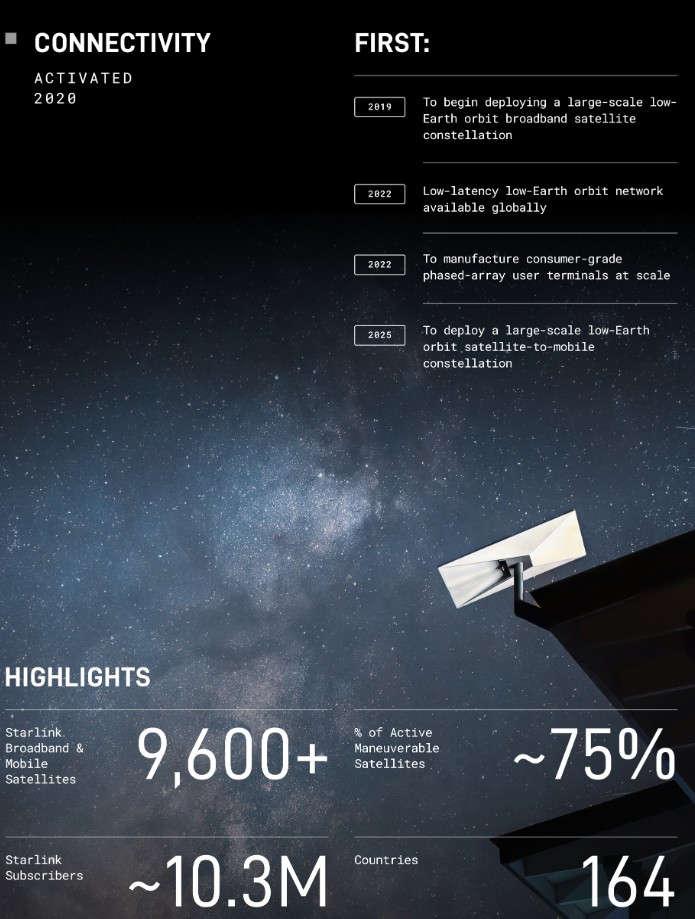
It also said Starlink operated about 9,600 broadband and mobile satellites in low-Earth orbit as of March 31, 2026, serving customers across 164 countries, territories and markets.
The prospectus also makes clear that Musk will remain firmly in control after the offering. SpaceX said Class A shares will carry one vote each, while Class B shares will carry 10 votes each, giving Musk the ability to control matters requiring shareholder approval, including board elections.
SpaceX pitches AI as its next frontier
A major part of the filing is SpaceX’s effort to position AI as a core growth engine after its February acquisition of xAI. The company said xAI is now an “integral pillar” of SpaceX and that Grok, its AI model, benefits from integration with X as a real-time data and distribution platform.
SpaceX said its AI platforms across Grok and X had more than 1.3 billion supported accounts active over the 12 months ended March 31, including about 550 million monthly active users. It also said around 117 million monthly active users had used Grok’s AI features.
The company is also pitching a more ambitious vision for its next phase, saying its reusable rockets, satellite manufacturing scale and Starlink network could support massive AI compute satellite constellations, with deployment expected as early as 2028.
SpaceX reported revenue of $18.67 billion in 2025, up from $14.02 billion in 2024, but posted a net loss of $4.94 billion for the year. In the first quarter of 2026, revenue reached $4.69 billion, while the company recorded a net loss of $4.28 billion.
For public investors, the IPO offers a chance to buy into SpaceX’s existing lead in rockets and satellite internet, while also backing Musk’s longer-term push into multiplanetary AI infrastructure.