



Peaq Network has unveiled peaqOS Scale, a new function that turns any robot or machine into an autonomous economic actor. The project states that “For the first time, machines can pay for compute, storage, data, and AI services from their own wallets, without a human swiping a credit card or approving every transaction.”
A Peaq of context
The Peaq Network is a specialized Lawyer-1 (L1) blockchain built as the base digital infrastructure for the “Machine Economy.” It is also known as the “omnichain economic system that enables robots and machines to do business on every chain.” Peaq is focused and optimized for Decentralized Physical Infrastructure Networks (DePIN), including Machine Real-World Assets (RWAs) applications: crowd-sourced noise monitoring (like Silencio), cloud data, and decentralized electric vehicle charging networks.
How peaqOS Scale works
To better understand this, let’s explain that the peaqOS Scale function is built on three core components already live:
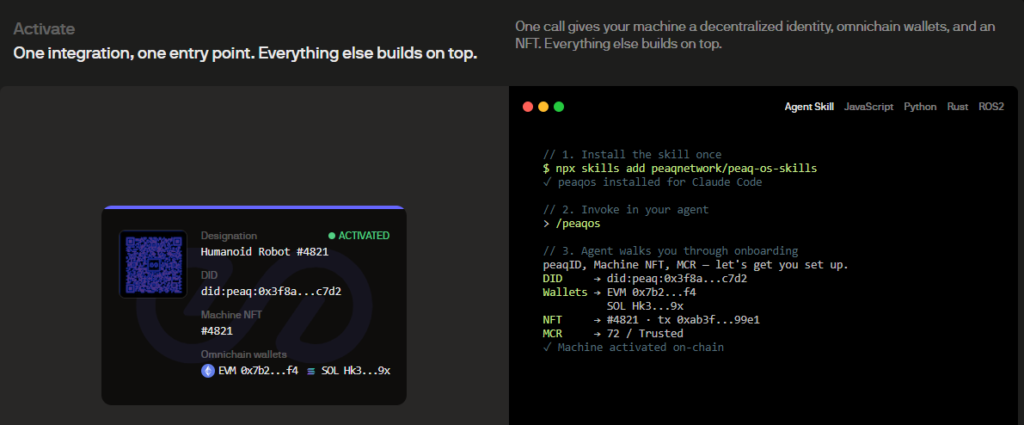
Activate: Giving each machine a peaqID (a W3C-compliant Decentralized Identifier (DID), omnichain wallets, and a Machine non-fungible token (NFT)].
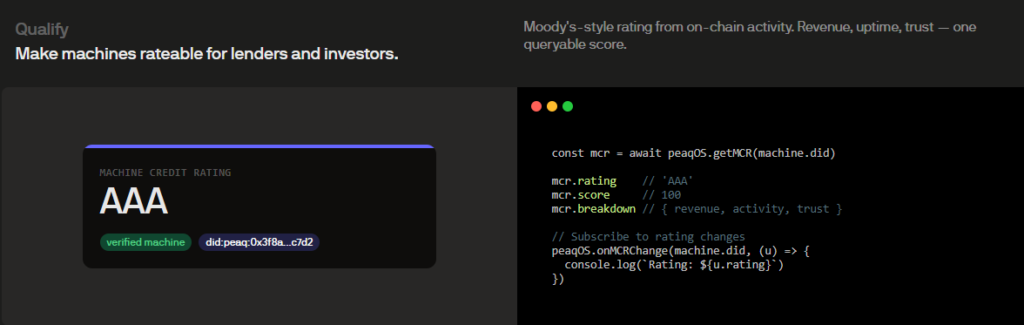
Qualify: Assigning a dynamic Machine Credit Rating (MCR), translated as a “scoring system that evaluates the financial health, economic productivity, and reliability of an autonomous machine or AI agent.”
Scale: Adds a paired AI agent, provisioned by the operator, with delegated access to the machine’s wallet, subject to explicit per-transaction limits, daily caps, and allow/deny lists. The agent searches, transacts, confirms, and disputes on behalf of the robot, while the operator stays in control of the rules.
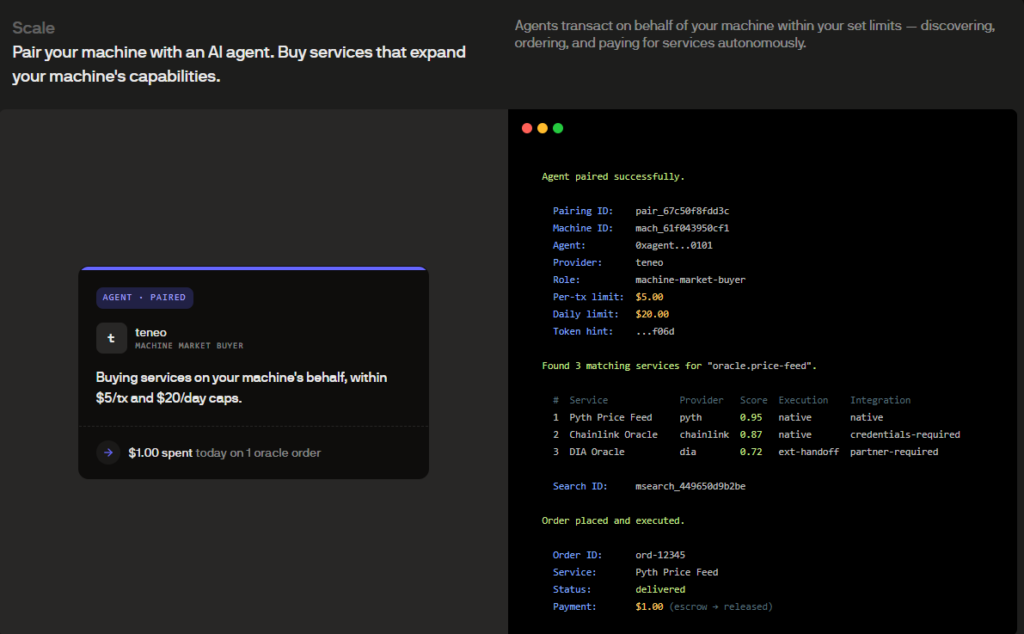
The machine market lives at robotic.sh, an open catalog of machine-consumable services. Any activated robot or machine running peaqOS can call these services via Command-Line Interface (CLI), Agent Skill, or Software Development Kit (SDK). Settlement happens onchain, with support for Solana, Base, and more chains to come.
Services available at launch
So far, twelve services are live at robotic.sh:
- AI and verifiable compute: QVAC (Tether), Claude (Anthropic), ChatGPT (OpenAI), Gemini (Google)
- Search and intelligence: Wolfram Alpha, Exa (semantic web search), Firecrawl (web text extraction)
- Structured data: Google Document AI, Cloud Translation, BigQuery
- 2Captcha: Captcha solving for the human web
- StableUpload: Storage and hosting (Merit Systems)
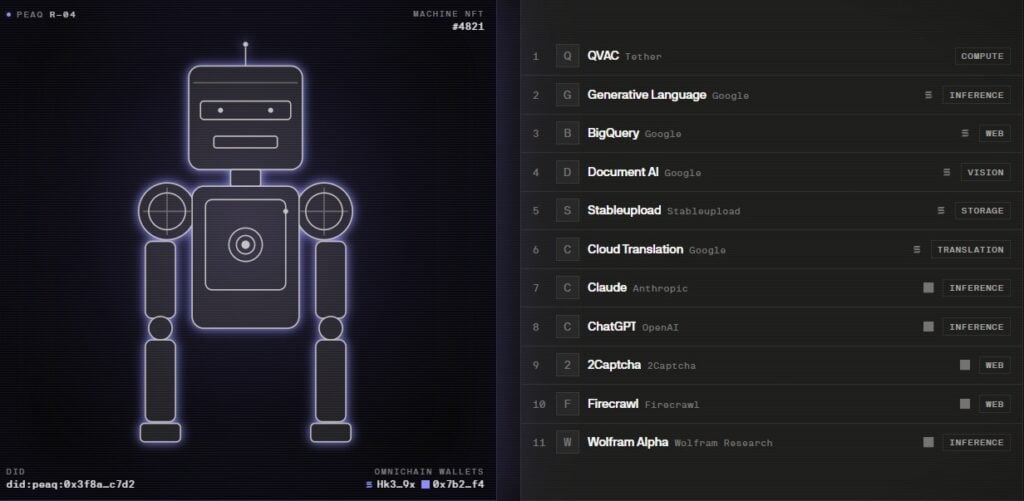
Each service is paid per request from the machine’s own wallet. For example, a drone needing extra compute buys it directly. A robotaxi stores sensor data on decentralized storage. A humanoid secures its Internet Protocol (IP) onchain. All autonomously.
How peaqOS Scale improves robotics
Before peaqOS Scale, robots could work, but they couldn’t act or grow. Regularly, a human paid for compute. A human provisioned storage. A human subscribed to data. A human applied for capital. But now, machines can fund their own operation. Adding more examples on this, a drone can pay for its own compute; a robotaxi can store its own mission data. Meanwhile, the revenue left over compounds in yield strategies and funds the next deployment.
This is quite important for capital providers, as robots and machines become addressable counterparties. For instance, they can now borrow, lend, and buy. Capital meets them at every layer (debt, equity, yield, exposure), the same way it meets any other onchain counterparty.
Moreover, for service providers, getting into the catalog opens up a whole new crowd: every robot and machine running peaqOS. From storage networks like Filecoin and compute setups like Akash to positioning DePINs and inference Application Programming Interfaces (APIs). To this point, the teams that spent years building Web3 infra finally have machines that actually need their tech at scale.
PEAQ token surge
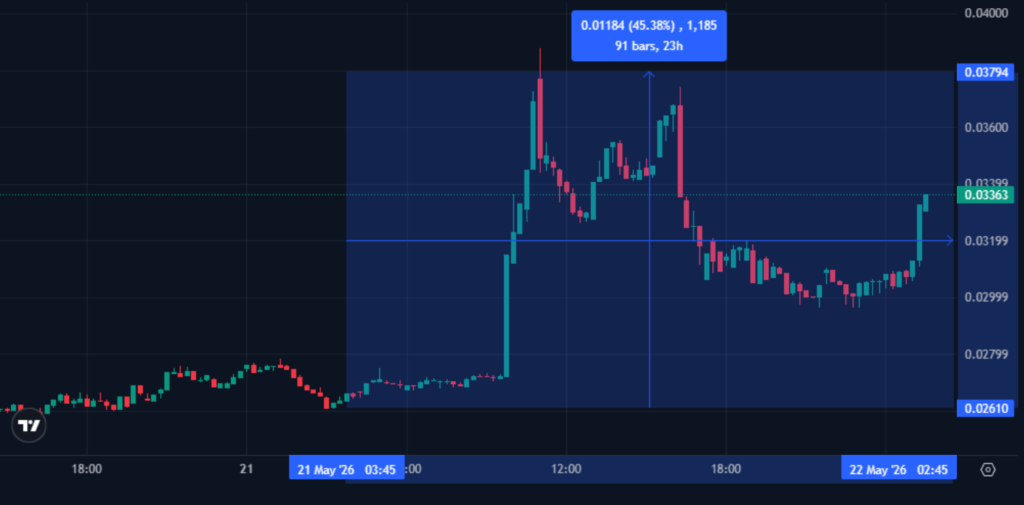
As for the PEAQ token, it has surged over 40 percent in the last 24 hours, having a price correction of around 20 percent, and it’s trading at $0,033 at the time of writing. Let’s say that the project’s token is not just trying to surf the wave, but it’s part of the most underrated market narratives: DePIN. With over $70 million in market cap (20 percent up), and around $50 million in trading volume (with a massive 410 percent surge in 24 hours), PEAQ is outperforming the crypto market, following a strong technical breakout.