

NVIDIA announced a major AI infrastructure push at ISC High Performance 2026, unveiling 35 new AI supercomputers across Europe, a rack-scale Vera Rubin computing platform and new software tools designed to speed up work in climate modeling, healthcare, energy, astronomy and advanced manufacturing.
The company said its latest lineup includes DAQIRI, a high-performance data acquisition library, ALCHEMI NIM microservices for chemistry, materials research, and cuPhoton, a reference code for processing large-scale imaging data from telescopes, X-rays and laser experiments.
NVIDIA’s Vera Rubin systems can deliver more than 7 exaflops of AI performance and 5 petaflops of native FP64 performance in rack-scale configurations, the company said, giving research centers and industrial users more power to process massive datasets, run simulations and train advanced models.
Europe leads the rollout with 35 systems across 23 countries
The largest announcement centered on Europe, where NVIDIA said a record 35 AI and high-performance computing supercomputers are now in development across 23 countries.
The systems are expected to support more than 3 million researchers and will be deployed across national supercomputing centers, EuroHPC AI factories and academic institutions.
NVIDIA said its infrastructure is powering more than 90% of Europe’s AI factory buildout, with 800 AI exaflops deployed or announced since last year.
The projects include Barcelona Supercomputing Center’s EuroHPC MareNostrum5 AI upgrade, BavariaAI’s Blue Swan, Italy’s IT4LIA, Germany’s HammerHAI and Sweden’s Mimer EuroHPC AI Factory.
Their work will span generative AI, climate modeling, biomedical discovery, sustainable agriculture, cybersecurity, meteorology, manufacturing and public-sector AI services, showing how Europe is trying to build more domestic computing capacity for industries and governments.
The announcement also fits Europe’s broader effort to strengthen sovereign AI infrastructure, giving researchers and companies access to advanced computing resources without relying only on external cloud platforms.
Vera Rubin puts TOP500-class power into a single rack
NVIDIA also introduced Vera Rubin as a new platform for high-performance computing, combining Rubin GPUs, Vera CPUs, NVLink-C2C, ConnectX-9 SuperNICs and BlueField-4 DPUs in direct liquid-cooled systems.
The platform is designed to merge simulation, AI and data analytics in one system, allowing users to run numerical models, train AI systems, process instrument data and support real-time analytics on a single architecture.
Major adopters include Leibniz Supercomputing Centre, the National Energy Research Scientific Computing Center at Lawrence Berkeley National Laboratory and Los Alamos National Laboratory.
Their planned systems will support workloads ranging from astrophysics and environmental modeling to fusion energy, materials development, national security and quantum computing.
Global manufacturers including Bull, Dell Technologies, GIGABYTE, HPE and Supermicro are expected to bring Vera Rubin NVL4-based systems to market later this year.
From CERN collisions to telescope data, NVIDIA targets research bottlenecks
NVIDIA’s software announcements focused on shrinking the time between raw data collection and usable results.
cuPhoton is being developed to help teams process multidimensional data from telescopes, X-rays and laser experiments. NVIDIA said early access testing accelerated loading and reading of Rubin Observatory LSST FITS images by 14,900x and enabled up to 8,400x faster signal processing and analysis.
DAQIRI targets real-time instrument data, including environments where storage limits force teams to discard large amounts of raw information. A CERN-linked project is using it to analyze collision data that would normally be rejected.
ALCHEMI, meanwhile, is built for chemistry and materials discovery, helping users simulate molecules and materials at scale for batteries, catalysts, OLED displays and energy applications.
Together, the announcements show NVIDIA pushing beyond AI model training and deeper into the infrastructure behind modern research and industrial development, from supercomputing hardware to the software layers that turn massive datasets into faster decisions.
Stock slips below $200 as investors look past AI push
NVIDIA stock slipped below the $200 line despite the company’s latest AI push, suggesting investors may be looking past fresh product announcements and focusing instead on valuation pressure, broader market sentiment and competition risks.
The stock opened near $200.04, touched $202.15, then fell as low as $192.22 before trading around $195.74, down about 1.7%.
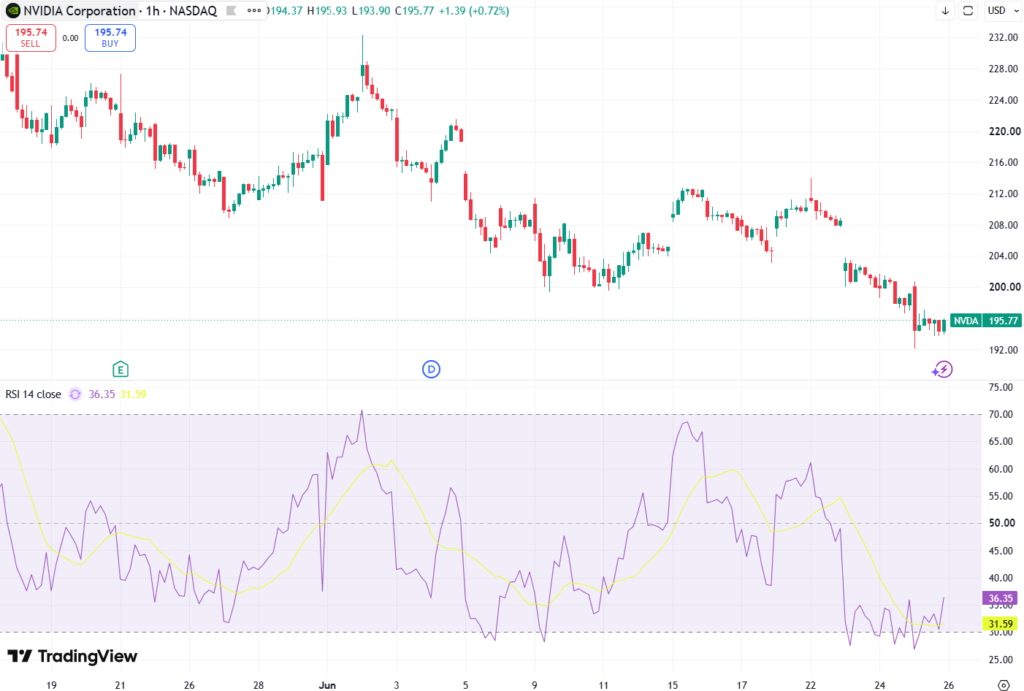
Technical momentum remained weak, with RSI near 36.35, above its 31.59 signal line but still showing soft buying pressure.
The move extends recent weakness after NVIDIA had largely held above $200 since its April breakout.
For now, the drop appears less like a reaction to the Europe AI buildout and more like a sign that investors want stronger proof that future AI infrastructure spending can keep supporting NVIDIA’s valuation.