


The Delhi High Court has decided to uphold the decision by India’s Narendra Modi government to restrict access to Telegram ahead of the upcoming medical entrance exam re-test on June 21. Justice Tejas Kalra pronounced the order on Friday, rejecting Telegram’s plea that challenged the action earlier this week. The restriction on Telegram, however, has resulted in a spike in VPN usage in India as per industry insiders.
Justice Kalra approved of the procedure used to block the platform under Section 69A of the IT Act, citing the emergency nature of the situation. Under Section 69A, the Central Government reserves the authority to block access to online information through a computer resource in the interest of public order and national security.
From Justice Kalra’s court room
As reported by Live Law, the Delhi High Court named a number of Telegram features which could be exploited by notorious miscreants to spread misinformation ahead of the sensitive national medical enterance test, which was leaked in April, leading to widespread protests in India and a number of student suicide cases in the last few weeks.
Telegram features like large public channels, automated bots, hidden phone numbers, and unlimited message editing attempts, Justice Kalra, are at high-risk of being misused by organized cheating rackets to spread fraudulent information, stirring panic among students.
“Telegram permits messages, including files, to be edited at a later point in time. Such functionality may be employed to disseminate misinformation by editing messages sent prior in time by replacing the attachment to give impression that the examination paper was leaked prior to the examination even though such editing takes place after conclusion of the examination,” Justice Kalra was quoted as saying. “Accordingly, any subsequent editing of messages relating to NEET UG, 2026 may mislead general public and, consequently, give rise to a potential public order situation.”
For now, Telegram services have been suspended in India until June 22. The message editing feature, on the other hand, will be disabled until June 30.
The action against Telegram was first asserted by the IT Ministry and the National Testing Agency (NTA) — which organizes the NEET-UG exam each year under the oversight of India’s Ministry of Education.
Telegram, meanwhile, has maintained that it has been proactive in terms of scanning its network for NEET-related topics and materials being circulated. The messaging app claims to have removed over 900 links involving NEET-related content using AI identification methods.
VPN much?
Telegram founder Pavel Durov said earlier this week that India is essentially barring the app for over 150 million users — which he called a mistake. Durov has not yet responded to Delhi High Court’s decision to uphold the block.
Responding to queries issued by The Coin Headlines on social networking platforms, Indian respondents said they were still accessing the platform via VPN services.
On Friday, India suspended the X account of David Peterson, the General Manager at Proton VPN after he posted about a 150 percent surge in hourly registrations.
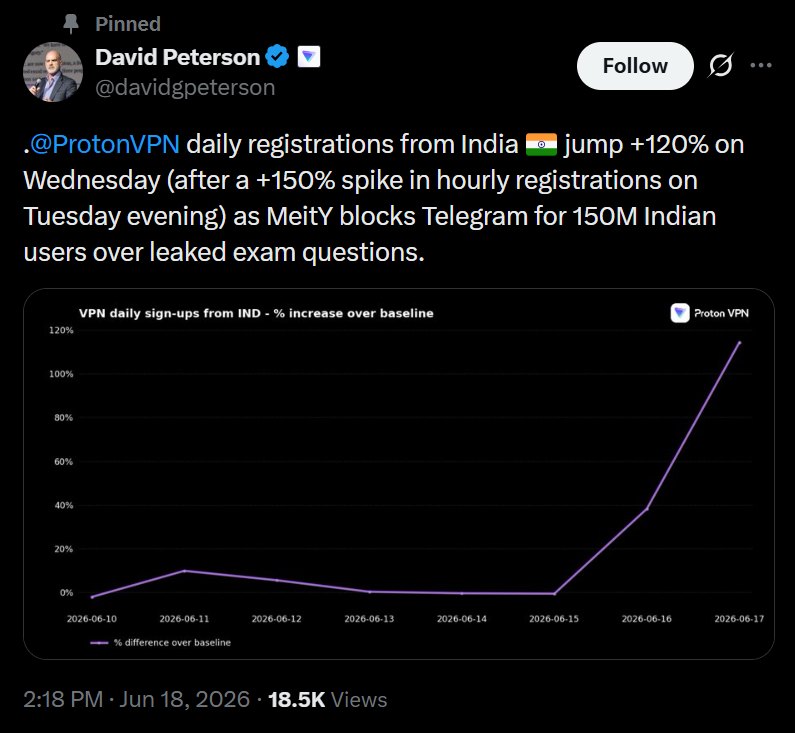
Source: X/ @davidgpeterson
Software Freedom Law Center, India — a legal services organisation has released a detailed statement on India blocking Peterson’s account on X.
“The suspension of his account adds to the growing trend of content takedowns and account suspensions ordered without transparency,” the SLFC.in noted, sharing a screenshot showing Peterson’s account being withheld in India.
The SLFC added that such account blocking instances are backed by Rule 16 of the IT rules under which, any person facing information blocking may never be heard or provided a reasoned order on why their content is blocked online.
“SFLC.in has filed a PIL in the Hon’ble Supreme Court challenging the constitutionality of Rule 16. We have urged the Court to quash or set aside Rule 16,” the organization noted.
Many others from the tech and startup communities in India have expressed disapproval of Delhi High Court’s decision to uphold the temporary ban against Telegram. The messaging platform, itself, has been sharing its experience with India on X in the backdrop of its ongoing tussle with the authorities there.


