

In the last 24 hours, the market participants went through a liquidation session amounting to ~$447.78 million and that impacted 119,295 traders as per coinglass data. The liquidations included $361.97M worth of long positions for $85.81M worth of short positions. The Bitcoin 4h candle is positioned at $62,536.90, just -0.10 percent over the period. The damage has already been done, and the price is mostly stagnant. That is a liquidation ratio moving from 4 to 1, implying front-loaded liquidations concentrated during the initial hour of this largest cryptocurrency’s price drop from the mid-60s and that this wave is almost over.
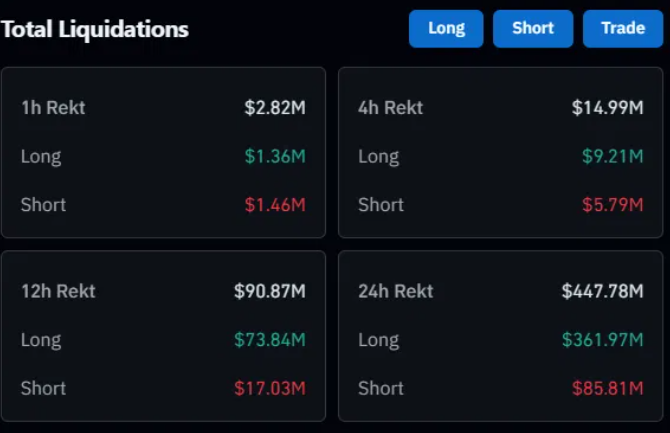
Things just come into the flip zone again in the 1h window; however, longs have lost $1.36 million, and shorts have lost $1.46 million. This is the first instance in this snapshot where the short side took it the hardest; this kind of reversal signals a short squeeze losing steam and being deprived of new longs that could come together and unwind.
Also interesting to note here is that $447.78M in total wasn’t on the BTC leg alone, despite the largest individual trade on the books being an ETHUSDT one over on Aster (at $10.49M) and thereby making this number an aggregate figure to read.
The bounce gave itself back
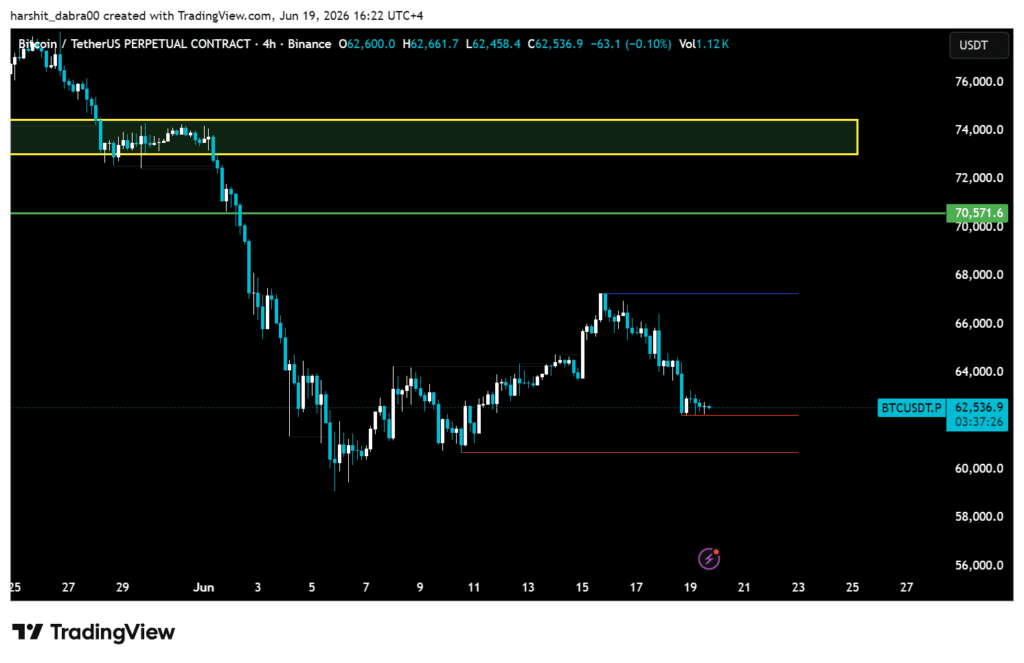
The largest cryptocurrency has shown a recovery rally, peaking close to $68,000 this wednesday. It topped out well under the zone of $72K to $74.5K and this is where most liquidations remained concentrated in the middle of this month. A swift trip back toward the point where it began the prior leg took shape within two days, and price currently trades beneath the level of $63,173 that is the level from 78.6 percent retracement of the $59,108-$78,100 leg. This is almost zero progress from that bounce.
The intraday pivot for Bitcoin is at $63,278. Price has dipped below this. Alone, this is a weak indication of bearishness. Add this to the retracement numbers above and the scenario repeats itself in another frame of reference, and those eight days of built were wiped out in about two days.
Indicators are not aligning with the trend
This data conflicts with itself and it is because the indicator, like RSI is sitting near 35 which is a weak reading but can’t be called oversold as seen on the MACD histogram, and long moving averages from SMA7 to SMA200 are all overhead from the price near $78,900 with the long-term trend intact. Volume has been modest on the side for $29.65 billion in the last 24 hours relative to $449 million in forced liquidations, and this points out that the force wasn’t from fresh capital. It makes for a complete positioning picture.
Any of the market participants that were involved in buying the support in the $64,000–$68,000 area were expecting to go towards $72,000–$74,500 and placed their stop loss in anticipation. As a result, they have paid the $361.97 million in long liquidations for entering before the level proved itself, and the timing essentially matched up precisely corresponding with the drop that just took place.
The levels that needs some focus
Below the current price, the chart shows a shelf near $60,500, the next real test if $62,500 fails to hold, with the swing low at $59,108 as the line that matters most since losing it invalidates the whole eight-day recovery structure rather than just retracing it.
Above, resistance is layered: the pivot at $63,278 first, then the $66,364 to $68,605 band where the 61.8 percent and 50 percent retracements line up with the SMA30 and where this bounce already failed once, with reclaiming that higher band mattering more than $63,173 alone, which has already flipped on the 4h chart multiple times. Extension levels at $83,266, $89,837, and $97,092 exist on paper from the same Fibonacci swing but aren’t relevant to anything happening this week.