

Within seconds, tens of thousands of students and youngsters were digitally silenced in central Delhi this week. As student protests erupted through the streets of India’s national capital, Prime Minister Narendra Modi’s government pulled the plug on the mobile data connectivity rendering traditional messaging platforms like WhatsApp, Instagram, Telegram, and Signal useless. Instead of falling quiet, however, the protesting students adapted — through Bitchat.
Launched by X-founder Jack Dorsey in July 2025, Bitchat is a decentralized application that allows localized peer-to-peer messaging without a cellular or internet network.
Why Bitchat?
The free, open-source platform essentially allows users to connect with each other via bluetooth — without any requirements of phone numbers, email addresses, or account creation.
Once downloaded, Bitchat allows phones to circulate texts onto other nearby devices without any support from central servers or cellular towers. Essentially, users using the dApp creates a local “mesh network” to bounce texts from one device to another.
Bitchat users within 30 to 100 meter Bluetooth range can be connected on a shared mesh network and communicate with each other. If a device happens to leave the mesh radius, the messages they recieve are stored and delivered as soon as it re-enters the mesh radius.
Messages sent through the dApp are end-to-end encrypted and can be circulated in group chats.
The platform additionally comes with a “Panic Mode” as a privacy tool. Tapping the dApp’s logo multiple times immediately wipes-off all stored conversation.
There are, however a fre drawbacks to consider. The platform only supports localized messaging — which means it cannot let users communicate with their peers outside the 100-meters radius. Also, as of now, the platform has limited support for media transfers, depending on which fork of the dApp is supported on what device.
Users have also shared a battery drain issue with excessive usage of Bitchat. Additionally, the dApp could become choppy if network jammers tamper Bluetooth connectivity.
Praises from Jantar Mantar
Jantar Mantar, the historic protest site in the capital city of the world’s largest democracy, has been home to thousands of Indian students for days now.
Demanding the resignation of Union Education Minister Dharmendra Pradhan, these students are standing in solidarity with 21 medical aspirants who committed suicides earlier this year owing to the leak of the NEET exam.
This exam offers 136,939 seats in medical colleges and each year, over 2.2 million students appear from around India.
A satirical social media group dubbed the Cockroach Janata Party (CJP) are heading the protests that has now amassed throusands of people.
After students tried to march to the Parliament demanding accountability for the paper leak and the resignation of Pradhan, the government decided to cut down the internet connectivity around all of Central Delhi.
“There were jammers installed deliberately so that people can’t talk to each other, coordinate and organise. They knew there was going to be lathi charge and tear gas use on us, so they installed network jammers across Connaught Place (CP), to obstruct any live coverage to get out on social media in real time. Within seconds, we were completely disconnected from our friends and colleagues with messages not going through and calls largely jammed,” 32-year-old entrepreneur Rijul Rajpal told The Coin Headlines on Wednesday. Rajpal had reached Jantar Mantrar from Ghaziabad to participate in the protests.
“But we had come prepared. My friends, their friends, and so many of the other protestors. We had Bitchat on our phones. Ahead of the protest, calls to download the app were already being extensively shared on social media — and we did, and it worked,” Rajpal added.
He said atleast those within 100 meters radius, even strangers, were able to inform each other of the police action being taken around and direct others to safer locations. While jammers did make Bluetooth choppy, Rajpal said, Bitchat did work better than WhatsApp and Telegram which had effectively gone dead in lack of mobile networks.
Those at the protest site already are now spreading the word among in-coming protestors — download Bitchat.
Is this why decenrtalization trumps?
Dorsey, the founder of legacy apps like X and Block, had launched Bitchat exactly for what it is being used in Delhi today — to provide secure communication during crisis and government-mandated internet shutdowns.
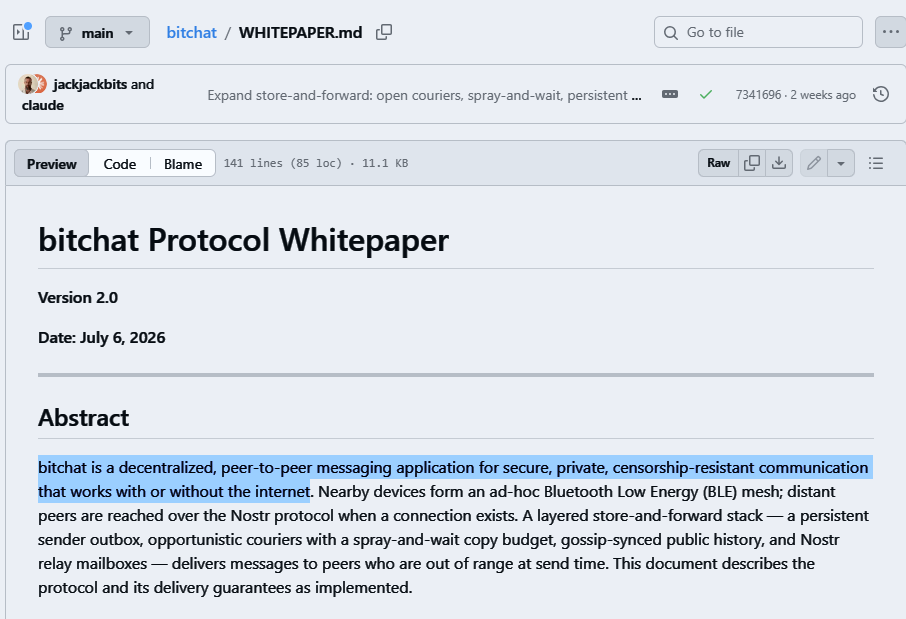
Source: GitHub/ @JackJackBits (Jack Dorsey)
For years, the backers of internet privacy have argued that traditional popular platforms do not come-in handy in times of crisis.
Apps powered by network connectivity, afterall, are still largely dependant on apt weather conditions, maintained connectivity hardware, government discretion, and app-owners’ control.
Open source decentralized apps (dApps), however, address these issues. Neither are they entirely reliant on mobile networks nor controlled by a government or corporate entity.
India’s Internet Freedom Foundation (IFF) has also acknowledged the usability of apps like Bitchat in the face of government-enforced internet and network blackouts — cutting comminication.
For now, the timeline of the ongoing student protests in Delhi and other parts of India remains indefinite. The NEET paper leak is up for discussions in the ongoing monsoon session of the Parliament. Whether Pradhan will tender his resignation from the post of the education minister or not remains unclear as of now.
The protestors are also demanding a compensation of INR 10 million for each deceased students and the hospital discharge of famed Indian scientist Sonam Wangchuk who was forcibly admitted amid his ongoing hunger strike that entered its 24th day on Wednesday.
Meanwhile, Internet and mobile networks remain choppy around Jantar Mantar, protestors confirmed to The Coin Headlines on Wednesday.
Bridgefy – Offline Messages and Briar are other apps working as platforms allowing people to connect without internet connections and mobile networks in Delhi.