

Ethereum’s price continues to go with the trend of lower highs and has carried it from the May peak. Active addresses of the asset, according to CryptoQuant data, are not depicting a similar trend.
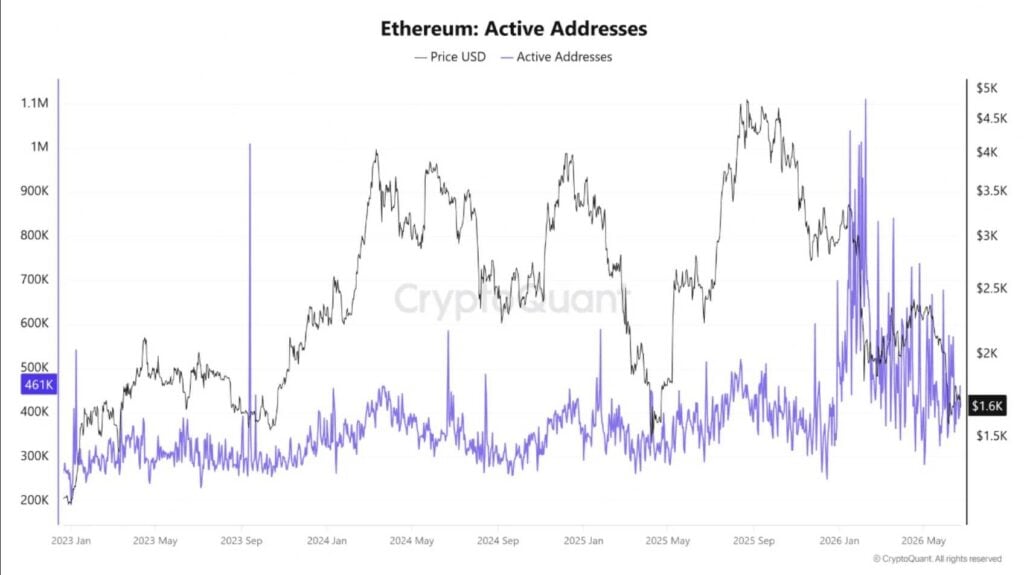
Since the start of 2026, the respective metric has consistently jumped into the 800,000 to 1 million range and this is a zone that the network rarely touched, particularly during the 2024 and 2025 price highs. This period was the time when ETH changed hands at approximately twice that level.
The current price action is likewise fading slowly back below the resistance that capped the last one, even though the closing is still pending at the moment. The consequent gap that exists between a chart constantly looking for a bottom and a network that rarely slowed down is the actual thing that needs to be addressed.
Liquidations: What is missing at the moment?
Some portion of these addresses are not here by choice. The drop that took place back from the May high through $1,527.81 wasn’t steady, but in fact it broke the prior $1,900 support zone as well as kept going. The speed of those moves forces action on the platforms like Aave and MakerDAO. Those with loans don’t get to hold off on this one. They post collateral, repay debt, or get liquidated on-chain, and every one of the aforementioned actions is counted as an active address.
This behavior can be called more of a conviction thing. It inflates the headline number without meaning new demand showed up. Anyone interpreting “active addresses near cycle highs” as bullish is failing to recognize the fact that a significant portion of this activity is risk management.
If we remove the liquidation noise, the market participants are then left with a second trend-wallets withdrawing ETH to self-custody. A correction from the highs around $2,480 to a local low around $1,527 and a trading action stalling near $1,660 is just the particular kind of dips that inevitably draw in market participants who were previously unable to take exposure. CEX-to-self-custody outflows compared with emergency deposits are distinctive in that outflows are often unidirectional and flow without returning in the time when price bounces and conversely, the market participants commonly tend to rush to exchanges in advance of the market fear retreating on news.
Increased active addresses during the drop prior to price hitting a bottom, which typically occurs in reverse order during capitulation events. This trend depicts traders increasing on-chain exposure. This type of sequencing and accumulation signifies that an aspect of the elevated activity in the context of addresses transacted in advance to the reclaim of an extremely significant price point at $1,736 shows a strategy-based accumulation.
A base is being formed from staking
There’s a third reason addresses stay active and that has nothing to do with this drawdown specifically. In 2021 and 2022, a like-sized drawdown usually was associated with a parallel drop in on-chain engagement whereby users simply opted out for L2s or other chains entirely. This cycle, yield-bearing positions serve as a reason to stay connected to the mainnet even in the case when the asset itself is unprofitable on paper. The L2 migration didn’t destroy mainnet activity; it simply impacted what exactly kind of activity stays here: settlement, staking, restaking, and liquidation management. It is more of an infrastructure utilization and less of trading stuff.
What the chart reveals about timing
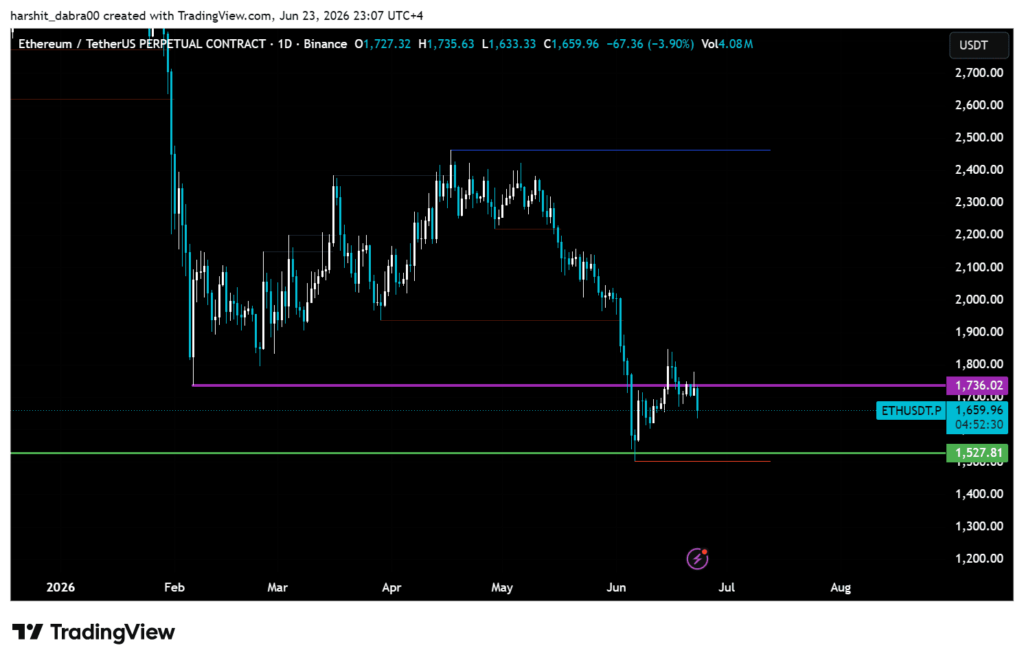
The price of ethereum attempted to recapture the $1,736 zone and has been fading from it intraday, with the candle still open and the low so far positioned at $1,633.33, slightly below the preceding $1,527.81 floor that is still in range if the fade continues.
That violet line that is marked in the above chart at $1,736 is the same level that already rejected the price once on the way down; therefore, a failed retest here will not be a surprise element. It is the level of carrying out what it already does. In conjunction with the network data, the depiction is a market during which short-term traders are frequently turned away at a defined resistance line even though long-horizon wallets tend to be already shifting their positions underneath them. The aforementioned two timeframes do not seem to agree and at this time they are not doing so.