

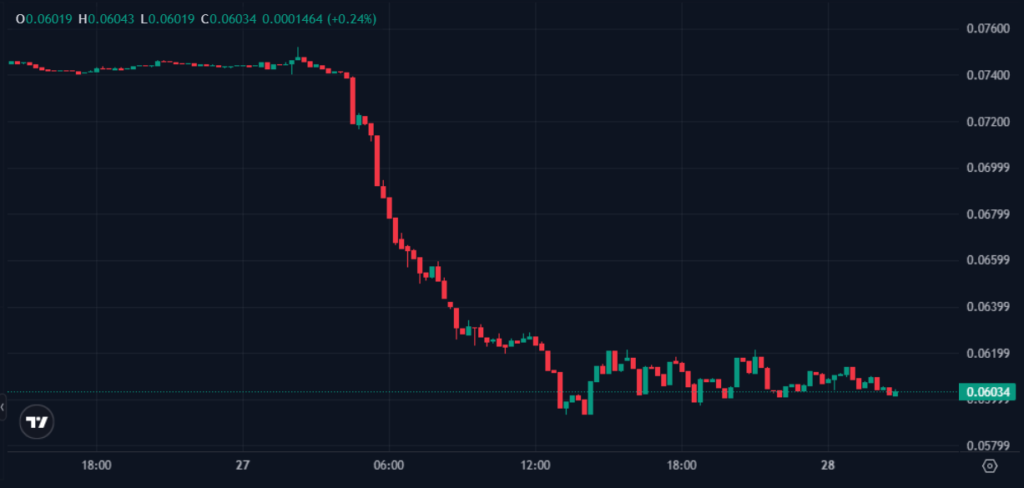
Storj Labs filed for Chapter 11 bankruptcy in West Virginia to address legacy liabilities while keeping operations and customer service running normally. The company proposed a plan to allow token holders to participate in the equity of the restructured business, an unusual provision where token holders typically receive nothing in bankruptcy. STORJ fell 19 percent to about $0.06, with nearly $28 million in volume at the time of writing.
The restructuring plan
Storj described the filing as a “decisive, positive step” to resolve legacy obligations from an earlier period while preserving its core business. To this point, the company said it is disposing of previous acquisitions and non-essential operations, focusing on its original decentralized cloud storage proposition.
Kaloyan Raev, Storj’s Director of Software Engineering, said through an official notice, “the business underneath is strong and right-sized. What holds it back are legacy obligations from an earlier chapter.” Parent company Inveniam, which acquired Storj last year, continues to support the reorganization and endorses the path forward.
The token holder equity proposal
Storj’s restructuring proposal includes a provision rarely seen in bankruptcy: token holders may be able to participate in the equity of the reorganized company. Token holders normally have no legal claim on an issuer and receive nothing in a Chapter 11 process, and that’s something meaningful at this stage.
Storj said it will develop the design, including eligibility, mechanics, and terms, during the process and disclose it formally. The company cautioned that a plan must be approved through the court process, saying it is “promising you a seat at the table and a genuine intention, not an outcome.”
A week of crypto reckoning
Storj’s filing caps one of the most concentrated periods of industry retrenchment in recent memory. In July 2026 alone, four recognizable crypto firms either entered bankruptcy or announced closures:
- AscendEX had already ceased operations on July 1, citing Markets in Crypto-Assets (MiCA) regulatory pressure.
- Movement Labs filed for Chapter 11 on July 15 after a scandal over a market-making agreement that gave an obscure entity control of 66 million MOVE tokens (about 5 percent of supply), which were rapidly dumped after launch. The company listed assets between $100,000 and $500,000 against liabilities of up to $10 million. Ousted co-founder Rushi Manche, who retains 34.25 percent equity, holds the largest unsecured claim at over $1.6 million for legal fees tied to a Department of Justice (DOJ) investigation.
- BitMEX, the pioneer of perpetual swaps, announced it would shut down permanently on September 23 after an unsuccessful sale process. Daily volume had collapsed to roughly $400,000, and its BMEX token fell more than 90 percent. Parent company HDR Global Trading said assets exceeded liabilities; this was a strategic exit, not insolvency.
- BitMart began winding down operations on July 26, halting deposits and new trading immediately. The exchange’s global CEO reportedly learned of the decision publicly after being terminated.
Some analysts view these closures as a healthy market reset, a potential sign of cycle bottom.