

Tokenized RWA had its best-growing month ever in May and now its first real test. May 2026 closed out at ~$10.2 billion spanning across tokenized treasuries, private credit, and equity. At this point in June, that figure is standing at ~$9.7 billion and no one is paying much attention to this.
And that is where it is appropriate to take a pause. 18 months of growth and with that growth picking up sharply in Sep 2025, the corresponding first contraction this cycle from monthly figures does not turn out as a crash. This turns out to be a typical negative 3 to negative 5 percent decline, somewhat spread out across different issuer types, resulting in one category contributing to the funds, whereas the other two major ones are still on the active bleed mode.
BlackRock’s BUIDL has lost the most
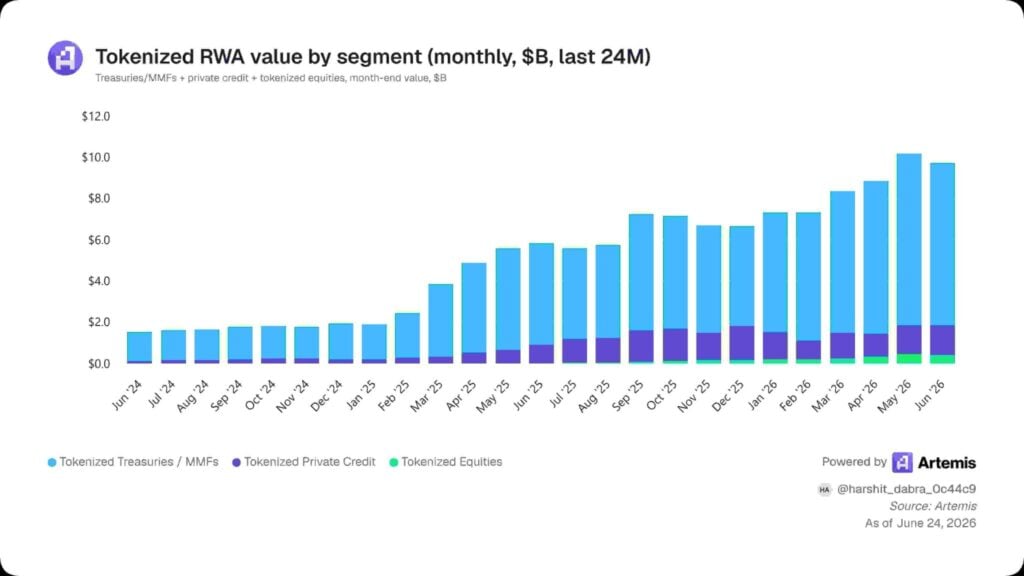
It makes sense to commence with the contradiction and this is so because it is the biggest alarm bell ringing in this chart that is provided above.
The BlackRock BUIDL Fund’s all-time high has topped out around mid-2025 and is now sitting around $2.9B. At the time of writing, it has now dipped to around $2.19B. This value indicates about an 11 percent decline over the previous 30 days and roughly represents a 23 percent drop over the previous year. The biggest, most credible, tokenized treasury solution on the market is now considerably smaller in size compared to what it was at the same time last year. In contrast, the aggregate value in the space has seen a growth and the figure stands at 68 percent relative to the exact same time period.
The resulting difference needs to be addressed here. BUIDL no longer holds that power to shape the RWA narrative. It’s a drag on it. No matter what growth thesis participants are pricing into “tokenized treasuries as a category,” it is not BlackRock’s product itself carrying out the pricing.
The one product that was the strongest
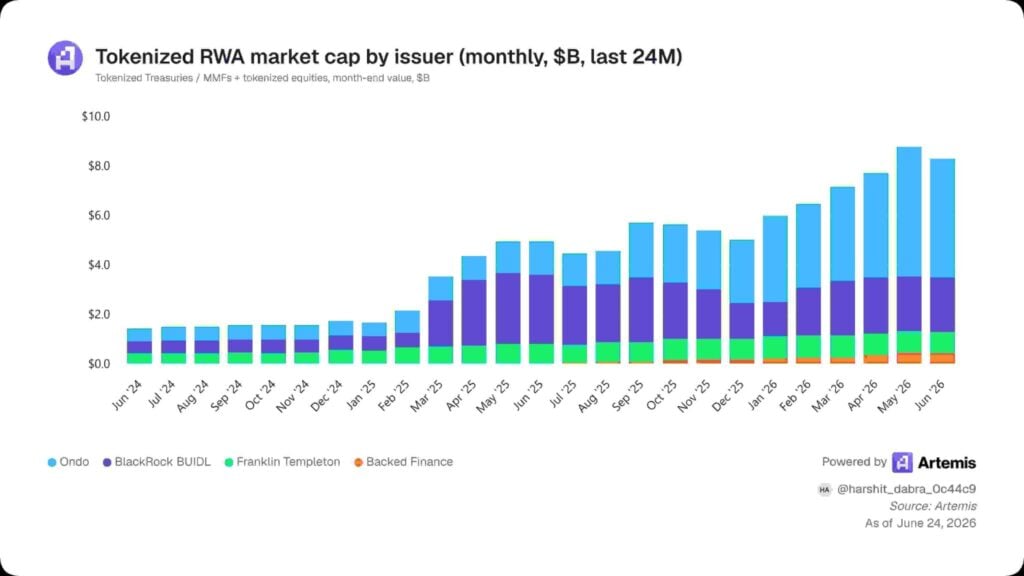
Ondo has seen the growth from $1.33 billion to $4.8 billion in the time period of just 1 year (+260 percent) and accounts for nearly half of the total RWA value that is tracked across each of these four assets-over double that of BUIDL.
A year ago both of these had been similar in size and now Ondo is representing essentially the category, despite BUIDL quietly falling in value. “Tokenized treasuries” is not defined as a single trade here: Ondo has quadrupled, BUIDL has been down, and Franklin Templeton’s BENJI has been hovering in place around $867 million all throughout.
Private credit continued to show strength this month
Additionally, treasuries have been softening, whereas Maple’s book of loans has added close to $172 million in thirty days, and this is highlighting a 13-14 percent increase to $1.45 billion on top of $4 billion in deposits (the biggest percentage is pointing to growth in the data) in precisely the same three-week window that BUIDL saw a bleed of $279 million. This cannot be termed a capital exit of the data in the form of the bond. This occurrence is a typical allocation shift that is taking place within the portfolio whereby a segment that is known for private debt takes in some of what Treasuries shed.
Treasuries were delivering an average of a little less than 5 percent and this is a yield that’s lower compared to what typically has been the case over the past couple years.
An investor who is rotating into that would almost surely not be trying to chase returns. It makes it absolutely difficult to justify unless some allocators had reason to think that the risk to a treasury is now standing greater relative to credit.
June’s dip is indicating something that can’t be ignored
$9.7 billion aggregate with a growth of 68 percent YoY appears to be a clean uptrend but that is not the case. Ondo pretty much quadrupled, and relative to that, BUIDL had lost a quarter of its value, BENJI went nowhere, and Maple had seen some acceleration.
June’s dip doesn’t indicate that treasuries have fallen out of favor. It took place simply because BlackRock’s BUIDL declined more rapidly than Ondo grew that month; on the other side, Maple’s credit growth made up some of the difference. The question of whether the dip turns towards a longer trend or BUIDL is just settling back down, followed by an exceptionally robust 2025 is one that the market participants will get to know only after watching the upcoming two or three months.