



Chainlink has lost its bullish shape after it slipped below the $9.3 support level. However, when the broader price action is put into context, it could be seen that Chainlink’s market cap has been on an uptrend for a few years.
Chainlink loses major support at $9.30
Chainlink has lost one of its major support levels, $9.30, after nearly three months. Since February, the token has been able to hold this uptrend shape of making higher lows and higher highs, which shows that the bulls were dominant. However, this pattern was dismantled when the bears pushed the prices below $9.30.
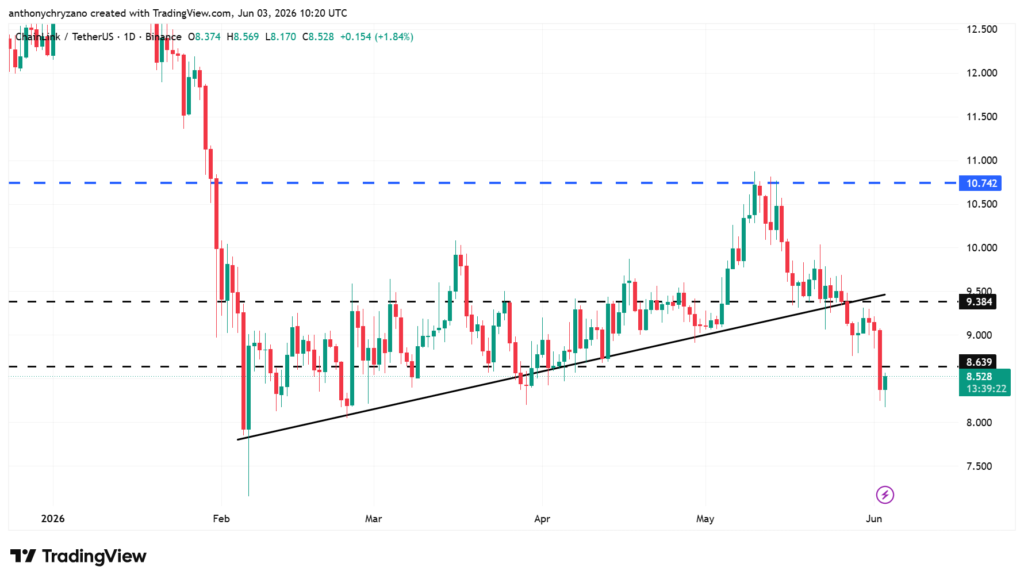
Chainlink’s bullish pattern was discontinued when a huge sell-off took place with the token hitting a psychological resistance level at $10. Psychological resistance levels are typically round numbers that attract significant attention from market participants. As prices approach these levels, many investors choose to take profits, while others place sell orders in anticipation of a potential reversal.
A massive sell-off at $10 drags LINK below $8
In LINK’s case, the approach toward $10 triggered a wave of selling activity that overwhelmed buying demand. This prevented the token from maintaining its upward momentum and ultimately invalidated the bullish structure that had been developing on the chart. When a bullish pattern fails to break through a key resistance level, traders often become more cautious, as it suggests buyers may not yet have enough strength to sustain a continued rally.
LINK market cap still hold its ascending pattern
Despite Chainlink losing its local support level, some crypto netizens still believe in the token and remain optimistic about it. For instance, an analyst who goes by the pseudonym Vuori observed that LINK’s market cap had been holding its bullish shape (ascending channel) for a few years now.
With the current market cap at $6.2 billion, Vuori expects it to hit $80 billion based on the setup of the uptrend channel.
An ascending channel is a bullish chart pattern characterized by a series of higher highs and higher lows bounded by two upward-sloping parallel trendlines. The lower boundary acts as a support zone where buyers typically step in, while the upper boundary serves as a resistance area where profit-taking often occurs. As long as the asset remains within the channel, traders generally interpret the broader trend as bullish, even if short-term corrections occur along the way.
According to Vuori, LINK’s recent weakness has done little to damage this larger structure. While the token may have lost a local support level on the price chart, its market cap continues to respect the long-term ascending channel that has guided its growth over multiple market cycles.
This suggests that the recent decline could be a temporary pullback within a broader uptrend rather than the start of a prolonged bearish phase. As a result, many bullish investors remain focused on the channel’s long-term trajectory rather than short-term price fluctuations.