

Kalshi is stepping up its game against insider trading with some new tools, like verifying where people work before they trade and launching better whistleblower services. These updates are rolling out right now because an advisory committee pushed for more safety. It follows a big scandal where a Google employee allegedly made a million bucks using insider information on rival platform Polymarket.
Kalshi’s three-pronged response
Kalshi’s taking a serious stance against potential trouble. The regulated prediction market just launched three new tools to keep things above board:
- First, a risk-scoring system evaluates every market across six dimensions, including national security concerns and regulatory acceptability. If a market’s score crosses a certain threshold, traders must complete employment verification before placing any trade.
- Second, they’ve beefed up their whistleblower features. Now, there are “internal alerting controls” that make it easy to report sketchy trading behavior straight to their surveillance team.
- Third, the platform will use these tools to screen traders pre-trade, not after the fact.
Robert DeNault, Kalshi’s Head of Enforcement, said the platform has already stopped over 100 potential insider trading incidents in Q1 using its new screening tools. “By implementing these new integrity measures, we continue to lead the industry on the issue of market integrity amongst federally regulated prediction markets,” he said.
Why is Kalshi rolling out this new rule now?
This all started because of a massive fraud case in May 2026. A Google staffer got caught using private info about earnings and new products to pocket over a million bucks on Polymarket. The case totally freaked out the prediction market world. Everyone started asking: if these sites can’t stop people from cheating like that, why should they even be allowed to run?
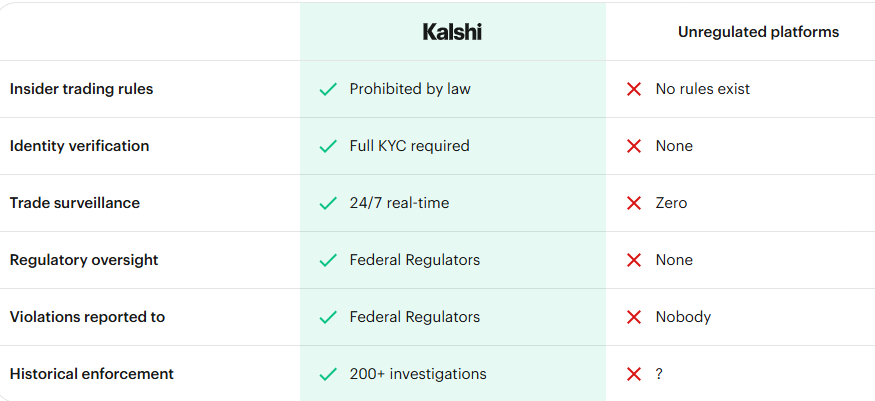
Kalshi, which is Commodity Futures Trading Commission (CFTC)-regulated, moved faster than its rivals. The company convened its advisory committee, which called for “stronger measures to clamp down on possible insider trading.” The result is a compliance-first approach that could become the industry standard.
In contrast to Polymarket (which is not regulated by the CFTC), Kalshi has a federal regulator looking over its shoulder… and that’s a big deal. Employment verification and whistleblower rewards are standard in traditional finance. With these improvements, Kalshi is just importing TradFi playbooks into prediction markets.
Deeper implications for users
For casual Kalshi users trading on “Will it rain tomorrow?”, nothing changes. Employment verification only triggers for markets with high risk scores, such as those involving corporate earnings, government policy decisions, or mergers and acquisitions.
For sophisticated traders who rely on non-public information, the new rules are a direct threat. For instance, you can no longer anonymously bet on your own company’s earnings report. If so, Kalshi will ask where you work. If you lie, and later a whistleblower tips off the surveillance team, you face not just account termination but potential referral to federal prosecutors.
The whistleblower feature is particularly significant: Kalshi built it to accept tips 24/7, and the platform has a commercial relationship with CNBC (which broke the story), ensuring that credible tips could become news quickly. The message is quite clear: trade clean, or trade elsewhere.
So, how is insider trading affecting the prediction market sector? Let’s say that, to this point, they need to look more like traditional exchanges and less like anonymous gambling parlors. In the end, regulators will likely favor Kalshi’s approach. Thus, if prediction markets want to survive and scale, they need to put things on the table, especially into regulated categories like event contracts on corporate earnings
Prediction markets are booming. Kalshi, Polymarket, and newer entrants have seen billions in volume on everything from election outcomes to AI benchmarks. But, as regularly happens, that growth attracted bad actors, and that needs to be avoided at all costs. Recently, even the U.S. Senate banned itself from prediction markets after insider betting scandals, so why not follow this path?