

Stablecoin issuer Circle reported a drop in net income for the first quarter of 2026 in its financial report released on Monday. However, investor attention has shifted to the firm’s capital raise and overall revenue trajectory.
The company’s total income for the first quarter of the year came in at $55 million, a 15 percent drop from the same time last year. The New York headquartered firm’s income attributable was largely hurt by “higher stock-based compensation and continued investment into product, distribution, and operating infrastructure.”
The slump resulted in the shares of the firm falling over 1 percent after the morning bell. The shares soon picked pace again to trade slightly up, marking a rather volatile trading session.
The fall in stock price came after the firm saw a rise of over 5 percent during pre market trading, indicating that shareholders saw beyond the profit slump and towards better positive cues initially.
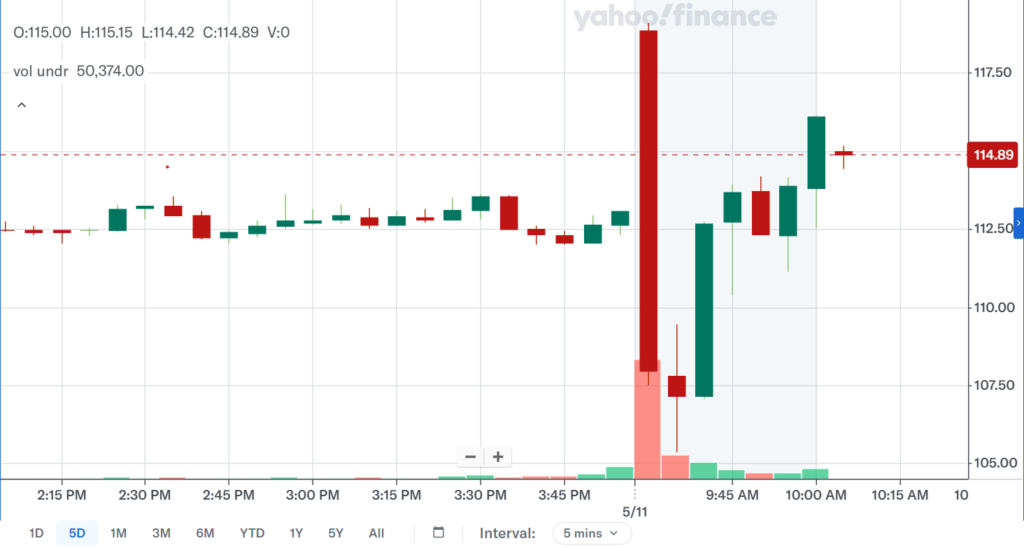
At present, investor attention has been fragmented towards the firm’s 20 percent revenue growth and a fresh capital raise from industry giants, but the fall in share price highlights a rather different story. Shareholders have quickly seen through the clouds of constructive add ons and towards the main reality
Circle’s results follow its public listing push wherein the firm sought to list on the New York Stock Exchange under the CRCL symbol. The initial share price range was set at $24 to $26.
This also comes in line with the recent increase in the stablecoin market, with significant regulations such as GENIUS ACT and CLARITY ACT coming into play. The stablecoin market has grown immensely with a total market capitalization increasing to more than $300 billion in early 2026, up from about $120 billion 18 months ago, according to Chainlysis.
Circle raises $222 million
Circle Internet Group has also raised $222 million via presale of tokens associated with their next-generation Arc blockchain. The fresh capital raise has made the valuation of the new network reach $3 billion.
Andreessen Horowitz served as lead investor in the latest round, alongside other well-known financial institutions such as BlackRock, Apollo Global Management, and Intercontinental Exchange. A total of some dozen prominent financial firms became involved in the presale, indicating increasing institutional appetite for blockchain-related projects linked to existing cryptocurrencies.
Commenting on this news during his recent interview with CNBC, Jeremy Allaire noted that the company’s aspirations have significantly expanded over the years and no longer revolve solely around stablecoins and payments.
“We are getting into the business of operating systems,” explained Allaire, referring to their Arc as a multi-stakeholder, tokenized network. The company also intends to venture into the applications market in its efforts to further diversify its strategic vision going forward.
Circle sees 20 percent rise in revenue
Circle reported higher activities related to the growth of its USDC stablecoin on Monday, alongside continued growth in its expansion into the digital asset market. The firm’s results for the first quarter of 2026 showed that it earned $694 million in revenue and reserve income, reflecting a 20 percent increase compared with the same quarter last year.
Moreover, according to Circle, by the end of the quarter, the number of active USDC was $77 billion, showing an increase of 28 percent from last year.
The firm’s activity in on-chain transactions grew significantly, with a total on-chain transaction volume of $21.5 trillion in USDC during Q1, which is 263 percent higher than the previous year.
In addition to payments services, Circle is also currently focusing on expanding its AI technology to facilitate digital payments. It has launched several services and software like Circle CLI, Agent Wallets, and Agent Marketplace, through which developers and AI applications can use and make USDC transactions via multiple blockchains.
Commenting on the results, Circle CEO Jeremy Allaire said that their ultimate aim is to create trusted infrastructure for “AI-native economic activity.” However, actual adoption will be subjected to how developers and institutions utilize the solutions.