

The calls in Washington for stricter export controls could soon intensify after a recent report by the Financial Times said Pentagon-blacklisted Chinese companies still had access to Google, OpenAI services via subsidiaries based in Singapore. The report has arrived amid amid intensifying U.S.-China friction concerning AI development and technology sharing.
The FT reported that Google and OpenAI have supplied advanced AI services to the subsidiaries of Alibaba, Baidu, and Tencent to their Singapore units. These companies are part of Pentagon’s 1260H list, that keeps track of businesses with alleged links to the Chinese military.
Understanding the tensions
Nations around the world are currently racing to establish themselves as early creators, adopters, and regulators of the AI technology. As AI makes rapid inroads into the corporate, financial, and social ecosystems — world governments are pushing to keep home-bound technolgies from reaching the hands of rival nations.
Now, the U.S. and China are not new to tech and trade wars. At present, the U.S. export controls already hold a tight noose on physical AI hardware getting into China’s possession — an issue that China has vouched retaliation threatening to add the U.S. to its its own “Malicious Entity List” — harming America’s tech access as well.
The FT report, however, brought to light a critical regulatory gap on the U.S.’ end that is leaking the American AI technology to Chinese players.
Since no dedicated legislation in the U.S. imposes a ban on Chinese companies access remote cloude services — especially outside mainland China — Google and OpenAI letting Singapore-based units of Chinese companies access their technologies are deemed technically legal.
While Google has reportedly confirmed that its AI products are available in Singapore and Hong Kong, OpenAI recently suspended API access for Alibaba-linked users after identifying that its AI tech was being illegally used to train third-party models.
In the coming weeks, the calls to fast-track the bipartisan Remote Access Security Act could grow louder in the U.S. This bill aims to categorize remote cloud and API access as technologies eligible for export. This could allow the U.S. to permanently ban blacklisted foreign companies from getting hands on American software technologies.
The bill, that amends the Export Control Reform Act, was passed by the House of Representatives in January 2026.
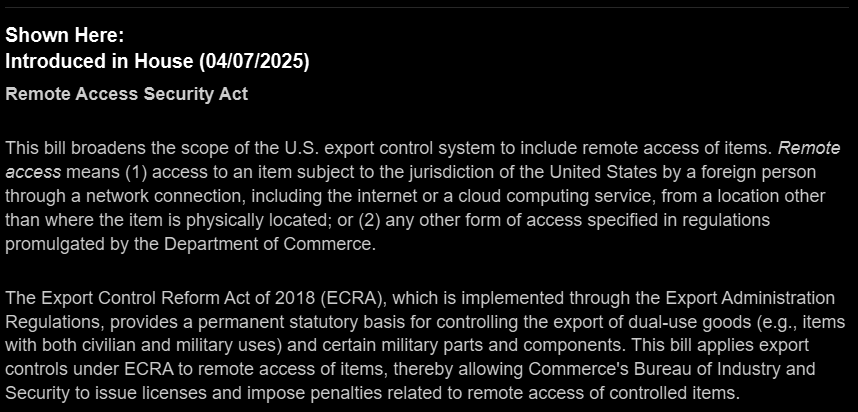
Source: Congress.gov
U.S.-China tech war
The U.S., since 2024, has tightened export controls on advanced hardware like Nvidia’s Blackwell-class chips to China. The Trump administration wishes to ensure that the U.S. maintains dominance in AI development — especially when China lacks the hardware to compete in the arena.
The U.S. is presently reviewing the MATCH Act, which once passed would become the legislative “chokepoint” strategy blocking China’s access to the essential machinery required to manufacture advanced AI chips.
China has expressed concerns on the MATCH Act calling it a systemic block to accessing advanced tech on a global level.
The topic was highlighted during President Trump’s Beijing meet with Chinese President Xi Jinping. At the time, the U.S. has said it could consider letting China tap older AI hardware — which did not make situations any better.
As U.S. and China navigate their broader tech-sharing equation, companies from both the nations are trying to keep pace with the ever-shifting red lines.
In a recent incident, Anthropic’s Claude Code AI assistant has been blacklisted by China’s Alibaba Group for use by its staff over data security concerns. Officially, Anthropic does not operate its AI services in China. On June 25, Anthropic accused Alibaba of illegally using Claude’s AI capabilities accusing Chinese engineers of accessing Claude via VPNs.
Following the development, China-based financial publication Yicai claimed that Alibaba had identified backdoor risks within Claude Code — leading it to ban access to it by its staff members.