

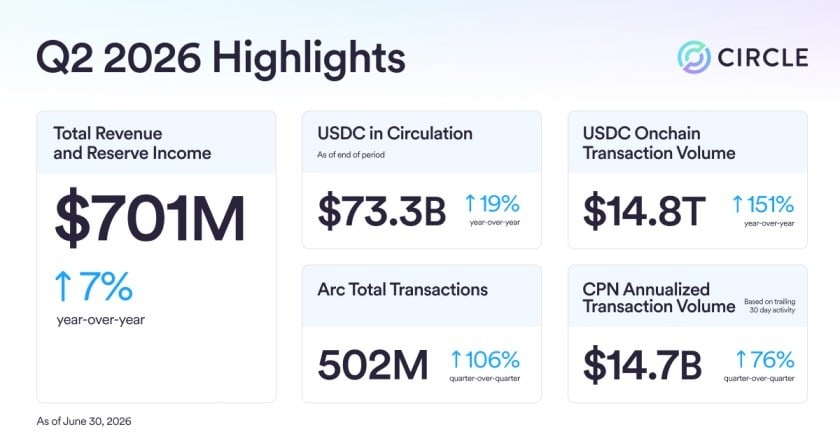
Circle reported Q2 revenue of $701 million and adjusted Earnings Before Interest, Taxes, Depreciation, and Amortization (EBITDA) of $143 million, with USDC onchain transaction volume up 151 percent year-over-year (YoY).
At the same time, Circle announced the founding validator cohort for Arc, its upcoming Layer-1 (L1) blockchain, ahead of the September 16 mainnet launch. The validator set includes BlackRock, Visa, Mastercard, Depository Trust & Clearing Corporation (DTCC), Galaxy, Standard Chartered, and MoneyGram.
BlackRock is expected to deploy its BlackRock USD Institutional Digital Liquidity Fund (BUIDL) tokenized fund on Arc, while DTCC will enable tokenization of Depository Trust Company (DTC)-custodied assets.
Arc’s institutional validator model
Arc’s validator model represents a new approach to blockchain infrastructure where the institutions that depend on network integrity are also the ones that secure it. Alongside Circle, the founding validator cohort includes BlackRock, DTCC, Galaxy, Global Payments, Intercontinental Exchange (ICE), Mastercard, MoneyGram, SBI Group, Standard Chartered, Sumitomo Corporation, and Visa.
BlackRock is planning to launch BUIDL on Arc, and DTCC is going to handle the tokenization of DTC-custodied assets.
Other financial institutions building on Arc include Bank of New York (BNY) and Standard Chartered, spanning tokenized asset settlement, digital asset custody, stablecoin access, and foreign exchange (FX) and repurchase agreement (repo) infrastructure.
The network is launching with more than 100 ecosystems and institutional builders on board. It’ll offer privacy tools, a stack for programmable finance agents, and support for tokenized real-world assets (RWAs).
Circle Q2 financial performance
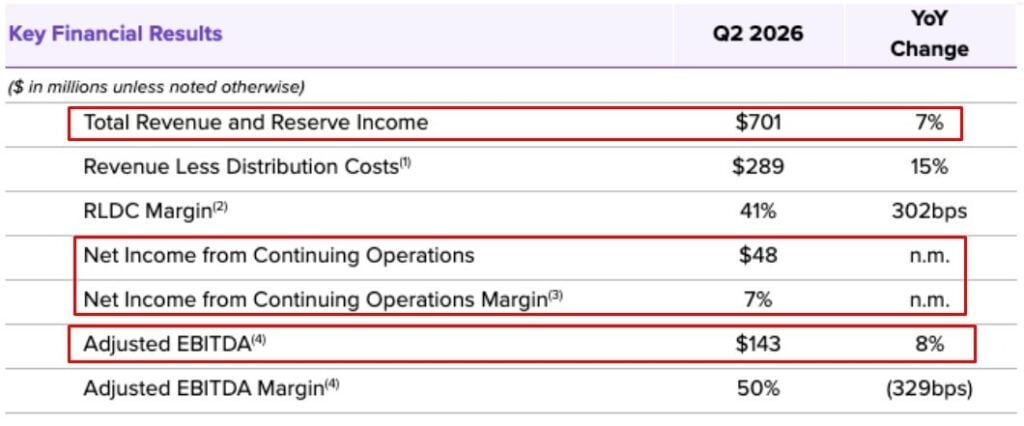
Circle reported Q2 2026 total revenue and reserve income of $701 million, up 7 percent year-over-year. Net income from continuing operations was $48 million, compared to a loss of $482 million in Q2 2025. Adjusted EBITDA was $143 million, up 8 percent.
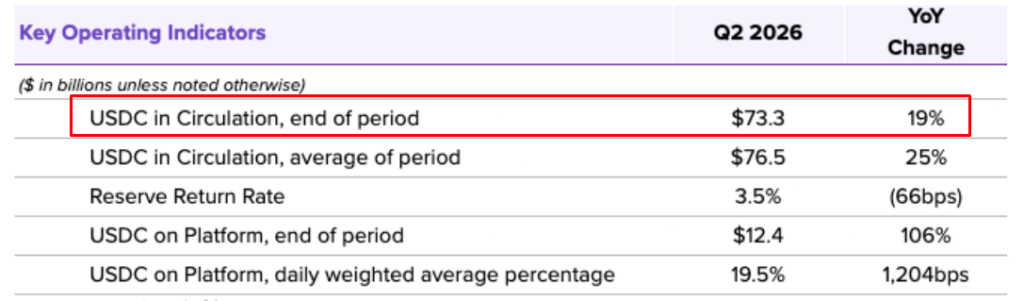
On its star product side, USDC in circulation was $73.3 billion at quarter end, up 19 percent year-over-year. USDC onchain transaction volume in Q2 reached $14.8 trillion, up 151 percent year-over-year.
Circle’s Q2 numbers make it clear they are finding a real groove. Now that the firm has locked in a federal trust charter and filled Arc’s validator list with big names, it’s basically setting itself up to be the regulated core of the whole tokenized world. CEO Jeremy Allaire says, “We have built the platform for the internet financial system.” Now we just have to wait and see if Arc actually lives up to the hype.
Circle’s federal trust charter and agentic economy push
Beyond Arc, Circle also received final approval from the Office of the Comptroller of the Currency (OCC) to establish a national trust bank, Circle National Trust, making it one of the first stablecoin issuers to hold a federal bank charter. Nevertheless, back in July, Circle got New York’s trust charter approval, strengthening its commitment to the highest standards.
These authorizations enable federally regulated digital asset custody and future capabilities, including management of the USDC Reserve, which would further enhance the safety, transparency, and trust of USDC.
On the product front, Circle’s Agent Stack (launched in May) now hosts over 900 paid services, with 99.3 percent of x402 agent-payment volume settling in USDC.
The company plans to expand its agentic product roadmap in H2 to include enabling agents to earn, positioning Circle at the center of the agentic economy.
Meanwhile, the Circle Payments Network (CPN) is really picking up steam, hitting $14.7 billion in annualized transaction volume by the end of Q2; a 76 percent jump from the previous quarter. They have also got 175 financial institutions on board, which is a 29 percent increase.
Circle’s other revenue guidance was raised to $310-$330 million for Fiscal Year 2026 (FY2026), largely driven by recognized ARC Token presale revenue.