

The Monetary Authority of Singapore (MAS) has placed the ByBit exchange on its Investor Alert List this week. Essentially, this list acts as a warning to inform the public about crypto firms that do not carry the necessary licenses and regulatory approvals in the country.
As per MAS’ official website, the ByBit Fintech Limited was added to the list on Wednesday. The exchange’s main website has been mentioned on the index.
As explained by the authority, the Investor Alert List flags companies and investment offers that may be wrongly perceived as being licensed, authorized, or registered by the MAS, or those falsely associated with documents officially lodged with the regulator.
While the list does not imply that ByBit has been banned in Sinagpore, it does alert the users to double check their exposure to the exchange and review their custodial decisions.
“This list is not exhaustive and is based on what was known to MAS at the time of publication,” the website said, showing a log of 910 entities.
The exchange, counted among the top five exchanges in the world alongside Binance and OKX, controls total assets worth $14.2 billion according to DeFiLlama.
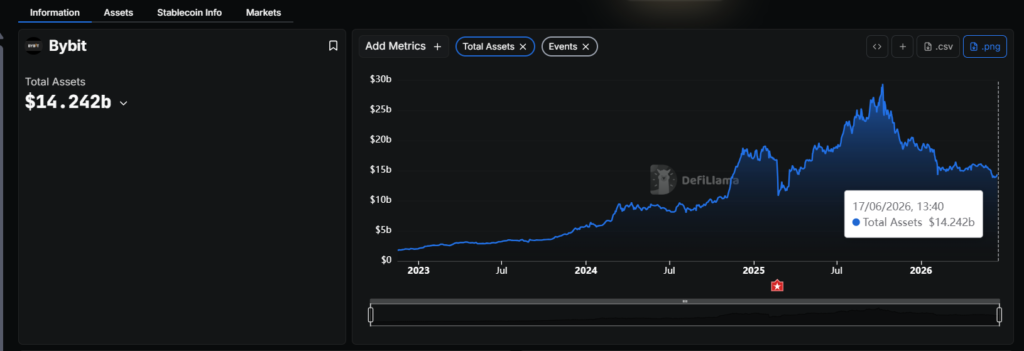
Source: DefiLlama
It has a rather deep routed connection with Sinagpore. It was launched in March 2018 by Singapore-based entrepreneur Ben Zhou. ByBit, for the first few years after launch, operated its headquarters from Singapore itself. However, the exchange moved its global headquarters to Dubai in 2022.
As of press time, ByBit had not addressed its addition to Singapore’s Investor Alert List.
Singapore, meanwhile, has been refining its policies around banking exposure, token classification, and market oversight to better encapsulate digital assets into its existing financial ecosystems.
The Payment Services Act, that came into effect in January 2020, acts as Singapore’s primary law for regulating crypto platforms. The act legally classifies cryptocurrencies as Digital Payment Tokens (DPTs) and mandates that any platform offering trading, exchange, or custody services must secure an official license, typically as a Major Payment Institution.
Crypto platforms lincesed in Singapore have to comply with Singapore’s Anti-Money Laundering (AML) and Know Your Customer (KYC) rules as well.