

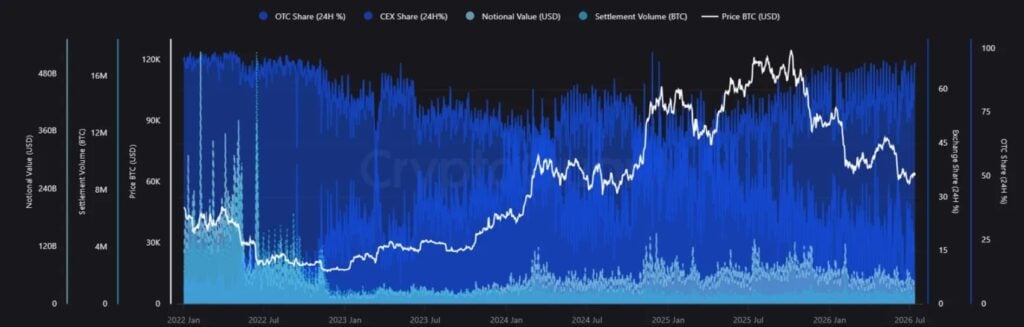
As U.S. and Iran tensions weigh on the risk assets, Bitcoin falls 2.89 percent in 24 hours, changing hands at $62,320. At first sight, the market has turned bearish on risk but the on-chain story may reveal otherwise. Over 91.64 percent of Bitcoin trading volume, at $30.72B, traded over the over-the-counter (OTC) market and not on exchanges.
Following the same point, the wallets that maintain the balance of more than 10,000 BTC have added over 10,050 BTC since the past month. But many retail investors reacted with panic and sold following the recent decline. Large buyers quietly took a large amount of Bitcoin away from public order books.
On-chain data is depicting the retails stress
According to on-chain metrics, a lot of recent bitcoin buyers appear to be struggling. Bitcoin’s MVRV-STH value currently reads 0.8977, which suggests short-term investors, considering the average, are in a net unrealized loss.
The SOPR ratio also sits at 0.99, depicting many coins being transacted are sold mostly at a loss or for a breakeven state. These mentioned metrics are indicating that the retail is not standing strong to carry the volatility and it looks like the market investors are selling the coins to cap their losses and avoiding holding them.
If we look at the bigger scenario, nearly 47.09 percent of the supply is at present being traded at a discount to the buy price. Additionally, stablecoin flows indicate more are going into USDT, and this is a sign that at least some investors are moving into cash. All of this is not an occurrence of a panic sell, but it is more that the retail continues to be under pressure.
Most of the Bitcoin trading is being controlled by OTC desks
In the last 24 hours, a whopping 91.64 percent of all Bitcoin settlement volume went through over-the-counter (OTC) desks, rather than that of public exchanges. OTC desk trades enable institutional investors with buy and sell orders larger than typical orders on exchanges’ order books. This mechanism allows larger transactions to take place without generating volatile prices on public exchanges. In essence, most of Bitcoin’s day trades took place outside the scope of public exchange activity, such as by retail traders.
This same pattern is seen over a larger time frame. In the last 30 days, wallet addresses with more than 10,000 BTC bought up more than 10,050 BTC, which is approximately $620 million in value at current prices. As Bitcoin has struggled under pressure, these large investors are taking the opportunity to increase exposure as opposed to dumping holdings. Many of these buys were executed via over-the-counter (OTC) transactions and this is what explains why the price action seen in exchanges has been deteriorating.
The exchange activity is dominated by the large players
Public exchange activity remains heavily concentrated among large players. The Exchange Whale Ratio stands at 99.53 percent, meaning almost all exchange inflows come from large wallets rather than smaller investors. Binance also accounts for 83.30 percent of tracked exchange activity, suggesting a small number of participants are driving most visible price moves. At the same time, the Coinbase Premium is -0.0967, showing Bitcoin is trading slightly cheaper on Coinbase than on other exchanges. This usually means US institutional buyers are not stepping in to buy the dip.
Taken together, the data is highlighting that retail investors are selling their assets at a loss on public exchanges but on the other hand, large investors continue to maintain their accumulation by the means of OTC markets. This metric does not prove coordinated buying, though it implies coins are moving from smaller holders to larger ones.
In the short term, Bitcoin could continue to be under pressure considering that OTC buying does not directly support prices on public exchanges. As long as the market bulls make their way to exchange order books, the market may remain likely to see swings regardless of large investors quietly going for accumulation.