



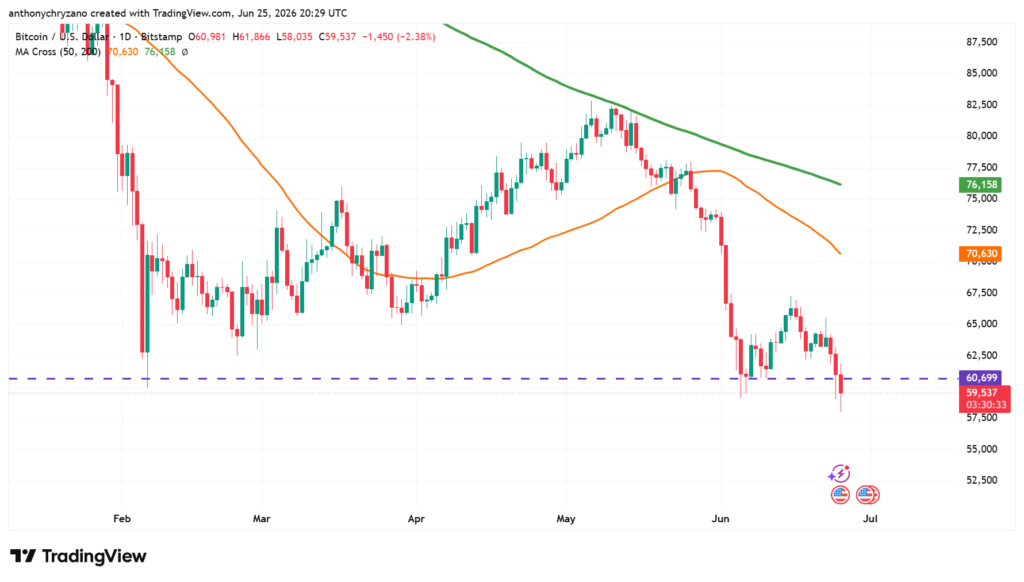
Bitcoin (BTC) broke below a psychological resistance level at $60,000, and the risk index signals that the flagship coin could be bottoming. However, an analyst argues that the coin has not even started to crash despite many in the market believing that BTC is bottoming.
Bitcoin loses $60K after being rejected at $80K
There is chaos and obscurity in the crypto market right now after Bitcoin lost a major support level at $60,000. The decline to this level began back in mid-May when BTC was rejected at the 200-day moving average ($80,000). Now that the price has slid below the $60,000 level, there are varying thoughts and ideas spreading across the market.
Risk index signals Bitcoin bottoming
According to Swissblock, a cryptocurrency analytics and market intelligence platform, the risk index, which measures the risk involved with BTC price, gives a high-risk signal. What this means is that when the indicator shows a high risk on its scale, Bitcoin usually moves sideways.
This indicator is useful during bear markets, as it shows when the BTC price destabilizes before crashing. When this destabilization happens, the risk index transitions from low risk to high risk, as shown above.
However, currently the indicator is high risk, and a transition from low risk to high risk is impossible. For Bitcoin to crash further, the risk must ease, allowing the market to absorb the selling pressure. Based on this phenomenon, Swissblock states that Bitcoin has reached its bottom.
Crowd thinks $58K is bottom, but BTC hasn’t even started falling yet
Contrasting this idea of BTC bottoming, another analyst who goes by the pseudonym Nonzee stated that Bitcoin has not even started to crash. Nonzee’s observation reveals that every single time the dollar strengthened, Bitcoin bled. As such, Nonzee believes the bottom for Bitcoin is $16,000, although the market thinks it bottoms out at $58,000.
Higher rate predictions make the dollar more appealing
So what is the reason for the dollar to spike all of a sudden?
“The pressure continues on metals as the US dollar climbs on prospects of higher interest rates in the US. Markets are pricing in one 25 bps rate hike, along with 42% odds of another rate hike by the end of the year. This has led the US Dollar Index to rise by about 1.82% over the past two weeks, adding headwinds for greenback-priced metals. A hawkish tone from the Fed makes bullion less attractive relative to yield-bearing assets like Treasuries.” Chief Investment Officer of Century Financial, Vijay Valecha,
In addition, Valecha stated that the US investment in AI and the energy it hold gives it the top hand in the market, which makes the dollar more appealing relative to energy-importing economies such as Europe and Asia. The fall in gold prices has also led major banks to cut price forecasts for gold in the last week, with Goldman Sachs now estimating bullion to end the year at $4,900.


