

Order book market structure is the foundation of most cryptocurrency trading on centralized exchanges. This includes a buyer and seller posting bids at a price point and a transaction occurs when they are matched up. AMMs operate on a completely different approach. There is no book and no counterparty that waits in the queue to trade the other way, and as a substitute, a smart contract works as a pool of two tokens where the market participants can interact with the pool to exchange currency, which is determined by an algorithmic process with no human involvement.
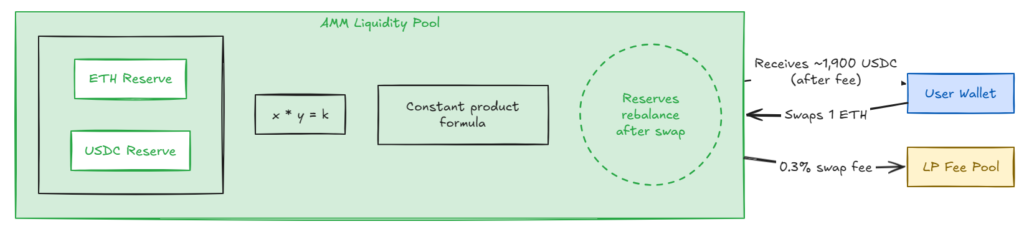
An AMM pool, for example, between ETH and USDC, stores both tokens at some ratio agreed to by the depositor. The user can deposit equal values of each token, become an LP, and trade into the pool as long as it can accommodate it. All of this can be done without finding an individual buyer or seller to fulfill the trade. Instead, individuals are trading with the smart contract in operation.
The feature carries importance because it is eliminating the dependency. For posting quotes around the clock, there is always a requirement for active participants for order books. There is no time constraint; the liquidity is available even at 3 am, whether the asset is being quoted actively or not.
The formula that drives the price
The most common design, which is being utilized by Uniswap v2 and many forks, operates with a constant product formula: x × y = k. In this case, x and y are the reserve amounts of the two tokens, and k is fixed.
Trade one token into the pool, and the formula comes into action, causing the other token’s reserve to shrink, which makes its price go up. Let’s consider an example: a pool holds 100 ETH and 200,000 USDC: k = 20,000,000. Purchase ETH with USDC, and the ETH reserve goes down but on the other hand, the USDC reserve increases, although their product still has to equal 20,000,000. The algorithm sets the new price. No oracle, no order book. This is pure algebra responding to whatever has been just traded.
Why the big trades impact more
Pool depth gives information regarding how much a trade shifts the price of the asset. A $10,000 swap in a pool that holds $50 million does not impact the ratio. But if that were the different case, the same $10,000 swap in a pool that holds $20,000 would move it to a good extent.
That price impact that has nothing to do with the fees is called slippage. This phenomenon is the real cost of trading shallow depth, and anyone entering large into a shallow well without first looking at the depth chart was charged a tax they weren’t having any idea about.
The benefits of liquidity providers and risks associated
LPs profit from a cut of every trade that is successfully processed by means of their pool, generally ranging somewhere from 0.01 percent to 1 percent and it depends on the protocol and pool. The corresponding fee is charged by default as well as is subsequently claimed during the time when the LP withdraws.
But there’s a cost that most newcomers underestimate: impermanent loss. If the two assets in a pool diverge in price, an LP ends up holding more of the asset that fell and less of the one that rose, compared to just holding both separately outside the pool. The loss isn’t due to the AMM malfunctioning. It’s a mathematical consequence of how the constant product formula rebalances reserves on every trade. It’s called “impermanent” because it only locks in if you withdraw while prices are still diverged; in practice, a lot of LPs withdraw at exactly the wrong moment.
The same curve is not universally applicable
Uniswap’s x*y=k functions optimally for volatile, uncorrelated pairs. Curve executes a different formula that is designed for assets that are believed to trade roughly at the same price, for example, USDC and USDT, and this allows stablecoin swap transactions to go smoothly with comparatively less slippage.