
Uniswap Labs kicked off a “temperature check” to activate protocol fees on select v4 pools across 11 chains, including Ethereum, Arbitrum, Base, and Polygon. Right now, the proposal (which would extend the UNIfication fee switch to Uniswap’s most flexible pool architecture) is clearing quorum with over 93 percent support; that’s about 13.9 million UNI voting yes. If things keep going this way, we are looking at an onchain vote during the week of July 13.
How the v4 fee system works
v4’s hook architecture requires a different approach to fee activation than v2 or v3, where each pool had a single or several static fee tiers. Since v4 has potentially infinite distinct fee tiers and dynamic fees that can change from block to block, Uniswap Labs is rolling out a V4 Fee Controller setup using two main contracts:
- V4FeePolicy computes the fee for any pool from rules defined by governance
- V4FeeAdapter makes sure those overrides stick, applies the fee, and sends the funds to a TokenJar contract on each chain
The proposal activates fees on three pool families:
- Static fee pools (without hooks)
- Continuous Clearing Auction (CCA) pools using auction-based mechanisms
- Aggregator hook pools that integrate external liquidity venues
Fees collected on Layer-2 (L2s) and alternative Layer-1 blockchains (alt-L1s) will be bridged back to the Ethereum mainnet and sent to 0xdead.
Liquidity providers pushback and market impact
The proposal drew immediate opposition from Guillaume Lambert, founder of Panoptic, who warned that “turning on the v4 fee switch risks killing the protocol” and argued that liquidity providers are “structurally short convexity.”
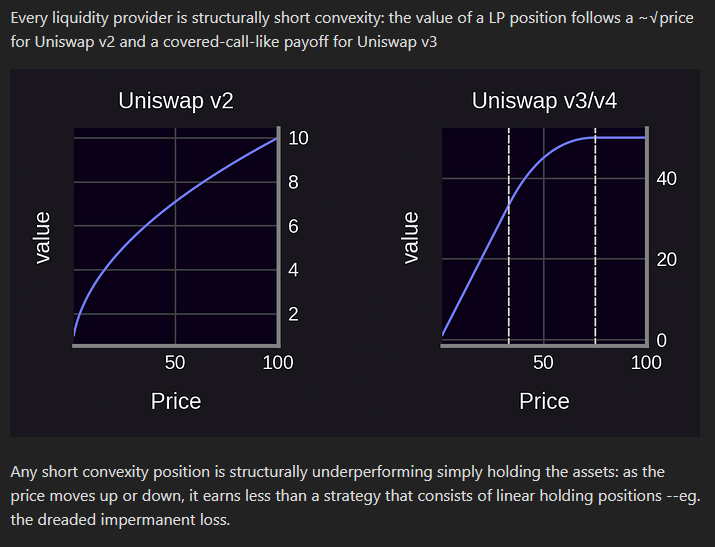
Also, Lambert said he could only support the move if LPs were directly compensated with sustained UNI incentives running “practically forever until organic activity returns.”
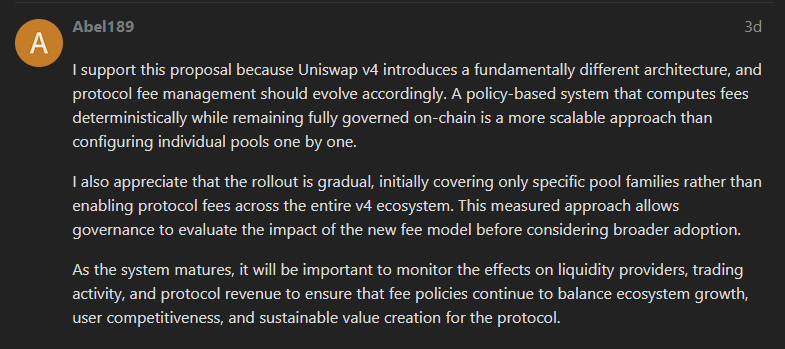
But not all feedback was against it; forum participant Abel189 (among others) backed the proposal, praising the deterministic, onchain fee policy as “a more scalable approach than configuring individual pools one by one.”
UNI token performance
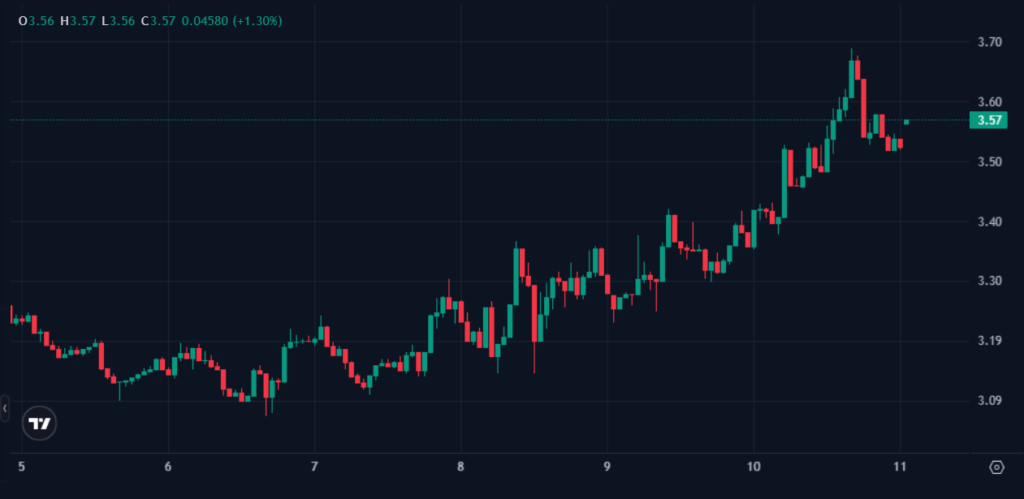
As for the UNI token, it went up around 6.8 percent to $3.57 at the time of writing, following the proposal, giving Uniswap a $2.21 billion market cap.
The fee activation proposal comes as the UNI burn program has already demonstrated its ability to remove meaningful supply, with daily burns peaking at 186,000 tokens last month. In May, the protocol hit and all-time-high (ATH) on Ethereum with a $3 trillion volume surge, making it the first decentralized finance (DeFi) project to reach such numbers.
As for the proposal, the snapshot timeline is between July 7 and 12, with the onchain voting starting on July 13. The team also clarifies that “because of GovernorBravo’s limit of 10 actions per proposal, there will be two separate onchain votes posted in parallel to accommodate all chains.”