

On July 15, Ostium suffered a $23.75 million exploit when an attacker compromised its off-chain price-signing infrastructure. Using a legitimate registered forwarder, the attacker submitted fabricated BTC-USD prices of $5,000 and $60,000, then executed repeated open-and-close trades in a loop, extracting artificial profits from the Ostium Liquidity Pool (OLP). The entire drain took under six minutes and was stopped by the treasury’s circuit breaker.
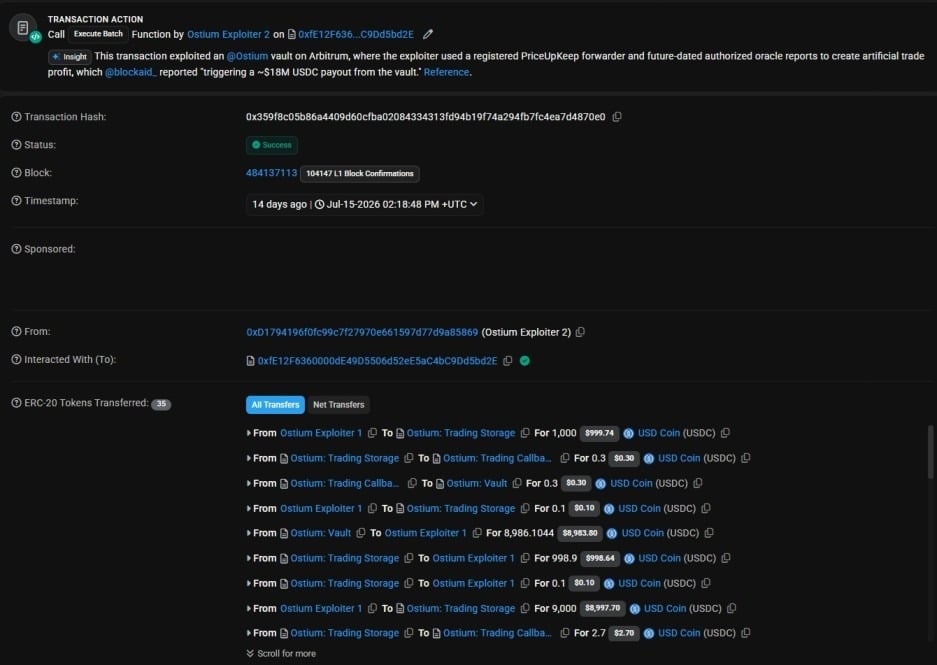
The attack: How a single signer key broke the system
The hacker basically got their hands on an authorized oracle signer key, which is pretty much like a master password for all that price data. Once they were in, they started firing off price reports that looked totally legit to Ostium’s Verifier contract. The system was just checking if the signatures matched up but didn’t actually bother to see if the prices made sense or if the timestamps were current.
The attacker started with a mere 100 USDC, using high leverage to flip positions almost immediately against those fake prices. Every time they ran this loop, they were essentially siphoning real USDC straight out of the public OLP vault.
This whole thing went down eight times in about five minutes before the circuit breaker finally kicked in and stopped the bleeding. By then, the looted cash had been swapped for roughly 12,084 ETH and sent off through Tornado Cash to cover their tracks. It was a whirlwind exploit that shows just how quickly things can go south when a single key is compromised.
Root cause and response
The root cause was not a smart contract bug but the absence of multi-party approval for off-chain price signers, a single point of compromise.
Unlike onchain governance requiring multiple signatures, the off-chain infrastructure had no equivalent protection.
Ostium paused trading within an hour, froze contracts, and spent eight days hardening infrastructure before resuming trading on July 23. User collateral remained safe in a separate contract.
Ostium is teaming up with Mandiant, zeroShadow, and SEAL 911 to track down the money, and they are still hashing out a recovery plan for the liquidity providers who got hit.
Final impact and community response
The $23.75 million exploit rattled the decentralized finance (DeFi) space, especially the liquidity providers who took the biggest hit. The OLP vault’s total value locked (TVL) tanked by about 72 percent, crashing from roughly $32.7 million down to just about $9 million. Even with such a massive drain, trader collateral stayed tucked away safely in separate smart contracts the whole time.
People reacted pretty quickly and in different ways. Some users were definitely annoyed about their funds being frozen, while others gave Ostium props for jumping on the problem so fast.
The fact that the attacker exploited off-chain infrastructure rather than smart contract code sparked broader discussions about oracle security. Security firms noted that the targeted PriceUpKeep infrastructure had been left out of Ostium’s bug bounty scope
As trading resumed on July 23, questions remained around compensation for liquidity providers. Ostium said it would contribute from its own balance sheet alongside partners to make affected LPs whole, but a detailed recovery plan remained pending.
The incident reinforced a growing industry lesson: smart contract audits are not enough. Off-chain infrastructure, particularly oracle key management, deserves equal scrutiny.