
India’s sluggish foray into the Web3 arena has now taken a turn towards exploring tokenization. The Securities and Exchange Board of India (SEBI) is planning a pilot on tokenizing corporate bonds using blockchain networks. The development comes at a time when the Web3 sector in India is reeling under a glaring lack of regulatory clarity from the government, leaving the sector to systemic risks.
Tuhin Kanta Pandey, the chairperson of SEBI, confirmed the tokenization pilot on Tuesday. He said the aim is to test if tokenization can improve liquidity, instant settlements, and autonomous settlements for corporate bonds via the corporate infrastructure.
Speaking to the media on Tuesday, Pandey said, the pilot is estimated to take between six to nine months to bring expansive data for a detailed evaluation to the table.
“Well, it will take some time to see the various stages and technical budget solutions of the pilot,” Pandey stated, noting that India is considering an update to the older financial technologies that support activities like the trading of corporate bonds in the present scenario.
Tokenization would entail the representation of corporate bonds on blockchain networks which will have smart contracts automatically handle payments and compliance requirements without the need for human intervention. This could make it simpler and faster for investors to buy and sell bonds — amping up the flow of capital into the markets.
Pandey revealed that the pilot strategy is ready and is presently awaiting a green flag from the Reserve Bank of India (RBI) as tokenization is subject to a clearance from India’s apex bank.
Up until now, the RBI has maintained a scrutinized approach around digital assets and the overall Web3 arena citing risks to India’s financial stability. It remains unclear, as of now, the timeline by which the RBI gives SEBI the go ahead for the tokenization pilot.
At present, the U.S.is making strides in exploring the tokenization of real world assets as its government’s pro-active approach towards regulating the Web3 space picks pace under President Donald Trump.
With the Wall Street giants participating in experimentations, the U.S. is already bringing short-term government debt and money market funds on-chain to serve as yield-bearing collateral.
Data by RWA.xyz showed on Tuesday that tokenized U.S. Treasuries command roughly $15 billion in on-chain value via products like BlackRock’s BUIDL fund while sectors such as tokenized private credit, gold-backed commodities, and tokenized public equities are also clocking visible expansion.
Singapore is another region, where tokenization initiatives are garnering momentum. The Monetary Authority of Singapore is overseeing this initiative called “Project Guardian”, under which international banks can pilot the tokenization of commercial bonds, foreign exchange, and structured asset vehicles within the compliance framework.
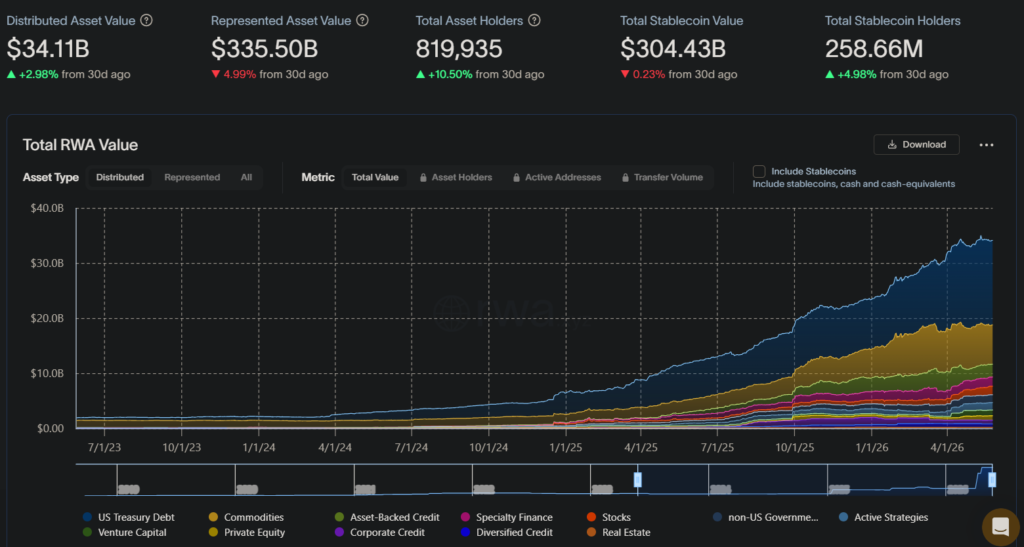
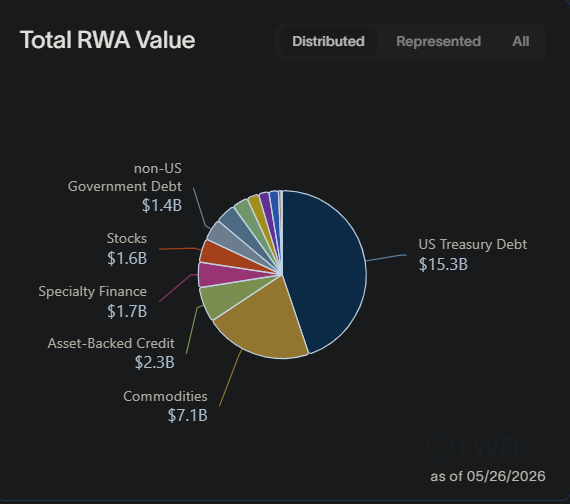
Source: RWA.xyz
As of now, India has not provided any information on the blockchain networks it is considering to tap for this pilot. Ethereum, Solana, BNB Chain, and XRP Ledger are among popular choices internationally.
While India has always shown an optimistic inclination towards exploring the blockchain technology, its resistance against crypto has remained strong for years. India has been under criticism for years over levying taxes as high as 30 percent on profits churned from digital assets activities. Tokenized assets should also come under the category of digital assets in the country, however, clarity on this remains blurry.
In conversation with The Coin Headlines, Arjun Vijay, the co-founder of the Giottus exchange said that SEBI’s corporate bond tokenization pilot is essentially asking: can we bring that same design to a market where the inefficiency tax is highest?
“The honest answer from the crypto side is yes — the technology is tested, the failure modes are understood, and the cost curve is already on our side. The direction of travel is also already visible with the dollar-denominated stablecoins now settling more value annually than several major card networks combined, and with tokenized U.S. Treasuries having crossed multi-billion-dollar AUM,” Vijay stated.
As per Vijay, the crypto industry itself has been the world’s largest live proof-of-concept for tokenization for over a decade — moving tens of billions of dollars on public blockchains daily with atomic, instant settlements, no failed-trade reconciliation, and no settlement risks.
India, as part of its blockchain exploration, has been working on its eRupee CBDC for a while now. The aim is to reduce the friction and time durations to clear cross-border settlements. On state-levels as well, the documentation of data on blockchains to maintain immutable transparency has been happening in the country — but India still remains far behind regions like the U.S., the E.U., the UAE, and others that have taken brisk steps towards understanding and regulating the Web3 sector to their benefits.
.