
GnosisDAO has approved a proposal to move Gnosis Chain, an Ethereum-compatible network for payments and decentralized apps, from a standalone Layer 1 into a zero-knowledge-proven Ethereum Economic Zone rollup that settles directly on Ethereum without disrupting existing users or applications.
The governance proposal, GIP-153, passed on Aug. 19 with 123,158 GNO in favor, 115 against and 151 abstaining across 54 voters, clearing the 75,000 GNO quorum requirement.
The vote marked the final approval of a proposal first introduced on July 22 and gave the Gnosis engineering team a mandate to begin designing the transition.
Under the EEZ plan, Gnosis Chain would instead rely on Ethereum for settlement and security while shifting away from treasury-funded staking rewards toward fees generated by network activity.
Gnosis says standalone Layer 1 model has run its course
The proposal gives a blunt assessment of Gnosis Chain’s current model, saying its original goal of offering a decentralized, low-cost and neutral network has not been enough to attract strong usage.
Gnosis said the network does not generate enough fees to cover its security and operating costs, forcing the DAO treasury to help pay for staking rewards and other infrastructure.
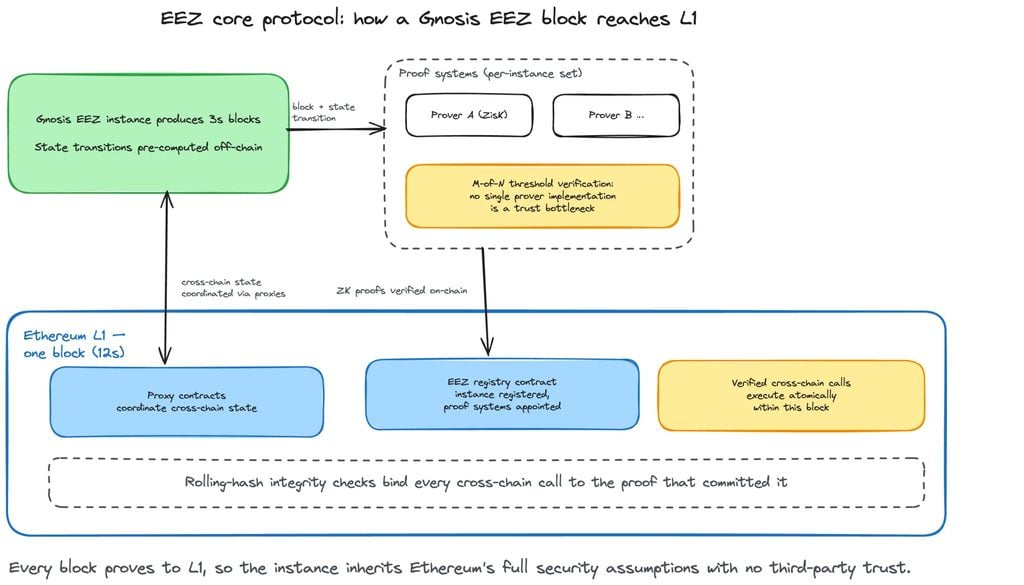
The biggest structural change would be the end of Gnosis Chain’s independent validator set. Around 350,000 GNO, roughly 27% of circulating supply, would be unlocked as staking is retired and Ethereum validators take over settlement security.
Existing addresses, balances, smart contracts and xDAI gas payments would remain unchanged, meaning users and developers would not need to migrate to a separate chain.
At launch, sequencing would remain centralized under Gnosis Ltd, while existing bridge validators are expected to be repurposed as proof-system operators.
What joining the Ethereum Economic Zone actually changes
The main benefit of the EEZ model is that Gnosis Chain could interact directly with Ethereum within the same transaction.
In practice, a smart contract on Gnosis Chain could call a contract on Ethereum mainnet and use the result inside the same transaction, with the entire operation either succeeding or reverting together. That would allow Gnosis applications to reach Ethereum liquidity, tokens, oracles and other infrastructure without relying on the traditional bridge-and-wait model.
Gnosis argues that this gives the network something most Layer 2s still lack, allowing direct, atomic access to Ethereum rather than simply offering cheaper execution.
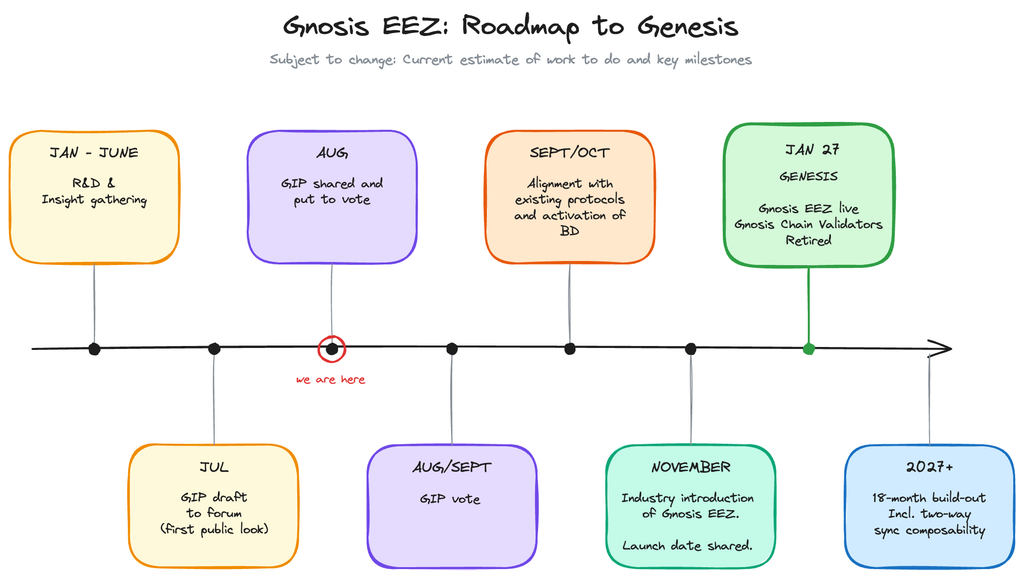
The first version would allow Gnosis Chain to interact directly with Ethereum, while two-way connections and links with other EEZ networks are planned later. Gnosis is aiming to launch the first version around December 2026 or January 2027, with stronger ZK proving and broader interoperability expected during 2027.