

Samsung Electronics forecast a sharp rise in second-quarter profit, with guidance pointing to another record quarter as AI infrastructure spending fuels demand for its advanced chips.
The South Korean technology giant said on Tuesday that it expects consolidated sales of about 171 trillion won and operating profit of about 89.4 trillion won for the quarter ended June.
The figures represent the midpoint of Samsung’s guidance ranges, with sales estimated between 170 trillion and 172 trillion won and operating profit between 89.3 trillion and 89.5 trillion won.
Q2 guidance tops Samsung’s previous record
The forecast builds on Samsung’s first-quarter record performance, when the company reported 133.9 trillion won in revenue and 57.2 trillion won in operating profit, describing both as all-time quarterly highs. If confirmed, the second-quarter operating profit would move comfortably above that level.
Samsung’s guidance also shows a steep year-on-year rebound, with the company expecting second-quarter sales and operating profit to rise sharply from the 74.57 trillion won in sales and 4.68 trillion won in operating profit it posted a year earlier.
AI infrastructure fuels demand for Samsung’s advanced chips
The expectation comes as Samsung pushes deeper into the global AI race, where demand for high-performance memory has become central to data centres, large language models and next-generation computing systems.
Samsung said its Memory Business delivered record quarterly revenue and operating profit in the first quarter, driven by strong demand for high-value AI products, tight supply and rising memory chip prices across the industry.
The company also said AI infrastructure expansion would keep memory demand strong in the second quarter, while early demand for new GPUs and CPUs was expected to support its AI-focused sales strategy across DRAM and NAND.
Samsung has been building that strategy around a wider portfolio of AI memory and storage products. The company said it had begun mass product sales of HBM4 and SOCAMM2 for NVIDIA’s Vera Rubin platform, while also advancing PCIe Gen6 SSDs.
Samsung expects demand from servers to stay resilient later this year as hyperscalers expand AI and large language model services, with agentic AI adding another layer of growth.
The company also began shipping HBM4E samples in May, saying the 12-layer product can reach speeds of up to 16Gbps and bandwidth of 3.6 terabytes per second per stack, with mass production planned in line with customer schedules.
For Samsung, the latest guidance signals more than a cyclical earnings recovery. It shows how the AI buildout is reshaping the memory business, turning advanced DRAM, HBM and high-speed storage into core engines of growth.
Samsung shares drop 8% despite record Q2 profit forecast
Samsung shares fell despite the record guidance, suggesting investors treated the update as a chance to lock in gains after a sharp AI-driven run.
The stock touched 310,000 won early in the session, then broke below the key 300,000 won level and dipped to 290,500 won, leaving it down about 8%.
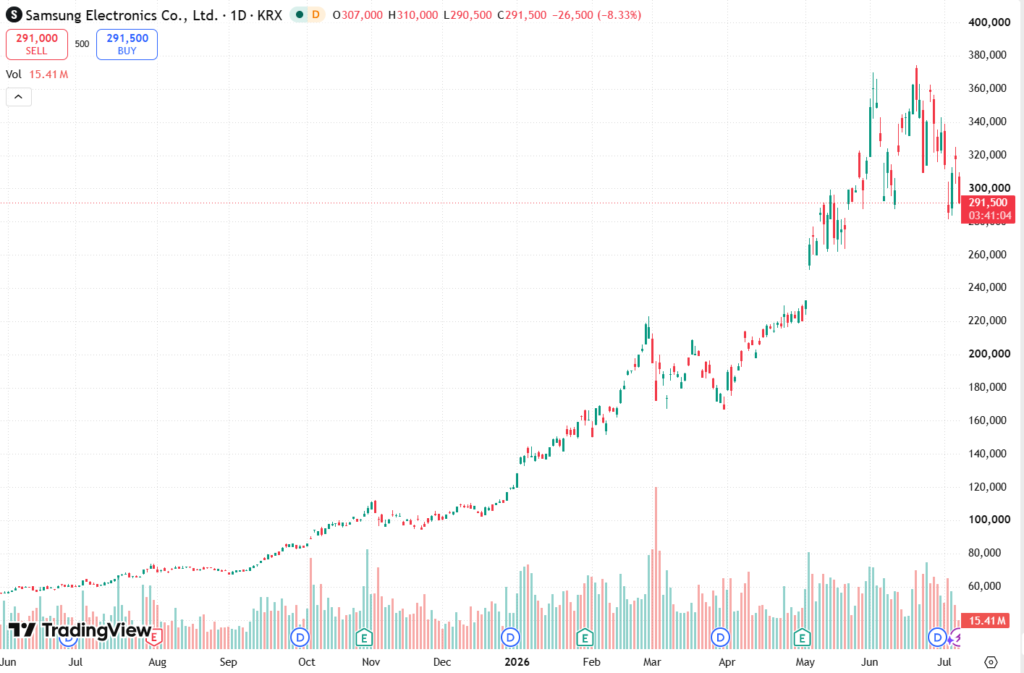
The slide came even as Samsung’s profit estimate stood 6.2% above market expectations, showing that the strong numbers were not enough to extend the rally.
The reaction suggests investors had already priced in much of the AI chip rebound and are now questioning whether AI infrastructure spending, memory prices and demand for advanced chips can keep climbing fast enough to push the stock higher.