

Meta has launched Muse Glimmer, a new 30-billion-parameter open-weight AI model built to run locally on consumer hardware, sharpening the company’s push to put more capable artificial intelligence directly into developers’ hands.
According to details published by Meta Superintelligence Labs, Muse Glimmer is designed primarily for autonomous agentic tasks, combining multi-step reasoning, tool use, image understanding and failure recovery, without requiring constant access to cloud infrastructure.
The model can process both text and images and carries a context window exceeding 131,000 tokens. Meta said quantized versions can shrink the language model to below 20 GB, allowing deployments on machines with 24 GB or 32 GB of memory, while the released artifacts are available under the Apache 2.0 license.
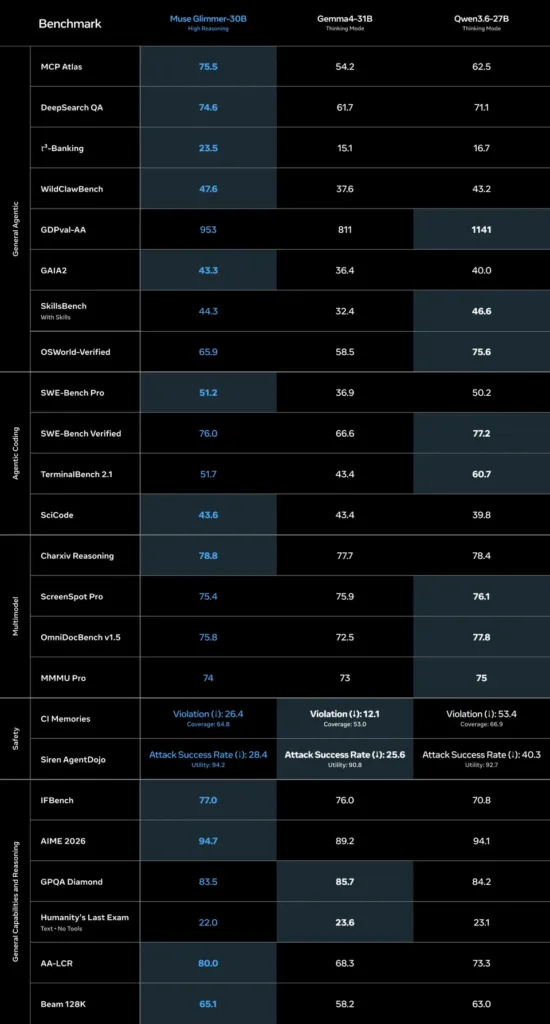
Meta revives its open-model ambitions
The release lands as CEO Mark Zuckerberg renews his argument that advanced AI should not remain concentrated among a small group of companies.
Meta has long promoted open AI development as a way to broaden access, allow developers to customize models and spread the benefits of the technology more widely. Zuckerberg has argued that open-source AI can help prevent technological power from becoming concentrated in a handful of organizations.
Muse Glimmer gives that position fresh weight, placing Meta back into the growing contest over whether the next generation of powerful AI will be controlled behind closed platforms or increasingly released for developers to run, modify and build upon.
What developers gain from open weights
Open-weight AI models make the core parameters learned during training available for developers to download and use directly. That means companies and researchers can run the models on their own systems, customize them for specific tasks and build applications without relying entirely on a provider’s cloud service.
Supporters say the approach can lower costs, give developers more control over how models are deployed and make advanced AI more widely accessible. Open-weight releases are not always fully open-source, however, as developers may still withhold training data, source code or other details about how the model was built.
Meta expands Muse push into coding tools
The latest development follows Meta’s launch of Muse Code, its first AI coding agent, further expanding the company’s push to challenge OpenAI and Anthropic in developer software.
Unveiled under Meta Superintelligence Labs chief Alexandr Wang, Muse Code is designed to handle broader software engineering tasks rather than simply suggest lines of code. The tool can plan changes, generate code and check whether updates work as intended, while also coordinating multiple AI agents from a single workspace.